Is grout the same as spackle? A practical homeowner guide
Explore whether is grout the same as spackle, with clear distinctions, uses, curing, and maintenance tips for tile and wall repairs. Expert guidance from Grout Maintenance helps homeowners choose wisely.


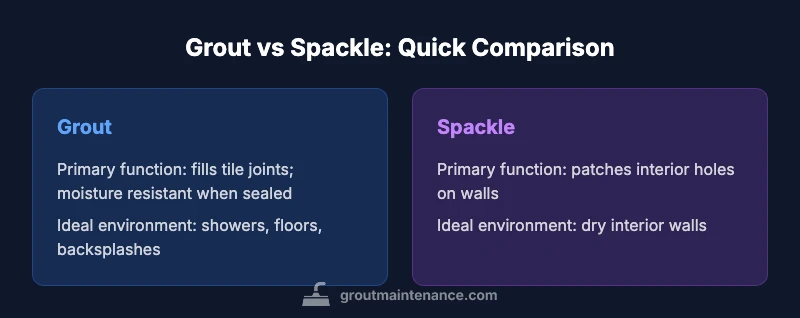
Is grout the same as spackle? Not really. Grout fills tile joints and resists moisture when sealed, while spackle patches interior holes on walls. They’re designed for different problems, require different prep, and cure differently. Using the wrong material can lead to cracking, staining, or water damage. Read on to understand the key differences and how to choose the right product for your project.
Understanding the distinction: is grout the same as spackle?
The short answer, from a materials perspective, is that grout and spackle are not interchangeable. Grout is formulated to fill tile joints and resist moisture in wet areas, while spackle is designed to patch interior wall surfaces. This difference alone explains most of the confusion homeowners feel when they face a bathroom repair or a drywall patch. According to Grout Maintenance, understanding the distinction hinges on moisture exposure and substrate type, because moisture and movement drive the performance of any filler. When you ask is grout the same as spackle, you should consider where the repair will occur (floor, shower, or wall) and what will surround it (tile vs drywall). In practice, using the wrong product often leads to long-term cracking, staining, or premature failure. A clear plan, and a basic familiarity with these products, will save you time, money, and frustration on future projects. The most reliable rule of thumb is to use grout for joints in tile and spackle for drywall patches or interior holes. Think of this rule as your quick-start guide before you shop or mix.
Composition and chemistry: what they're made of
Grout and spackle differ in their primary binders, fillers, and moisture handling. Grout is typically a cement-based material that contains fine sand or aggregates; modern formulas include cementitious blends and, in some cases, epoxy resins for high-end installations. Spackle is a gypsum- or lime-based interior patching compound designed to bond with drywall and plaster. These formulations matter for performance: grout needs a substrate that accepts sealing and moisture control, while spackle relies on a smooth drywall surface and careful feathering. The Grout Maintenance team notes that the different chemistries translate into markedly different behavior under stress: grout resists moisture better once cured and sealed, whereas spackle remains more flexible to accommodate minor wall movement but offers little moisture protection. This chemistry also influences sanding, paint adhesion, and color matching, which are essential considerations for seamless repairs. When you’re choosing between the two, assess the substrate, exposure, and expected movement to predict long-term results.
Application methods and curing: how to apply differently
Applying grout and spackle requires distinct tools, prep, and patience. Grout is mixed with water or a polymer admixture and worked into vertical or horizontal joints with a rubber float; after it dries, joints are wiped clean and often sealed to protect against moisture. Spackle is applied with a putty knife or taping knife to fill holes and irregularities on interior walls, then smoothed and feathered so paint can blend in. Curing times differ in principle; grout needs time to set and cure in a way that becomes water-resistant when sealed, whereas spackle dries primarily by evaporation. The Grout Maintenance analysis indicates that improper curing—such as sealing grout too early or applying spackle over a dusty surface—compromises adhesion and finish. Always follow manufacturer instructions for set times, temperatures, and staining or painting readiness. A small test area can reduce risk on larger projects, and wearing protective gloves protects skin during mixing and related tasks.
Moisture, sealing, and environmental factors
Moisture exposure is a major driver of decisions in tile environments. Grout’s strength is realized when it is properly sealed and maintained; sealed grout helps resist water penetration and staining, which is critical in showers and tub surrounds. Spackle, by contrast, is not designed for wet areas; exposing patch material to water can cause softness, crumbling, or mildew growth behind the patch. This is why interior patching typically uses patch compounds, plus primer and paint, not grout. Environmental factors such as humidity, temperature, and substrate condition influence performance; poor substrate preparation reduces adhesion for both products. The Grout Maintenance team emphasizes that proper surface preparation, including cleaning and priming where needed, is essential for durable results. If you’re patching near a wet area, plan to seal or re-apply once the area has cured and dried completely to protect the repair and neighboring areas.
Aesthetic considerations: color, finish, and texture
Aesthetics often drive the choice beyond function. Grout comes in multiple colors and textures, which, when sealed, can mimic natural stone or create a crisp line between tiles. Spackle colors are limited to drywall shades and plaster-like finishes; mismatched finish can be difficult to paint to a seamless look. Color matching is a common challenge; when you choose grout, you can often blend the shade with existing tiles or repaint the surrounding area to achieve uniformity. The texture of grout lines affects perceived tile depth; in contrast, a spackle patch should disappear into the wall with paint to avoid noticeable bumps. The Grout Maintenance analysis suggests testing color and sheen on a hidden wall before full application to ensure the final look meets expectations. Consider practicing on a spare sample board to compare grout colors against tile grout lines or, for patching, test texture options with paint sheen.
Durability, movement, and repair longevity
Durability and longevity depend on substrate movement and maintenance. Grout, when correctly installed and sealed, offers strong resistance to cracking in joints and can handle foot traffic and environmental changes better than most patch compounds. Spackle patches, while quick for small interior repairs, are more vulnerable to cracking with wall movement and moisture exposure. For many homeowners, this means reserving spackle for drywall holes and choosing grout for tile joints, especially in showers, kitchens, or laundry areas. The Grout Maintenance team notes that evaluating movement at the repair site helps determine the appropriate method. In renovation projects, acknowledging movement early and selecting the right material minimizes future repairs and maintenance.
Cost, availability, and DIY practicality
Cost and availability influence the decision beyond performance. Grout tends to be stocked with tile setting materials and sealers, and a typical tile job uses grout in multiple joints; it also requires sealing to maintain durability. Spackle is widely available in home centers and is often cheaper per patch, but its long-term value is limited to interior patches. DIY practicality differs: grout work demands careful mixing, tool handling, and wet-work safety, while spackle patches are generally faster and simpler for small interior repairs. The Grout Maintenance analysis suggests that homeowners should weigh long-term maintenance concerns against upfront labor and material costs when planning a project. For most tile projects, investing in proper grout installation and sealing is cost-effective over time; for minor drywall touch-ups, spackle is usually sufficient, though you’ll still want a matching primer and paint for a uniform finish.
Common mistakes and troubleshooting
Common mistakes include using spackle in place of grout in wet areas, neglecting to seal grout joints, applying grout too thickly, or failing to remove excess material before it cures. Conversely, attempting to patch a grout joint with patch compounds can result in a visible crack or color mismatch. Troubleshooting starts with surface prep: clean the area, remove loose material, and select the correct product for the job. If a patch fails, assess whether the substrate has movement, whether moisture has penetrated the repair, and whether the patch was allowed to cure fully before painting. The Grout Maintenance team encourages patch-and-retest cycles until the repair meets expectations, and to reseal grout after repairing joints to maintain moisture resistance.
Decision framework: when to choose grout vs spackle
A simple decision framework helps you decide quickly: first, determine whether the area is a tile joint or an interior wall patch. If it’s a joint or wet area, grout is typically the correct choice; apply with proper sealing for moisture resistance. If you’re patching drywall holes or interior imperfections, spackle offers a smoother finish when finished with primer and paint. Movement and exposure are critical test criteria: treat areas with significant movement or moisture as grout candidates; treat calm, interior walls with spackle patches. The Grout Maintenance analysis reinforces that aligning product choice with substrate, environment, and movement potential leads to durable results. Document your plan and gather the necessary tools to avoid last-minute substitutions.
Practical test methods and starter projects
When in doubt, run a small test on a hidden corner or inside a cabinet. Mix a small batch of grout and apply to a mock joint to observe curing and sealing behavior; apply spackle to a test drywall hole and monitor drying and paint adhesion. For starters, begin with a minor interior patch using spackle to gain technique, then tackle a bathroom tile joint with grout to practice joint filling and sealing. Keep notes on color matching and finish so you can adjust the approach for larger projects. The goal is to learn the material properties and behavior in your home environment, allowing you to work confidently on future repairs.
Comparison
| Feature | Grout | Spackle |
|---|---|---|
| Primary function | Fills tile joints and resists moisture when sealed | Patches interior holes in walls and plaster |
| Environment suitability | Suitable for tile joints and wet areas when sealed | Not designed for wet areas; best for interior drywall patches |
| Adhesion and durability | Strong adhesion in joints when prepared and sealed | Adequate for patches but not durable in high humidity environments |
| Ease of repair | Requires mixing and careful tool work; sealing needed | Typically quick for small patches; easier for beginners |
| Maintenance and finishing | Needs sealing maintenance; color matching critical | Paint-ready surface; no moisture resistance |
| Typical projects | Tile joints in showers, backsplashes, floors | Interior wall patches in drywall |
Pros
- Clarifies when to pick grout vs spackle to avoid mistakes
- Helps plan moisture control and substrate considerations
- Supports longer-term durability by guiding proper use
- Encourages better maintenance and sealing practices
- Reduces call-backs from DIY repairs
What's Bad
- Can overwhelm beginners with terminology
- Requires time to read manufacturer instructions
- Some projects blend uses, requiring judgment calls
Grout is the better choice for tile joints and moisture-prone areas; spackle is best for interior drywall patches.
For tile work and wet environments, rely on grout; for drywall patches, use spackle. The two materials aren’t interchangeable, and using them correctly yields durable, aesthetic repairs. The Grout Maintenance team’s guidance reinforces project-specific decisions and proper curing.
Got Questions?
Can I use spackle to fill grout joints?
No. Spackle is not designed for tile joints and wet areas. It lacks moisture resistance and long-term durability in joints. Always use grout for joints.
Spackle in joints is not recommended; use grout for joints, especially in wet areas.
Is grout waterproof?
Grout is not inherently waterproof. It becomes moisture resistant when sealed properly, and epoxy grout offers higher moisture resistance. Plan sealing as part of installation.
Grout isn’t waterproof by itself; seal it to improve moisture resistance.
Can grout be used on drywall?
Grout is not recommended for drywall patches. It’s rigid and not designed for interior wall repairs. Use spackle for drywall and save grout for joints.
Grout on drywall isn’t advised; use spackle for patches.
Should I seal grout after repair?
Yes. Sealing grout after repair helps maintain moisture resistance and color. Re-seal periodically as part of routine maintenance.
Yes—seal after repairs and re-seal as needed.
Can you sand grout after it dries?
Grout can be smoothed during finishing and sometimes lightly sanded when fully cured, but avoid sanding sealers or epoxy coatings. If imperfections exist, reapply.
Grout can be sanded after it's fully cured; avoid sanding sealers.
What is the best alternative to grout for tile joints?
Epoxy grout is a common alternative with superior moisture resistance. It’s harder to work with but durable and stain-resistant.
Epoxy grout is a strong alternative for moisture-prone joints.
The Essentials
- Define job type before choosing material
- Grout and spackle serve different purposes
- Seal grout after installation and repair
- Test color and finish before full application
- Follow manufacturer curing instructions