Laticrete Ready-To-Use Grout vs Spectralock: A Practical Comparison
An objective comparison of Laticrete Ready-To-Use grout vs Spectralock epoxy grout, focusing on installation, durability, maintenance, and value for showers and floors.


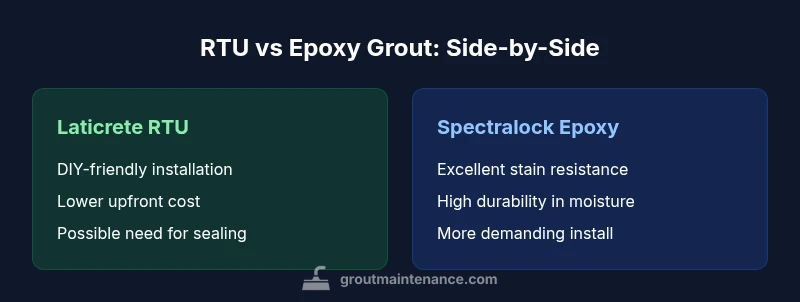
The Laticrete Ready-To-Use Grout (RTU) and Spectralock epoxy grout address different installer goals. For ease of installation and lower upfront cost, RTU grout generally wins, especially for DIY projects. Spectralock epoxy grout delivers superior stain resistance and long-term color stability, but at higher cost and with more demanding installation. See our detailed comparison chart for nuances and best-use scenarios.
What these products are
Laticrete Ready-To-Use Grout (RTU) and Spectralock epoxy grout occupy two distinct ends of the grout spectrum. The keyword laticrete ready to use grout vs spectralock appears frequently in consumer searches, and the reason is simple: one product line emphasizes ease and value, while the other emphasizes performance under stress. RTU grout is a cementitious, pre-mixed formula designed to simplify installation for DIYers and reduce setup time on small tile jobs. It cures through hydration and tends to mimic traditional cement grout in texture and shade variance. Spectralock, by contrast, is an epoxy-based grout engineered for high chemical and stain resistance, color stability, and long-term durability in damp environments. It requires careful surface preparation, exact mixing ratios, and meticulous cleanup, but it rewards users with superior performance in showers, backsplashes, and heavy-use floors. For many homeowners, choosing between the two boils down to three practical questions: How much time can I devote to installation? How important is stain prevention in my space? And what is the total cost of ownership over the life of the grout?
Core technical differences explained
At a high level, the key difference between Laticrete RTU grout and Spectralock epoxy grout is the chemistry: cementitious vs epoxy. RTU is ready-to-use cementitious grout, typically polymer-modified to improve consistency and reduce cracking. Its color is set during curing, and it requires sealing in some formulations to resist moisture and staining. Spectralock epoxy grout uses resin-rich epoxy resins that cure into a hard, non-porous matrix. This reduces porosity and makes it inherently more resistant to dyes, household chemicals, and moisture intrusion. The trade-off is installation complexity and cost. The epoxy system demands clean tools, precise timing, and more deliberate cleanup—especially around tile edges and corners—to avoid air bubbles or streaking. Understanding these material science differences helps set expectations for how the grout will behave in bathrooms, kitchens, and exterior installations.
Workability, installation, and cure times
For DIYers, installation ease is often the deciding factor. Laticrete RTU grout tends to be forgiving: you mix or simply apply, then wipe off grout haze after curing, with a relatively short wait before grouting is complete. Spectralock epoxy grout, on the other hand, requires careful mixing, precise ratios, and more deliberate troweling technique. The curing process for RTU proceeds through hydration and typically reaches a usable surface quickly, but full strength develops over hours to days depending on temperature and humidity. Epoxy grout cures more slowly and generates less heat during curing, but you should avoid exposing epoxy grout to cleaners or abrasives until fully cured. Both systems benefit from good substrate prep, clean tile surfaces, and consistent joint depth. The main takeaway is to align your method with your skill level and project timeline.
Durability, stain resistance, and color stability
Durability and stain resistance are the most important performance axes. Spectralock epoxy grout offers exceptional resistance to stains, chemicals, and moisture, which translates to longer color life in kitchens and showers. RTU cementitious grout can be highly durable in normal conditions but is more susceptible to staining if spills sit undisturbed and if the grout is not sealed (or if the seal fails). In practice, epoxy grout maintains color more consistently across years, while cementitious grout may show slight shading changes due to wear, cleaning practices, and humidity. If you expect heavy foot traffic, frequent use of colored cleaners, or exposure to dyes (red wine, coffee, sauces), Spectralock’s non-porous matrix tends to perform better overall.
Maintenance, cleaning, sealing considerations
Maintenance workflows differ markedly. Epoxy grout generally requires minimal maintenance once installed: clean with non-abrasive cleaners and avoid acidic agents that can etch the surface. Sealing is not required for Spectralock, which reduces maintenance steps. Laticrete RTU grout often benefits from sealing or penetrating sealers, especially in high-moisture zones, to improve stain resistance and repel water infiltration. Routine cleaning with a mild pH-neutral cleaner is recommended for both products, but you’ll find epoxy grout is more forgiving of occasional, mild caustic cleaners. If you’re aiming for a low-maintenance bathroom, Spectralock is compelling; if you want a simpler, more budget-conscious update, RTU grout fits well with a practical cleaning routine.
Use-case mapping: best scenarios for RTU vs Spectralock
Bathrooms with moderate moisture and everyday cleaning routines are ideal for RTU grout when DIY speed and cost matter more than ultimate stain resistance. Kitchens and showers subject to frequent staining or aggressive cleaners benefit from Spectralock’s epoxy matrix, especially in grout joints that see splashes or dye-based foods. In exterior tile installations where temperature swings are large, epoxy grout tends to hold up better to moisture and UV exposure; however, you’ll pay a premium for professional-grade epoxy systems. If you value color consistency across many joints, both options perform well, but Spectralock often preserves shade uniformity better over time in challenging environments.
Cost, value, and long-term considerations
Cost tends to be a primary driver in the decision. Laticrete RTU grout usually carries a lower upfront price and can be installed by DIYers with basic tools. Spectralock epoxy grout commands a higher price due to its resin chemistry, specialized installation, and longer durability. Over the life of a project, epoxy grout may offer better value in high-traffic spaces or where cleaning performance matters most; cementitious RTU grout may prove more cost-effective in low-traffic areas with modest stain concerns. The total cost of ownership includes not only material price but labor time, sealing products, and potential maintenance cycles.
Decision checklist: how to choose for your project
Use this quick checklist to decide between RTU and Spectralock:
- Assess moisture exposure and staining risk: is there a lot of dye-based staining potential?
- Consider maintenance tolerance: can you commit to sealing and routine care?
- Evaluate installation timeline: do you want a faster weekend project or are you willing to invest more planning?
- Factor total cost: are you budgeting for upfront price or long-term performance?
- Confirm tile type compatibility and joint width: both options have preferences but cover common ceramic and porcelain installations.
- Review warranty coverage and service considerations from your supplier.
Your decision should balance performance needs, budget, and skill level; the choice does not have to be permanent and you can plan for future replacement if needed.
Common pitfalls and practical tips for grout projects
Common pitfalls include insufficient surface prep, using the wrong sealer, and rushing cleanup during epoxy grading. For RTU, test sealing on a small area first, and follow manufacturer guidelines for curing times to avoid cracking or hazy grout. For Spectralock, ensure sharp mixing and thorough removal of resin flash during installation, as residual material can create uneven shading. Always review the substrate and moisture management plan before starting, and maintain good ventilation during curing. Following these tips helps maximize the long-term appearance and performance of either grout system.
Comparison
| Feature | Laticrete Ready-To-Use Grout | Spectralock Epoxy Grout |
|---|---|---|
| Installation ease | Easier; no mixing or special tooling | More complex; requires precise mixing and cleanup |
| Stain resistance | Good; needs sealing in some cases | Excellent; epoxy is non-porous |
| Durability under moisture | Moderate; wear depends on care | High; best in wet areas |
| Shade/color stability | Good; can vary with sealing | Excellent; color holds over time |
| Maintenance needs | Sealing often recommended; periodic maintenance | Low maintenance; no sealing required |
| Typical cost per sq ft | Lower upfront cost | Higher upfront cost |
| Best environments | Bathrooms/kitchens for DIY projects | Showers and high-traffic areas |
Pros
- Lower upfront cost and easier DIY for RTU
- Faster installation with RTU
- Wider color availability with cementitious grout
- RTU repairable in stages if a spot needs rework
- Easier tool handling and cleanup for beginners
What's Bad
- Lower long-term stain resistance than epoxy
- Sealing may be needed for RTU in moisture zones
- Epoxy requires careful mixing and cleanup
- Spectralock has higher upfront cost
- Color variation can occur if RTU is not sealed or mixed properly
RTU is best for fast, budget-conscious DIY projects; Spectralock excels where stain resistance and long-term durability are top priorities.
Choose RTU when you value ease and cost savings and can accept routine maintenance. Choose Spectralock when you need superior stain resistance and durability in moist, high-use spaces; be prepared for higher install effort and cost.
Got Questions?
Which grout is easier to install for a DIYer?
RTU grout is typically easier to install for DIYers due to simple mixing and faster setup. Spectralock requires careful mixing and more precise tooling, which can be challenging for beginners.
RTU is easier for DIYers; epoxy like Spectralock needs more careful steps. Start with RTU if you’re new to grout work.
Is Spectralock truly stain-proof?
Spectralock epoxy grout offers strong stain resistance in most household conditions, but no grout is completely stain-proof. Prompt cleaning and using appropriate cleaners help preserve color over time.
Spectralock resists stains well, but you still should clean spills promptly for best results.
Can I use Laticrete RTU in a shower?
Yes, RTU can be used in showers if the area is properly prepared and sealed as recommended by the manufacturer. In very wet zones, consider additional sealing or opting for epoxy in key joints.
RTU can work in showers with proper prep and sealing; weigh moisture exposure when choosing.
Does epoxy grout tolerate tile movement better?
Epoxy grout generally handles movement and moisture stress better than cementitious RTU, but significant substrate movement can still cause cracks in any grout.
Epoxy tends to handle movement better, but foundation issues still matter.
Do both products require sealing?
RTU often benefits from sealing to improve moisture resistance, while Spectralock typically does not require sealing due to its non-porous epoxy matrix.
Sealing is more common with RTU; epoxy usually doesn’t need it.
Which offers better color consistency?
Epoxy grout (Spectralock) generally maintains color uniformity longer, while cementitious RTU can show slight shading changes with wear and cleaning.
Epoxy keeps color more consistent over time, RTU can vary a bit with use.
The Essentials
- RTU minimizes upfront cost and simplifies DIY installation
- Spectralock delivers superior stain resistance and durability in damp areas
- Sealing needs and maintenance differ; RTU often needs sealing, Spectralock generally does not
- Choose based on space, maintenance tolerance, and budget rather than just color options
- Consider long-term ownership: epoxy may reduce maintenance over years in busy spaces