Will grout sealer stop leaks? A practical troubleshooting guide
Discover whether grout sealer can stop leaks, how to diagnose grout-related moisture, and the best steps to repair and prevent water damage in tiled areas. Grout Maintenance offers practical, expert guidance for homeowners and DIY enthusiasts.


Will grout sealer stop leaks? In most cases, a penetrating grout sealer helps limit moisture intrusion, but it won't fix leaks already seeping through cracked grout or damaged substrate. According to Grout Maintenance, the effectiveness of grout sealer depends on where the water is entering. If the source is superficial staining or minor surface dampness, a good sealer can slow moisture migration and make cleaning easier. However, when leaks come from structural issues—cracked grout that allows water through, loose tiles, or leaks behind the wall plane—the sealer is only a temporary Band-Aid.
Understanding the problem: will grout sealer stop leaks in real life?
Moisture around tile joints is a common household headache. Homeowners often ask will grout sealer stop leaks, hoping for a simple, long-lasting fix. The honest answer is: sealers can reduce water penetration for non-structural moisture, but they do not repair cracked grout or compromised substrates. According to Grout Maintenance, the effectiveness of grout sealer depends on where the water is entering. If the source is superficial staining or minor surface dampness, a good sealer can slow moisture migration and make cleaning easier. However, when leaks come from structural issues—cracked grout that allows water through, loose tiles, or leaks behind the wall plane—the sealer is only a temporary Band-Aid.
In this guide, we’ll separate the scenarios: showers and wet rooms with high humidity, kitchens with occasional splashes, and outdoor tile areas exposed to rain. You’ll learn how to test if a leak is grout-related, how to pick the right type of sealer, and when to abandon sealing and pursue actual grout repair, water barriers, or professional help. The goal is to avoid mold growth, efflorescence, and expensive water damage by acting at the source rather than chasing damp patches with spray sealants.
How grout sealers work: penetrating vs surface sealers
Grout sealers come in two broad families: penetrating sealers and surface sealers. Penetrating sealers soak into the porous cementitious matrix and form a water-repellent barrier inside the grout, which can reduce capillary action and limit staining. Surface sealers create a protective film on top of the grout that repels water and stains. For leaks, penetrating sealers are generally preferred when moisture is coming from within the grout joints or tile edges. Surface sealers can be useful for cosmetic protection on dry, clean grout, but they are less effective in damp bathrooms or heavy-wet zones. Importantly, neither type can fix structural failures, such as cracked or missing grout, undermined tile beds, or leaks from behind the wall. If moisture is persistent after sealing, you must inspect for deeper issues and pursue repairs accordingly.
Choosing the right sealer also depends on grout type (sand-and-cand grout vs epoxy grout), tile material, and the expected level of exposure to water. Epoxy grout resists water better than cementitious grout, but sealing epoxy grout is often unnecessary. Always follow the manufacturer’s instructions for curing times, ventilation, and reapplication intervals. Regular maintenance, including cleaning with non-acidic cleaners and avoiding harsh chemicals, will extend the life of sealed grout and reduce the risk of premature wear.
Leaks by source: grout joints vs behind-wall leaks
Before you rush to seal, identify where the water is entering. Leaks that originate at grout joints are the most straightforward to fix with regrouting and sealing. Signs include visible cracks, missing grout, or damp patches that appear with tile movement. Leaks behind the wall, in a shower pan liner, or through waterproofing defects require more involved remediation, including checking the shower pan, membrane, and even plumbing lines. Grout maintenance experts emphasize that a damp patch alone does not confirm a grout problem; moisture can travel through the wall cavity and appear at a distant joint. A systematic inspection—visual inspection, moisture meters, dye tests, and water testing—helps pinpoint the exact path of intrusion. If you’re unsure, start with the simplest cause first and escalate to more thorough fixes only as needed. This approach minimizes unnecessary costs and reduces the risk of over-sealing a non-problematic area.
Quick checks you can do to locate the leak
Begin with a practical triage: inspect the grout lines for cracks or missing sections, measure grout depth, and test small areas with a spray bottle to observe moisture behavior. Use a flashlight at night to spot moisture along grout joints that remain damp after cleaning. A moisture meter can help differentiate surface moisture from deeper infiltration. If moisture persists after cleaning and sealing, the issue is likely structural—call a professional. Record your findings with photos and notes to compare over time. Remember, while sealing can help prevent future staining, it does not seal a leak from a cracked substrate, hidden plumbing, or a compromised shower pan. This distinction informs whether you should proceed with sealant-only repair or pursue regrouting, membrane repair, or a full remodel.
When sealing isn't enough: deeper repairs you may need
If you suspect structural problems, sealing is not a cure-all. Cracked grout, loose or hollow-sounding tiles, or water leaks from behind walls require removing and replacing grout, re-tiling, or installing a new waterproof membrane. In showers, a failed pan liner or membrane is a common culprit behind recurrent leaks. In grout-heavy areas like floors and countertops, regrouting with epoxy grout offers superior water resistance, especially in wet zones. In many cases, the best long-term fix is to address the root cause: damaged substrate, failed waterproofing, or a DIY-friendly regrouting job paired with proper sealer application after curing.
Tools, materials and safety to use during grout sealing projects
Prepare a kit with safety gear (gloves, eye protection, mask), a grout removal tool, a stiff brush, a grout float, a quality cementitious or epoxy grout, a matching sealer, and appropriate cleaning products. Ventilate the work area and protect surrounding surfaces. Always test products in a small area first to ensure compatibility with your tile and grout. Avoid acidic cleaners on natural stone or cementitious grout, as acids can deteriorate grout and tile. Take your time with curing—excess moisture during curing can ruin a seal or grout color. If you’re unsure about the substrate condition, seek professional advice before proceeding.
Steps
Estimated time: 3-5 hours
- 1
Identify likely leak source
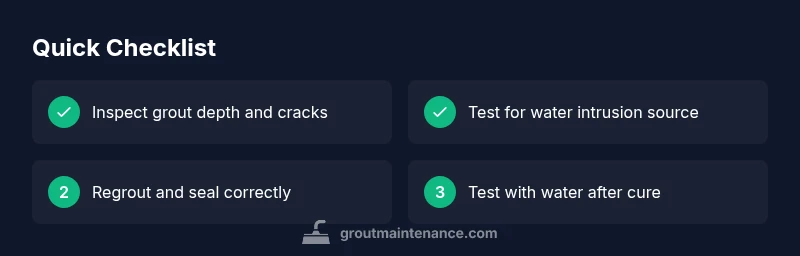
Visually inspect grout lines for cracks or gaps and perform a controlled water test on a small area to see if moisture appears at the joint. Document findings with photos.
Tip: Start with the simplest area first; don’t assume behind-wall leaks until proven. - 2
Gather materials and safety gear
Prepare grout removal tools, replacement grout (cementitious or epoxy), sealer, sponges, and PPE. Ensure ventilation when using sealers and cleaners.
Tip: Label bags for each area to avoid cross-contamination between epoxy and cementitious grout. - 3
Remove damaged grout
Carefully remove only the compromised grout to avoid weakening adjacent joints. Clean the joints to a bright, hard edge before refilling.
Tip: Take your time; aggressive removal can damage tile edges. - 4
Clean and dry the joints
Wipe away dust and moisture; let the substrate dry completely before applying new grout.
Tip: Consider a fan or dehumidifier to speed up drying in humid spaces. - 5
Apply new grout and cure
Mix and apply grout evenly with a float; wipe excess material and allow it to cure according to product specs.
Tip: Use epoxy grout for higher water resistance in showers if you’re comfortable with the technique. - 6
Seal after cure
Apply a penetrating grout sealer once the grout has cured fully. Allow the recommended cure time before exposure to moisture.
Tip: Test a small area first to ensure the sealer does not alter color or texture. - 7
Test for leaks and monitor
Reintroduce water and observe for several minutes. Check for damp patches over the next 24–48 hours.
Tip: Keep a moisture log to track any changes over time. - 8
Finalize and prevent future leaks
Reinstall surrounding fixtures, clean surfaces, and perform routine maintenance with non-acid cleaners. Schedule periodic seal checks.
Tip: Plan annual inspections to detect wear before leaks reoccur.
Diagnosis: Persistent moisture or leaks around grout joints despite cleaning
Possible Causes
- highCracked or missing grout allowing water through
- mediumWater intrusion from behind tile due to plumbing or framing leak
- lowShower pan liner or waterproofing failure under tile
Fixes
- mediumRemove damaged grout and regrout, then seal joints after curing
- hardInspect and repair waterproofing or shower pan liner if needed
- hardInvestigate behind-tile plumbing or framing leaks and repair
Got Questions?
Will sealing grout stop leaks by itself?
Sealing grout can reduce dampness and staining, but it rarely fixes leaks caused by cracked grout, missing grout, or waterproofing failures. Repair the source first, then seal.
Sealing can reduce dampness, but it’s not a guaranteed fix for leaks caused by structural problems.
How long does grout sealer usually last?
Penetrating sealers typically last 1-5 years depending on traffic, cleaning routine, and exposure to water. Surface sealers may wear faster with frequent moisture.
Most sealers last a few years, but high-use areas may need more frequent reapplication.
Can I seal over old grout that looks moldy?
Moldy grout should be cleaned and the grout replaced if the mold has penetrated the porous material. Sealing over mold usually makes the problem worse.
Avoid sealing moldy grout; clean or replace the grout first to prevent mold growth.
Should I seal before or after regrouting?
Regrout first, then seal the grout after it cures. Sealing before regrouting can trap moisture and complicate repairs.
Seal after the new grout has cured for best results.
When should I call a professional?
If water intrusion continues after regrouting and sealing, or you suspect a hidden leak behind walls, a licensed professional should assess for waterproofing, pan liner, or plumbing issues.
If leaks persist after basic DIY fixes, get a pro to check waterproofing and plumbing.
Watch Video
The Essentials
- Diagnose the source before sealing
- Sealer is not a cure for structural leaks
- Regrout or waterproofing repair may be required
- Test leaks after repairs and seal only when joints are fully dry