Can You Use Grout Instead of Sealant? A Practical Guide
Explore whether grout can replace sealant, when it might work, and why sealant remains essential in wet areas. A data-driven, homeowner-focused analysis from Grout Maintenance.


In most cases, you should not replace sealant with grout. Grout and sealant serve different roles: grout fills joints and provides structure, while sealant creates a moisture barrier on surfaces that move. When moisture or movement is a concern (showers, backsplashes), sealant remains essential; grout alone cannot reliably prevent leaks.
Can You Use Grout Instead of Sealant? Understanding the Basics
In most tile installations, grout and sealant are designed to handle different demands. According to Grout Maintenance, can you use grout instead of sealant? is a question homeowners often ask when planning budget-conscious upgrades. Grout is a ceramic or stone filler that locks tiles into place and resists some staining; sealant is a surface-applied barrier that protects porous materials from water and oil penetration and accommodates movement. The short answer for most residential bathrooms and kitchens is no: grout should not serve as a replacement for a moisture sealant in areas exposed to standing water or frequent thermal movement. The Grout Maintenance team would emphasize that understanding the distinct functions helps homeowners plan better and avoid costly failures later. If you look at a typical shower, you’ll notice that the sealant around corners and transitions is what actually blocks leaks while grout covers the joints between tiles.
The functional roles of grout and sealant
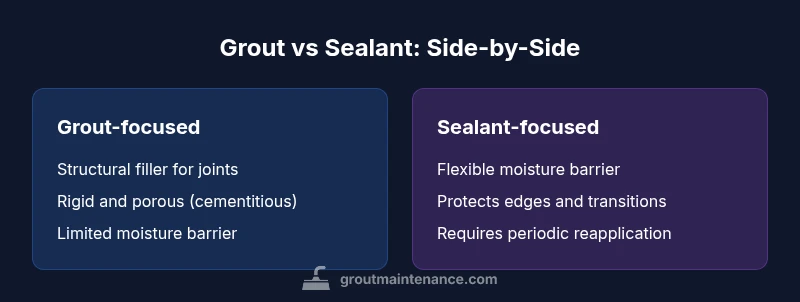
Grout fills the gaps between tiles and locks the tile grid in place, providing structural integrity and a defined aesthetic. It is typically rigid and porous when cementitious, which means it can absorb moisture and stains if left unprotected. Sealant, by contrast, sits on the surface of the grout lines and adjacent surfaces, creating a flexible barrier that resists water penetration and accommodates tiny movements without cracking. These materials are not interchangeable. A thoughtful installer plans grout and sealant in concert: grout provides the backbone, while sealant protects the vulnerable edges and transition points that see the most water exposure and movement.
When grout substitution might seem viable (low-moisture zones)
There are scenarios where homeowners consider a grout-based approach as a substitute, usually in low-moisture zones such as dry kitchen backsplashes or decorative wall tiling. In these contexts, the risk of water exposure is lower, but that does not negate the fundamental need for a moisture barrier at critical joints. Even in dry areas, splash risks, spills, and humidity can creep in, especially where tile continues into near-wet spaces. If you choose to pursue grout as a substitute, be aware that this is not commonplace practice among pros and should be considered only after evaluating all moisture pathways and movement patterns. The decision should be based on a clear understanding of the surface’s exposure profile and maintenance commitments.
Why moisture barrier matters: where sealant shines
Moisture barrier is not a luxury option; it is essential in most wet environments. Sealant provides a continuous, elastic layer that can bridge tiny substrate movements and seal the micro-gaps that grout alone cannot address. In areas like showers, tub surrounds, and wet-room edges, a high-quality sealant around corners, transitions, and edges reduces capillary action, prevents water ingress, and minimizes mold growth. The failure mode when sealant is skipped or neglected is often hidden behind tiles and grout, making leaks harder to detect until they cause structural or cosmetic damage. This is why professional guidelines emphasize sealant as a critical component of a durable tile installation.
Epoxy grout, cementitious grout, and their limitations
Grout comes in several formulations, primarily cementitious and epoxy. Epoxy grout improves chemical resistance and low water absorption, which can extend the time between maintenance cycles. However, even epoxy grout does not provide a true moisture seal for movement gaps or edge joints, and it remains relatively stiff compared with flexible sealants. Cementitious grout with a penetrating sealer can resist staining and moisture to a degree, but its porous nature means it is not a substitute for a dedicated sealant in wet areas. The takeaway is that material choice matters, but function cannot be ignored: grout’s primary job is spacing and rigidity, while sealant’s job is moisture management and elasticity.
Movement and expansion joints: the design imperative
Most tile installations experience some degree of substrate movement or thermal expansion. Seams and expansion joints are deliberately placed to accommodate this movement. A sealant fill between tiles, especially at corners and transitions, remains flexible enough to absorb these shifts without tearing. Grout, by its very nature, is less forgiving of movement and more prone to hairline cracks when stress is introduced. If you place grout in joints that routinely experience movement, you will likely see early cracking, water intrusion pathways, and faster debris accumulation, which can compromise both durability and hygiene.
Installation considerations if not using sealant
If you decide to minimize or skip sealant in a given area, you must implement compensating measures. This includes selecting non-porous or highly resistant grout formulations and ensuring that all joints are truly dry and free of contaminants before grouting. Surface prep is critical: any moisture that infiltrates during curing can compromise bond strength, leading to joint failure. Additionally, you should plan for more frequent inspections and potential resealing strategies that address the specific exposure profile of the area. While this approach may seem to simplify the process, it can introduce long-term maintenance challenges and moisture risks that are hard to mitigate without professional guidance.
Maintenance realities: cleaning, resealing, and replacement
Even when you avoid topical sealants, maintenance practices matter. Regular cleaning helps prevent staining and buildup that can mask grout integrity. Inspect grout lines for cracks, hairline separations, and discoloration. If you notice degradation, you may need to regrout or apply protective surface treatments in localized areas. In contrast, sealants require periodic reapplication to maintain their barrier properties. The longevity of grout without sealant protection depends on environmental conditions, tile type, and how frequently joints are exposed to water. A conservative, evidence-based approach is to treat wet areas with sealant and reserve grout-focused strategies for dry zones or decorative applications where water exposure is minimal.
Scenario-based guidance: kitchens, showers, backsplashes
Kitchen backsplashes, bathroom walls, and shower surrounds each present different moisture profiles. In kitchens, occasional splashes and cooking steam are common; a sealant around edge joints is often prudent, while grout can handle interior joint lines with careful maintenance. In showers, the protection system must be robust and continuous; sealant at all edges and transitions is typically the safer choice. Backsplashes are a mixed bag: if they remain dry most of the time, grout with a penetrating sealer can suffice in some cases, but any area adjacent to a sink or exposure to daily water contact calls for sealant practice. These distinctions matter for long-term performance and hygiene.
Choosing the right approach: decision framework
Develop a decision framework that evaluates exposure level, movement, and maintenance capacity. Start with risk assessment: how much water exposure does the joint receive? What is the substrate’s movement potential? Can the area tolerate occasional maintenance without causing downtime? A structured framework helps homeowners weigh the trade-offs between grout-based approaches and traditional sealant-based installations. Keep in mind that most wet-area installations benefit from a dedicated sealant strategy, particularly where tile meets non-tile surfaces or where movement is likely.
Tips for longevity regardless of approach
Whether you rely on sealant, grout, or a combination, a disciplined maintenance schedule is essential. Clean tiles with grout-safe products, promptly address any signs of water intrusion or discoloration, and plan periodic inspections. Use tools designed for grout cleaning to prevent abrasive damage that can expose porous materials. If you use epoxy grout for added chemical resistance, still monitor edge joints for sealant-related wear in wet zones. The overarching principle is proactive care: early detection and timely intervention save money and preserve tile aesthetics over the long term.
Common misconceptions debunked
A common myth is that sealing tile is optional if grout is sealed. In reality, sealant and grout serve different purposes, and relying solely on grout to protect against moisture is a high-risk approach in most homes. Another misconception is that epoxy grout eliminates the need for any surface protection. While epoxy grout resists moisture better than cementitious grout, it does not replace the elasticity and barrier function of a proper sealant. Finally, some believe all grout types offer equal performance. Material choice matters, but the barrier role of sealant remains indispensable in wet areas.
Comparison
| Feature | Grout-as-sealant approach | Traditional sealant approach |
|---|---|---|
| Moisture barrier | Limited moisture barrier; not designed to replace edge/water barriers | Dedicated moisture barrier around joints and edges |
| Joint movement compatibility | Rigid grout offers limited elasticity; higher crack risk with movement | Sealant accommodates expansion/contraction without tearing |
| Maintenance and resealing | Sealing typically not applied on top; stains and wear can require regrouting | Periodic resealing preserves barrier performance and edge protection |
| Aesthetic flexibility | Color durability tied to grout and staining risk; sealing impact can be minor | Wide range of finishes; sealant maintenance mostly invisible to appearance |
| Repairability | Regrouting can be invasive; localized cracks may require replacement of sections | Sealing repairs are often localized to joints; quicker, less invasive fix |
| Best-use scenarios | Non-wet areas or decorative installations where movement is minimal | Wet areas (showers, tub surrounds) and edge joints |
| Long-term cost considerations | Initial savings may be offset by higher maintenance or replacement needs | Predictable maintenance cycle with sealants; costs spread over time |
Pros
- Fewer layers to apply in restricted projects when allowed
- Potential cost savings upfront in dry zones
- Simplified surface appearance with a single material choice in some designs
- Clear, straightforward maintenance routines in specific scenarios
What's Bad
- Greater risk of moisture intrusion in wet areas
- Higher likelihood of cracking with substrate movement
- Limited long-term durability without a dedicated moisture barrier
- Maintenance complexity increases if stains and leaks emerge
Sealant usually offers the better long-term protection for wet areas; grout substitution is limited to dry, non-movement zones
For most tile installations, especially bathrooms and showers, the recommended approach is to use sealant for moisture barriers and expansion joints. Grout should not be used as a blanket replacement for sealant due to movement and water exposure concerns. Homeowners should evaluate exposure and movement patterns before deciding.
Got Questions?
Can grout ever fully replace sealant in a shower?
In most showers, no; grout cannot provide a reliable moisture barrier. Sealant around joints ensures flexibility and leak prevention where tiles meet other surfaces.
Generally not in showers. Sealant is needed for reliable moisture protection.
What is the essential function of sealant?
Sealant creates a flexible moisture barrier at joints and edges, accommodating movement and preventing water ingress. It protects underlying substrates and reduces mildew risk in wet zones.
Sealant acts as a flexible moisture barrier around joints.
Are there grout types that act as a moisture barrier?
No grout type can equal a dedicated sealant. Epoxy grout resists moisture better than cementitious grout, but it does not replace the elastic barrier provided by sealant in wet areas.
Grout isn’t a substitute for a proper sealant in wet spaces.
How do I maintain grout to prevent leaks?
Regular cleaning and timely repair of cracks or chips are essential. In wet areas, plan for sealant maintenance and resealing where appropriate to prevent water intrusion.
Keep an eye on cracks and stains; act early.
Is epoxy grout a good substitute for sealant?
Epoxy grout offers improved moisture resistance but does not replace the flexible barrier of sealant in wet joints. Use it where appropriate, but still apply sealant where necessary.
Epoxy is not a substitute for sealant in wet joints.
What about non-wet areas like backsplashes?
In dry areas, grout can be used with close attention to stain resistance and maintenance. However, sealing may still be advisable at edges or nearby water sources to extend durability.
Dry zones can be more flexible, but edges might still benefit from sealing.
The Essentials
- Assess moisture exposure before deciding; wet areas need sealant.
- Sealant provides the elasticity grout cannot match.
- Grout substitution is generally limited to dry, low-movement zones.
- Epoxy grout improves moisture resistance but does not replace sealant.
- Plan maintenance early to protect long-term performance.