No Grout Bathroom Floor: A Complete How-To Guide
Discover no grout bathroom floor options, installation methods, and maintenance strategies. Grout Maintenance explains seamless surfaces, edge sealing, and care for groutless designs in wet rooms.


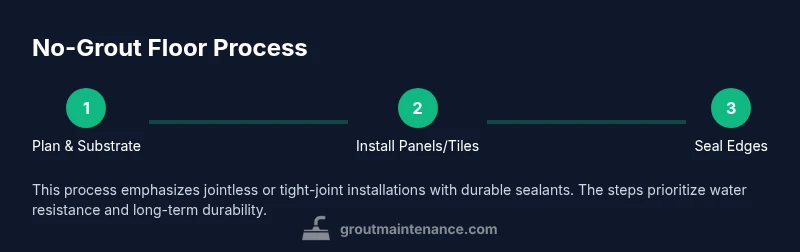
By completing a no grout bathroom floor project, you can achieve a durable, easy-to-clean washroom surface with minimal maintenance. This guide covers material choices, installation approaches, and ongoing care. According to Grout Maintenance, groutless designs favor seamless looks and water resistance, but require precise planning and proper substrate preparation. Prepare to invest time and patience for best results.
No-Grout Bathroom Floors: What They Are and Why They Matter
A no grout bathroom floor describes a tile or surface installation designed to minimize or eliminate visible joints between panels. In practice, this often means large-format tiles laid with butt joints or solid-surface panels that are sealed tightly and run continuously from room to room. The result is a sleek, cohesive look that can make small bathrooms feel more spacious and easier to clean. According to Grout Maintenance, the concept is popular in kitchens and baths where moisture is a constant concern, because fewer joints require less routine scrubbing and reduce the risk of grout staining.
When homeowners first hear about a groutless or no-grout approach, they worry about water intrusion or tile movement. There are legitimate concerns, but with proper substrate preparation, waterproofing, and careful material selection, a no grout bathroom floor can perform well for many years. The strategy hinges on choosing materials with inherently low porosity, flat availability, and stable dimensions. Materials that tolerate expansion and contraction while maintaining a seamless surface include large-format porcelain or ceramic tiles and solid-surface panels such as engineered stone or dense composite slabs. Materials that some designers explore include poured epoxy coatings that harden into a continuous layer, creating a truly jointless feel. Regardless of the route, success starts with a flat, well-prepared substrate and a reliable waterproofing system.
Another benefit highlighted by the Grout Maintenance team is maintenance simplicity. With fewer grout lines, daily cleaning becomes faster, and there is less opportunity for mildew and staining to form in joints. This is particularly appealing in bathrooms where soap scum can rapidly accumulate along grout lines. However, the trade-off is that edge or perimeter joints must be impeccably sealed to prevent water infiltration, and material costs can be higher than traditional tile installations. The goal is to balance aesthetics, durability, and long-term upkeep, tailoring the approach to your bathroom’s size, moisture exposure, and traffic patterns.
Materials and Methods That Maximize a Groutless Look
To achieve a convincing no grout bathroom floor, you’ll align three pillars: tile or panel choice, substrate preparation, and edge sealing. The most reliable route for many homeowners is large-format porcelain tiles or dense solid-surface panels. Large-format tiles minimize joints to create the visual continuity that defines a groutless look. If you plan to install panels that span several feet without visible joints, ensure the substrate is perfectly flat and that panels can be joined with butt joints or very narrow gaps.
Substrate and moisture management are non-negotiable. A rigid, flat subfloor with an appropriate moisture barrier prevents slow degradation under bathroom conditions. In practice, you would install backer board or cementitious substrate with a waterproofing membrane beneath the surface, then seal all transitions to walls and fixtures. The Grout Maintenance analysis emphasizes the importance of moisture protection in bathrooms; without it, even the best-looking no-grout floor can fail prematurely.
Adhesives and edge details matter, too. Polymer-modified thinset provides a stable bond for large tiles, while a leveling compound helps achieve a flawless surface. For edge joints and perimeter transitions, silicone sealant is essential to maintain water control and a clean aesthetic. If you use panels, you may need a compatible adhesive system specified by the manufacturer to sustain adhesion over time. In all cases, document the installation plan and verify flatness with a long straightedge before setting the final pieces.
Substrates, Waterproofing, and Preparation
A no grout bathroom floor relies on a flat, stable substrate and robust waterproofing. Start with a moisture-check of the existing subfloor and remove protrusions that could cause high spots. Install a cement backer board or a gypsum-based board rated for wet areas, then apply a waterproof membrane at the seams and around drains. The waterproof layer should extend beyond the tile edges to prevent leaks into the subfloor. For added protection, consider a surface-applied sealant or a subfloor that is already sealed against moisture penetration. The Grout Maintenance team notes that a well-prepared substrate is more important than the tile choice itself; even premium materials fail if the substrate is crooked or damp.
Flatness is the ally of a groutless design. Use a long straightedge to check every section and fill high spots with a leveling compound. If you’re installing on an uneven substrate, address the irregularities before setting tile or panels. A truly jointless look also requires careful control of expansions and contractions. Plan for expansion joints at transitions to walls or vertical surfaces and seal them with silicone instead of grout to prevent water infiltration. Finally, ensure that the bathroom ventilation is adequate to reduce humidity levels, which helps maintain the durability of sealants and the substrate.
Installation Scenarios: Joins, Spacing, and Seals
There are several routes to a no grout bathroom floor depending on the chosen material. In a butt-joint tile installation, you set tiles with negligible gaps and rely on careful trimming and flatness to deliver a continuous surface. In a panel-based approach, you place sheets or slabs with seamless edges and fill only edge gaps with silicone. Poured coatings, such as epoxy or cementitious pour, create a monolithic surface with zero horizontal joints, but require professional-grade preparation, ventilation, and curing conditions. No matter the method, accuracy in layout is critical.
Before you begin setting, dry-fit a section to confirm alignment and edge tolerances. Use spacers only as needed to maintain the initial alignment, then eliminate them once you confirm the joint layout. If you’re working near drains or transitions, you’ll need to cut tile or panel edges precisely to maintain continuous edges and flush surfaces. Remember: avoid overworking adhesives at joints, and keep a clean, damp cloth ready to wipe residue away immediately to preserve the surface finish.
Edge Finishes, Sealing, and Long-Term Care
The success of a groutless floor rests on how well edges and transitions are treated. Perimeter bands around walls, thresholds, and fixtures should be sealed with a silicone sealant that remains flexible and moisture-resistant. Choose a sealant compatible with the tile or panel material; neutral-cure formulas are often a safe choice for bathrooms. Regular maintenance includes gentle cleaning with pH-neutral cleaners and avoiding abrasive scrubbers that might scratch the surface. Grout, if present elsewhere in the bathroom, should be sealed, but joints that connect to a groutless area must remain water-tight through silicone seals.
For longevity, schedule periodic inspections of the sealant and substrate. If you notice a gap appearing or discoloration at seams, address it promptly to prevent water intrusion. Education and planning pay off in the long run: a no grout bathroom floor can maintain its seamless look for many years when properly cared for. The Grout Maintenance team suggests documenting the installation so future renovations can retain the jointless aesthetic without compromising waterproofing.
Maintenance and Cleaning: Keeping a Jointless Surface Pristine
Cleaning a groutless floor is straightforward but requires attention to surface specifics. Use a mild, non-acidic cleaner and a non-abrasive pad to remove soap scum and mineral deposits. Microfiber mops work well for larger areas, reducing streaks while preserving the finish. Since there are no grout lines to harbor dirt, you’ll notice quicker daily maintenance; however, you must protect the joints from moisture through proper sealing and ventilation.
If you installed epoxy or resin coatings, follow the manufacturer’s care instructions to avoid chemical damage or color changes. For natural stone or dense ceramic panels, reseal periodically as the product dictates; the sealant will slow moisture penetration and maintain a uniform appearance. If you see micro-scratches or dulling, consult a professional for a refresh that preserves the no-grout look. Grout Maintenance emphasizes that routine checks of edges and joints help catch issues early, preventing larger repairs later.
Quick Start Checklist and Next Steps
- Verify substrate flatness with a long straightedge; fix any high spots before laying tiles or panels.
- Choose a groutless method (butt-joint tiles, panels, or poured coating) and confirm the manufacturer’s recommendations.
- Install a complete moisture barrier and waterproofing system before setting the surface.
- Use silicone sealant for all perimeter and edge joints; avoid grout in these areas.
- Plan for expansion joints and ventilation to maintain long-term durability.
- Schedule a final inspection after curing and perform a water test to confirm waterproofing.
Next steps include obtaining an on-site quote from a qualified installer, ordering the chosen material, and preparing the bathroom for a professional installation if needed. The Grout Maintenance team notes that the quality of substrate preparation and sealing largely determines success.
Tools & Materials
- Large-format porcelain tiles or solid-surface panels(24x24 inches (600x600mm) or larger for minimal joints)
- Flat, rigid substrate with moisture barrier(Cement backer board or equivalent; avoid soft subfloors)
- Waterproofing membrane(Sheet or liquid membrane rated for bathrooms)
- Polymer-modified thinset mortar(Use per tile manufacturer guidance)
- Notched trowel(Choose size matching tile joint recommendations)
- Wet saw or tile cutter(For precise edge cuts and squaring)
- Silicone sealant (neutral cure)(For all perimeter and edge joints)
- Long straightedge and level(Check substrate flatness across the room)
- Spacers (optional)(Use for initial layout alignment only)
- pH-neutral cleaner and non-abrasive pad(Safe everyday cleaning)
Steps
Estimated time: 48-72 hours
- 1
Plan and finalize method
Assess the bathroom layout and select between butt-joint tiles, panel-based sheets, or a poured coating for a seamless surface. Confirm substrate readiness and warranty compatibility before purchasing materials.
Tip: Draft a layout diagram to minimize edge waste and ensure straight lines. - 2
Prepare substrate and moisture barrier
Test subfloor moisture, repair any damage, install backer board, and apply waterproofing membrane at seams and around drains. Ensure the surface is perfectly flat before setting any tile or panel.
Tip: Use a straightedge over 10 feet to confirm flatness; fix any high spots first. - 3
Cut and dry-fit panels/tiles
Dry-fit sections to confirm alignment and edge tolerances; mark cuts for walls and fixtures, and trim carefully with a wet saw.
Tip: Maintain consistent edge alignment to reduce edge finishing challenges later. - 4
Apply adhesive and place surface
Spread polymer-modified thinset and set tiles or panels, using butt joints or minimal gaps as planned. Keep surfaces clean and wipe adhesive residues immediately.
Tip: Work in small, repeatable sections to prevent adhesive drying before seating. - 5
Seal edges and transitions
Apply neutral-cure silicone at all transitions (walls, fixtures, drains). Do not use grout at the joints where a groutless look is required.
Tip: Cure times vary; plan a proper cure window per product instructions. - 6
Cure, clean, and inspect
Allow required cure time, then clean the surface with a pH-neutral cleaner. Inspect for any gaps or gaps around drains and reseal if needed.
Tip: Do a water test after curing to verify waterproofing integrity.
Got Questions?
What is a no grout bathroom floor?
A no grout bathroom floor uses large-format tiles or panels joined with minimal or no visible joints, sealed at edges to prevent water intrusion. This creates a seamless look and easier cleaning, but relies on precise substrate prep and waterproofing.
A no grout floor uses large tiles or panels with tiny joints sealed at the edges, giving a seamless look while staying waterproof.
Which materials work best for groutless floors?
Large-format porcelain tiles, dense solid-surface panels, or poured coatings offer the strongest groutless effect. Each option requires flat substrates and proper sealing at edges and transitions.
Large-format porcelain tiles, solid-surface panels, or poured coatings work best for groutless floors when installed with proper flat substrates and edge sealing.
Is a groutless floor suitable for showers?
Yes, with rigorous waterproofing and appropriate slope, but some groutless methods are more water-resistant than others. A professional assessment is recommended for wet zones.
Yes, but showers need careful waterproofing and the right groutless method; consult a pro for wet areas.
Can I retrofit an existing bathroom to a groutless floor?
Retrofitting is possible if the subfloor is flat and moisture issues are resolved. It often requires substrate replacement and professional installation.
Retrofitting is possible if the subfloor is flat and moisture issues are addressed; it may require substrate work.
How long does installation take?
Time varies by method and room size; panel installations can take longer than traditional tile. Plan for several days including curing and sealing.
It varies, but plan for several days including curing and sealing.
What maintenance is required?
Regular cleaning with a pH-neutral cleaner, resealing where needed, and periodic checks of silicone joints to prevent leaks.
Keep it clean with pH-neutral cleaners and check silicone joints regularly.
Watch Video
The Essentials
- Plan the groutless approach before buying materials
- Ensure substrate flatness and robust waterproofing
- Seal all edges with silicone, not grout
- Maintain the surface with gentle cleaners and periodic reseals