Sanded vs Unsanded Grout for Bathroom Floors: Guide
Compare sanded vs unsanded grout for bathroom floors, covering joint width, tile compatibility, sealing, and maintenance to help homeowners pick grout for durability and easy cleaning.


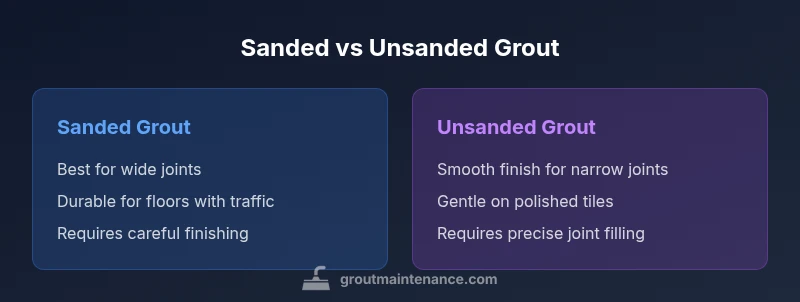
Choosing the right grout for bathroom floors hinges on joint width, tile type, and maintenance goals. Sanded grout offers strength for wider joints and high traffic, while unsanded provides a smooth finish for narrow joints and polished tiles. This side-by-side guide from Grout Maintenance helps you pick the right grout and plan for sealing and cleaning from the start.
What sanded vs unsanded grout mean for bathroom floors
Sanded and unsanded grout are both cementitious mixtures used to fill the gaps between tiles, but they differ in texture, particle size, and performance. Sanded grout contains fine sand particles that create a textured surface, which adds strength and helps prevent cracking in wider joints. Unsanded grout is smoother and more delicate, lacking the abrasive sand grains. When evaluating sanded vs unsanded grout for bathroom floors, consider joint width, tile type, movement, and how the grout will be sealed and cleaned. According to Grout Maintenance, the choice should begin with joint needs and tile characteristics, then account for maintenance expectations and long-term durability. The Grout Maintenance team emphasizes that accurate joint measurements and tile inventory are essential to avoid failures down the line. In practice, your bathroom floor grout decision should align with how you use the space, how much foot traffic you expect, and how you intend to maintain the grout over years of use.
When to choose sanded grout
Sanded grout is the workhorse for many bathroom floors where joints are wider and the floor endures frequent foot traffic. The typical recommendation is to use sanded grout for joints roughly 1/8 inch (3 mm) or wider. The added texture helps resist cracking when the substrate moves or settles over time. For ceramic and porcelain tiles with a rough or textured edge, sanded grout also fills larger gaps more securely, reducing the chance of hollow sounds or loose edges under pressure. In showers and tub surrounds with stone or concrete substrates, sanded grout can hold up better under damp, demanding conditions. However, this grout type requires careful finishing to avoid grout haze on the tile face, and proper sealing is often recommended to protect color and prevent staining.
When to choose unsanded grout
Unsanded grout shines when the joints are narrow or when tiles have smooth, polished faces that could be scratched by sand. Typical guidance points to joints of 1/8 inch (3 mm) or less as the sweet spot for unsanded grout, especially on polished porcelain, glass tiles, or delicate stone. The absence of sand yields a slicker finish that’s easier to wipe clean, which can be a significant advantage in a bathroom. If your floor has glass mosaic tiles or glossy subway tiles with tight grout lines, unsanded grout minimizes texture and helps preserve a clean look. Do keep in mind that unsanded grout may be more susceptible to cracking if you have substantial substrate movement or heavy load-bearing sections without proper substrate preparation.
Tile and substrate compatibility
Tile type and substrate influence grout choice almost as much as joint width. For rough-textured tiles, larger joints, and floors with some movement, sanded grout tends to be the safer choice due to its durability. On smooth, delicate tiles or surfaces with very fine edges, unsanded grout reduces the risk of scratching and chipping. Natural stone tiles, especially those prone to etching or staining, may benefit from careful sealing and, in some cases, a specific grout type recommended by the tile manufacturer. Cementitious grouts (both sanded and unsanded) react differently to moisture, so ensuring proper curing and environmental control during installation is essential for long-term performance.
Installation considerations and technique
Grouting a bathroom floor requires discipline to avoid common issues like haze, color variation, and premature wear. When using sanded grout, take extra time in packing the joints and finishing to minimize texture that can trap dirt. Use a rubber float at a shallow angle to avoid pushing grains into tile edges. For unsanded grout, the application should emphasize smooth, continuous lines with careful cleaning to prevent grout from pulling away from joints. Always follow the grout’s cure time, mix ratio, and water quality guidelines, and consider sealing cementitious grout after it cures to improve stain resistance and moisture protection. Poor substrate prep or inconsistent joint depth can magnify both grout types’ weaknesses.
Durability, stain resistance, and maintenance
Durability on bathroom floors depends on joint width, traffic, and maintenance. Sanded grout generally offers higher strength in wider joints, with reduced risk of cracking under pressure, making it a reliable choice for busy family bathrooms. Unsanded grout, while smoother and easier to clean, can be more vulnerable to cracking if joints are wide or the substrate shifts. Both types benefit from a proper sealant to resist moisture and stains, especially in wet environments. Routine cleaning with non-abrasive cleaners and avoiding harsh acidic products will help preserve color and prevent surface wear. If you notice color inconsistency or small cracks, address them early to prevent larger repairs later.
Sealing and long-term care
Sealing cementitious grout is a critical step for both sanded and unsanded varieties, though the specifics may vary by product. Sealing slows water penetration, helps resist staining, and makes routine cleaning easier. For bath floors, a penetrating grout sealer that is compatible with cementitious grout is often recommended. Re-seal as recommended by the manufacturer, particularly in high-moisture zones like showers and steam rooms. Avoid sealing epoxy grout, which already provides moisture resistance. Regular maintenance includes wiping up spills promptly, using pH-neutral cleaners, and performing periodic re-sealing every 1-2 years depending on traffic and cleaning frequency.
Practical decision guide for bathrooms
To choose between sanded and unsanded grout for your bathroom floor, follow this quick decision framework: 1) measure and verify joint width across all areas; 2) identify tile types (polished, glazed, natural stone, or textured); 3) assess foot traffic and moisture exposure; 4) plan sealing and maintenance in advance; 5) consider long-term color choices and repairability. By aligning these factors with product recommendations and tile manufacturer guidelines, you’ll select a grout that balances aesthetics with durability.
Common mistakes and troubleshooting
Common mistakes include selecting a grout type based solely on color, failing to account for joint width, and neglecting substrate movement and sealing requirements. If you notice cracking, uneven joints, or haze, re-check joint depth, surface preparation, and curing conditions. For tough maintenance challenges, consult tile and grout manufacturers for compatibility notes, re-seal after cleaning, and consider a color-match regrout to restore a uniform look. Taking proactive steps now saves time and money later.
Comparison
| Feature | Sanded grout | Unsanded grout |
|---|---|---|
| Best for joint width | Wide joints (≥ 1/8 in / 3 mm) | Narrow joints (≤ 1/8 in / 3 mm) |
| Tile compatibility | Rough textures, large-format floors, edges | Polished, glazed, or fine-edge tiles (low risk of scratching) |
| Finish texture | Textured surface; more pronounced grout line | Smoother finish; easier to wipe |
| Durability on floors | Higher strength in wider joints; reduced cracking | Better for narrow joints but more movement risk unless joints are well-prepared |
| Maintenance and sealing | Sealing improves color stability; sealing often advised | Sealing helpful but grout is smoother to clean |
| Installation considerations | Requires careful finishing to avoid haze; tends to be slightly harder to work | Easier to push into grooves; less likely to leave edge texture |
| Best for | High-traffic bathrooms with wider joints | Delicate tiles or very tight joints |
Pros
- Better crack resistance for wide joints (sanded)
- Higher durability for floor use in busy bathrooms
- Strong performance in movement-prone substrates
- Sealing enhances stain resistance for cementitious grout
What's Bad
- Can scratch delicate tile faces if joints are narrow (sanded)
- Prone to cracking if joints are too wide or substrate moves (unsanded)
- Sanded can be harder to finish cleanly on very narrow joints
- Color consistency can be challenging with cementitious grout if not sealed and cured properly
Sanded grout is the default recommendation for bathroom floors with wider joints; unsanded is the go-to for narrow joints or delicate tiles.
For most bathroom floor applications, match the grout type to joint width. Seal and maintain regardless of type to maximize durability and ease of cleaning.
Got Questions?
What joint width qualifies as 'wide' for sanded grout on a floor?
In most installations, sanded grout is preferred for joints around 1/8 inch (3 mm) or wider. This helps prevent cracking under movement and heavy use. Always verify with tile manufacturer guidelines for your specific tiles.
For bathroom floors with joints about 3 mm or wider, go with sanded grout. Check your tile makers’ guidance for exact specs.
Can I mix grout types in different areas of the same bathroom?
Mixing grout types in the same bathroom is generally not recommended because it can create color and texture mismatches and complicate sealing. If you must mix, isolate areas with similar movement and moisture exposure and clearly label each section.
Better to keep one grout type per project area to avoid mismatches.
Does sealing matter equally for sanded and unsanded grout?
Sealing is usually recommended for cementitious grout to minimize staining and moisture uptake, regardless of sanded or unsanded. Some grout products are stain-resistant and may require sealing only in particularly damp zones.
Seal your cementitious grout to keep it looking new longer.
How do tile types affect grout choice?
Polished or delicate tiles often benefit from unsanded grout to prevent scratches, while rougher or larger-format tiles tolerate sanded grout better. Always follow tile manufacturer recommendations for the best pairing.
Polished tiles usually pair well with unsanded grout.
What’s the best way to repair cracked grout on a bathroom floor?
Identify the source of movement or moisture, remove the cracked grout with a grout saw, clean the joints, and re-grout with the appropriate type. Allow proper curing and reseal if required by the product.
If grout cracks, replace just the affected area and reseal after curing.
Is epoxy grout a better option for bathrooms?
Epoxy grout offers excellent stain and moisture resistance but is more expensive and harder to work with. For many homeowners, cementitious grout (sandeds or unsanded) with sealing provides a practical balance of performance and ease.
Epoxy is tough, but cementitious grout with sealant is usually simpler for DIYers.
The Essentials
- Measure joint width before choosing grout
- Sanded grout suits wider joints and high traffic
- Unsanded grout suits narrow joints and polished tiles
- Seal cementitious grout to protect color and moisture resistance
- Follow tile manufacturer guidelines for compatibility and cure times