How Much Does Grout Cost in 2026: A Practical Guide for Homes
Learn realistic grout cost ranges for cementitious and epoxy options, plus labor, sealing, and maintenance. This 2026 Grout Maintenance guide helps homeowners budget tile projects with data-driven estimates and smart saving tips.


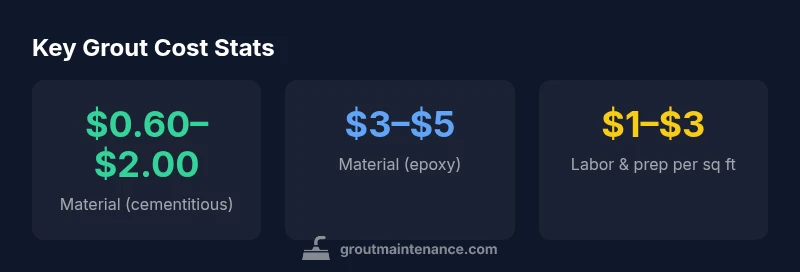
Grout cost ranges depend on material type and project size. Expect material costs of roughly $0.60–$2.00 per square foot for standard cementitious grout, with epoxy greater at $3–$5 per square foot. Labor, prep, cleaning, and sealing can add $1–$3 per square foot, depending on local rates and project complexity, and these figures can vary widely.
What drives grout pricing in 2026
When homeowners ask how much does grout cost, the answer isn't a single price. It's a function of material choice, project scope, and installation conditions. The Grout Maintenance team has analyzed common price drivers to help you budget confidently. The largest levers are grout type (cementitious vs epoxy vs specialty), tile format and grout width, color and porosity, site accessibility, and whether preparation work is needed (removing old grout, cleaning, or patching substrate). For many kitchens and bathrooms, the cost picture breaks down into three components: material, labor, and ancillary services such as sealing or anti-mold treatments. In urban areas, labor rates tend to run higher than in rural markets; in markets with skilled tile trades, you may see quicker turnaround but slightly higher per-square-foot costs. Finally, projects with intricate patterns, narrow grout joints, or large spans will push per-square-foot totals upward, even if the tile surface area remains modest. If you’re asking a question, how much does grout cost, understand that your final price will reflect these combined factors and local pricing dynamics. According to Grout Maintenance, planning around material choice and scope is the fastest way to control overall spend.
Material cost ranges by grout type
Material costs break down by grout type. For standard cementitious grout (sanded or unsanded), expect material costs roughly in the range of $0.60–$2.00 per square foot. Epoxy grout typically runs $3.00–$5.00 per square foot for material alone. Specialty blends or color-extreme products may push material costs higher, especially for large color runs or premium brands. Remember that pigment-heavy colors can influence price slightly due to pigment load and packaging. In some cases, larger tiles reduce grout material per square foot slightly, but this is often offset by higher labor demands for neat joints and tighter tolerance work.
Labor costs and how job scope changes price
Labor costs for grout work vary by region and contractor skill. A cementitious grout job might add roughly $1.00–$3.00 per square foot for labor, depending on whether hand-tooling, extra wipe-down time, or color matching is required. Epoxy grout, which requires more time and a trained applicator, can push labor to about $2.00–$4.00 per square foot or higher. If you need removal of existing grout, heavy cleaning, or substrate patching, expect substantially more labor, and possibly a two-step process for resealing afterward. Always request a line-item estimate showing material, labor, and any contingency.
Hidden costs: prep, cleaning, sealing, maintenance
Prep work can drastically affect total grout costs. Removing old grout, cleaning porous substrates, and ensuring a clean, dry surface adds to the bill. Sealing grout, especially in humid areas or projects with white or light grout, is an ongoing maintenance expense that can add $0.50–$2.00 per square foot per coat. Cleaning products and tools contribute further, and maintenance cycles (re-sealing every few years) should be budgeted. These costs are often overlooked but can account for a sizable portion of the long-term price.
Regional differences and DIY considerations
Prices vary by region due to labor markets, material availability, and contractor competition. Urban centers tend to have higher labor rates but might offer faster turnaround. DIY work can save labor costs but requires time, skill, and proper tools to avoid costly mistakes like cracked grout or mold growth. If you’re comfortable with tile work, a DIY approach paired with professional sealing later can balance cost and durability.
How to estimate grout costs for your project
Start by measuring your total groutable area (width multiplied by length, excluding fixtures). Choose a grout type (cementitious for most projects; epoxy for high-stain areas). Multiply the area by the material cost per sq ft, then add labor and prep using local hourly rates or per-square-foot estimates. Don’t forget sealing, cleaners, and potential removal of old grout. This method yields a practical range rather than a single fixed price, which helps in budgeting and shopping around for quotes.
Practical steps to budget and save
Create a two-column budget: material costs and labor/ancillary services. Compare multiple quotes, verify line-item details, and ask about color-matching fees or specialty sealers. Consider standard grout colors and formats to minimize pigment-related surcharges. Scheduling work during off-peak seasons can reduce labor costs, and performing prep work (like removing loose grout) ahead of time may reduce contractor time and price.
Typical cost breakdown by grout type (2026 estimates)
| Grout Type | Material Cost per Sq Ft | Labor/Prep Cost per Sq Ft | Estimated Total per Sq Ft |
|---|---|---|---|
| Standard cementitious grout | 0.60–2.00 | 1.00–2.50 | 1.60–4.50 |
| Epoxy grout | 3.00–5.00 | 2.00–4.00 | 5.00–9.00 |
| Sealing/maintenance (per coat) | 0.50–1.50 | 0.50–1.50 | 1.00–3.00 |
Got Questions?
What factors influence grout cost the most?
Grout cost is driven by material type, project size, tile format, grout width, color, and labor rates. Epoxy is typically more expensive than cementitious grout, and complex patterns or patterns with small joints increase labor time.
The biggest factors are material type and project size; epoxy is pricier, and complex patterns raise labor time.
Is epoxy grout worth the extra cost?
Epoxy grout provides superior stain resistance and durability but at a higher price and with more challenging installation. For high-traffic kitchens or showers prone to staining, epoxy can be a wise long-term investment; for simple, dry-area installations, cementitious grout usually suffices.
Epoxy lasts longer and resists stains, but costs more—consider it for high-traffic areas.
How do I estimate grout costs for a DIY project?
Measure area, pick a grout type, and multiply by per-square-foot costs for materials and labor. Include sealing and maintenance. Get multiple quotes to compare. This helps you gauge budget while avoiding surprise charges.
Measure, pick a grout type, estimate per-square-foot costs, and compare quotes.
Do grout costs differ by region?
Yes. Local labor rates and material availability influence price. Urban areas often have higher labor rates, while rural areas may offer lower costs but longer project times.
Regional differences affect price; local rates and availability matter.
Should I replace old grout or seal it?
If grout is cracked or moldy, replacement offers a longer-term fix. Sealing helps protect new grout and reduce staining but won’t fix structural damage. A pro can recommend the best approach for your situation.
If grout is damaged, replace; sealing helps protect but isn’t a cure for damage.
What should I ask when getting grout quotes?
Ask for line-item estimates, whether sealing is included, the type of grout recommended, expected timelines, and guarantees. Clarify whether removal of old grout is included and any color-matching fees.
Ask for line-item quotes, inclusions, and timelines to compare fairly.
“Grout costs are most sensitive to grout type and job scale. Planning for prep, cleaning, and sealing helps prevent expensive surprises later.”
The Essentials
- Budget material costs by grout type and project size.
- Epoxy grout has a higher upfront material cost.
- Add labor and prep costs for accurate estimates.
- Sealing adds ongoing maintenance expense to plan for.