Adhesive Grout vs Grout: Practical Comparison
Explore an objective comparison of adhesive grout vs grout, covering performance, installation, moisture handling, sealing, and maintenance to help homeowners make informed choices.


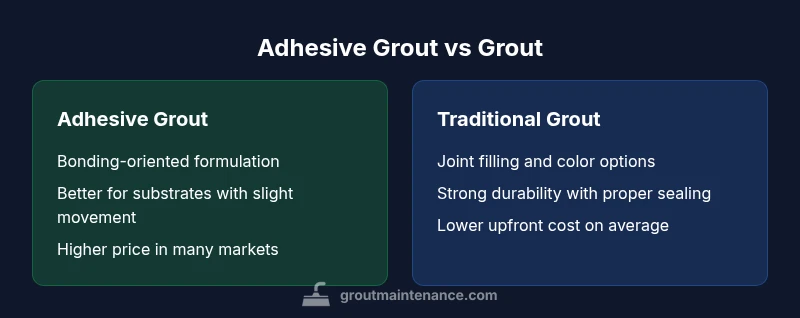
Adhesive grout is marketed to enhance bonding behind tiles, while traditional grout primarily fills joints. In practice, most tile installations rely on a separate bonding layer (thin-set) and a grout that sits between tiles. For many homes, standard grout with proper sealing is safer, more cost-effective, and easier to maintain—unless you are addressing substrate movement or special installation needs.
What is adhesive grout vs grout? Definitions and scope
Adhesive grout vs grout is a topic that confuses many homeowners when starting a tile project. In practice, adhesive grout refers to products that blend bonding capability with joint filling, often marketed to promise easier installation or stronger tile adhesion. Traditional grout, by contrast, is primarily a joint filler that locks the tile pattern in place and provides a clean, color-coordinated finish. It is important to distinguish marketing language from actual construction needs. According to Grout Maintenance, most tile installations rely on a separate bonding material behind the tile (thin-set or polymer-modified adhesive) and a grout that sits between tiles. The idea of adhesive grout appears most often in mosaic backs or specialized repair products where manufacturers tout a dual-role formula, but it rarely replaces the need for a proper adhesive layer. For many DIYers, the practical takeaway is simple: adhesive grout is typically not a universal substitute for a true bonding mortar, and choosing between them should be driven by the substrate, tile size, and expected movement.
Comparison
| Feature | Adhesive grout | Grout |
|---|---|---|
| Bond strength | High (with proper substrate prep) | Moderate |
| Moisture resistance | Excellent with sealing | Good with sealing |
| Movement tolerance | Better tolerance with polymer-modified systems | Standard tolerance |
| Installation complexity | Higher due to bonding considerations | Lower, more straightforward |
| Maintenance and cleaning | Requires sealing and careful cleaning | Easier to clean; sealing optional |
| Best use case | Movement-prone substrates or mosaics | Stable substrates and traditional joints |
Pros
- Stronger bonding on movement-prone substrates
- Potentially fewer patches on backsplashes or mosaics
- Polymer-enhanced formulations can improve flexibility
- Good moisture resistance when sealed properly
What's Bad
- Higher material cost
- Not universally compatible with all tiles or substrates
- More complex installation and curing requirements
- Can be harder to trim and finish around edges
Adhesive grout offers targeted bonding benefits, but traditional grout remains the default for most projects.
Choose adhesive grout when substrate movement is likely or mosaic backs require extra bonding. For typical interior floors and walls with stable substrates, standard grout plus sealing usually provides better value.
Got Questions?
What is adhesive grout vs grout, in simple terms?
Adhesive grout is marketed to improve bonding while filling joints; traditional grout mainly fills joints. The two products differ in bonding emphasis and installation considerations.
Adhesive grout focuses on bonding; traditional grout focuses on joints. Both require proper prep and sealing where applicable.
Can I use adhesive grout in place of traditional grout on a typical shower wall?
In many showers, traditional grout with proper sealing is the standard. Adhesive grout can be used in some specialized cases if substrate compatibility and product guidelines are met.
For most showers, go with traditional grout and seal. Adhesive grout is for niche cases with the right prep.
Is epoxy grout considered adhesive grout?
Epoxy grout is a distinct category from cementitious adhesive grout. It offers excellent stain resistance and durability but requires different mixing and curing procedures.
Epoxy grout is not the same as typical adhesive grout; it is a different option with its own pros and cons.
How does sealing affect adhesive grout vs grout?
Sealing benefits most cement-based grouts, including some adhesive formulations. Epoxy grout usually does not require sealing; always follow manufacturer guidance.
Seal cementitious grout to prevent stains; epoxy usually does not need sealing.
What maintenance routine works best for adhesive grout vs grout?
A regular cleaning plan with sealing (when applicable) extends grout life. Adhesive grout may need more frequent checks in damp areas.
Keep it clean and seal when required; check for wear in moist spots.
The Essentials
- Assess substrate movement before choosing
- Seal cementitious grout to reduce staining
- Consider long-term maintenance and life-cycle costs
- Epoxy grout is a rigid, durable alternative to consider
- Follow manufacturer guidelines for cure times and sealing