Grout Sizes Chart: Joint Width Guidelines for Tile Installations
Discover a practical grout sizes chart with unsanded vs sanded joint ranges, how tile size affects joints, and step-by-step tips for measuring and selecting the right grout width in DIY tile projects.


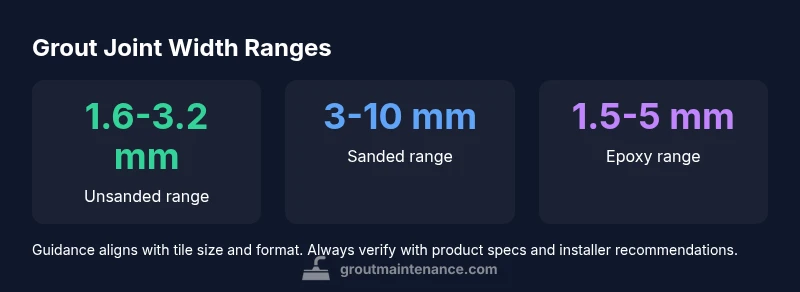
A grout sizes chart typically recommends: unsanded joints of 1.6-3.2 mm (1/16-1/8 in) for small-format tiles and sanded joints of 3-10 mm (1/8-3/8 in) for larger joints. Always reference tile type, format, and manufacturer guidance when selecting grout widths.
Why grout sizes matter
Choosing the right grout size is more than a cosmetic choice; it affects crack resistance, cleaning ease, and tile performance over time. The Grout Maintenance Team notes that misaligned joints can transfer stress, leading to micro-cracks, efflorescence, and staining issues. A well-chosen grout size accommodates tile tolerance variations, substrate movement, and the grout’s physical properties. In practice, adhering to a grout sizes chart helps homeowners predict maintenance needs and avoid common failures. This is especially important in showers and floors where traffic, moisture, and temperature fluctuations are constant. By understanding joint width as a design parameter, you can balance aesthetics with durability, ensuring a long-lasting tile installation that stays clean with routine care.
Unsanded vs. sanded grout: typical ranges
Unsanded grout is feito for narrow joints and smooth tiles; it resists shrinking in thin joints but can be more prone to staining if left untreated. The chart commonly recommends 1.6-3.2 mm (about 1/16-1/8 in) for joints up to roughly 3 mm. Sanded grout is preferred for wider joints; it resists cracking in larger gaps. Typical ranges run from 3-10 mm (1/8-3/8 in). For most interior walls, backsplashes, and low-traffic areas, this unsanded-to-sanded guidance covers the majority of projects. Always verify with tile manufacturer guidelines and regional climate considerations. As joints widen, grout thickness can affect cure times and finish.
How tile size and format influence joint width
Tile size and format dramatically influence the grout size you should use. Small-format tiles, mosaics, and intricate patterns often require narrower joints (toward the 1.6-3.2 mm end) to preserve grout line proportions and ease of cleaning. Large-format tiles or flooring with heavy foot traffic typically benefit from wider joints (toward 3-10 mm) to accommodate tile warping and substrate imperfections. Mosaic sheets and curved surfaces may call for special considerations, including flexible grout formulations or backer rod solutions in contour-heavy installations. Grout sizes chart guidance helps you map tile size, edge finish, and substrate movement into a practical grout width plan.
Reading a grout sizes chart: what the numbers mean
A grout sizes chart presents ranges rather than a single value. The lower end (around 1.6-2.5 mm) usually applies to fine, high-detail tile work, while the upper end (3-10 mm) covers broad joints in floors and outdoor setups. Regional moisture, tile material (ceramic, porcelain, natural stone), and grout type (unsanded vs sanded vs epoxy) influence the final choice. When interpreting the chart, correlate the tile size category, joint color preference, and cleaning expectations. Remember to factor in the grout’s performance under humidity and temperature exposure for longevity.
Measuring joints in real kitchens and bathrooms
Begin by removing any loose grout to obtain a clean measurement surface. Use a calibrated gauge or a standard ruler to measure the width of an empty joint from edge to edge, not the tile thickness. For accuracy, measure several joints across the project (both horizontal and vertical) and calculate a mean. If tiles are not perfectly uniform, use the mid-range value of the chart that covers most joints. Record this data and compare against the tile manufacturer guidance. When in doubt, choose the narrower end if the tile edges are particularly uneven to avoid oversized, difficult-to-clean joints.
Case studies: showers vs backsplashes
Showers normally use narrower joints due to frequent water exposure and maintenance access. An unsanded or very fine sanded grout (1.6-3.2 mm) is common in shower walls where tiles are small to medium, while larger 3-6 mm joints can be suitable for larger shower tiles with proper sealing. Backsplashes, on the other hand, vary by height and traffic; the goal is a balance between aesthetics and surface cleaning. For high-traffic kitchen backsplashes, consider mid-range joints (3-6 mm) and epoxy or high-performance cementitious grout if stain resistance is a priority. The grout sizes chart helps you map these scenarios to consistent, maintainable joints.
Maintenance implications of different grout sizes
Smaller joints can be harder to seal and clean, increasing the importance of stain resistance and proper sealing products. Larger joints tend to accumulate more mortar thickness, which can affect grout color uniformity over time. The chart helps anticipate sealing needs, curing times, and cleaning strategies appropriate for the chosen width. In any installation, plan for periodic maintenance: resealing, deep cleaning, and replacing worn grout to maintain performance. The Grout Maintenance Team emphasizes that predictable maintenance arises from deliberate grout width choices aligned with tile format and usage.
Common mistakes to avoid when choosing grout sizes
Typical errors include selecting too-wide joints for small tiles, undersizing joints for textured surfaces, or ignoring tile warpage. Another mistake is treating grout size as purely aesthetic; it directly affects waterproofing, crack resistance, and cleaning ease. Before finalizing, cross-check the chart against tile type and installation area, test a small sample, and confirm with a professional if moisture and heat are factors. Following these practices reduces callbacks and ensures a durable finish.
Grout type and joint width guidelines by tile scenario
| Grout Type | Recommended Range (mm) | Typical Use | Notes |
|---|---|---|---|
| Unsanded grout | 1.6-3.2 mm | Joints up to ~3 mm in walls/backsplashes | Best for narrow joints and delicate tiles |
| Sanded grout | 3-10 mm | Mid-to-large joints in floors and showers | Resists cracking in wider gaps |
| Epoxy grout | 1.5-5 mm | High-traffic areas and wet zones | Stain-resistant but harder to work with |
| Large-format joints | 6-12 mm | Very wide joints in specialty installations | Requires careful substrate prep |
Got Questions?
What is a grout sizes chart?
A grout sizes chart is a reference that lists recommended joint widths for various tile formats and grout types. It helps you plan joints that balance appearance with performance and maintenance needs.
A grout sizes chart is a reference showing recommended joint widths for different tile sizes and grout types.
Should I use unsanded grout for large joints?
No. Unsanded grout is best for narrow joints, typically up to about 3 mm. Larger joints require sanded grout to resist cracking and to fill gaps properly.
Unsanded grout is for small joints; use sanded grout for larger gaps.
How do tile size and format influence grout width decisions?
Tile size, edge finish, and format determine the appropriate joint width. Smaller tiles often use narrower joints to preserve pattern, while larger tiles can use wider joints to accommodate slight warping.
Tile size and format guide whether you use narrow or wider joints.
Can I change grout width after installation?
Post-install changes to grout width are generally not feasible without regrouting. If a mismatch occurs, consult a professional about regrouting or resealing options.
Usually you need to regrout if the width isn't right.
Is epoxy grout included in grout sizes chart?
Epoxy grout follows its own width ranges, typically narrower due to its stiffness and performance. Always refer to product guidance for epoxy formulations.
Epoxy grout has its own width guidelines; check the product label.
How do I measure grout joints accurately?
Use a calibrated gauge or ruler to measure several joints across the installation, in multiple directions, then average the values. Document findings before selecting grout.
Measure several joints with a ruler, then average the results.
“A well-chosen grout size is the foundation of a durable tile installation; it reduces cracking, helps with cleaning, and accommodates tile variation.”
The Essentials
- Start with tile size and format to pick a grout width
- Use unsanded for narrow joints and sanded for wider joints
- Read the chart and verify with tile manufacturer guidance
- Measure joints accurately across the project
- Consider maintenance implications when selecting a width