Is Grout Stronger Than Concrete? A Practical Comparison
Analyze whether grout can match concrete in strength. This analytical guide explains how grout and concrete differ, what governs their strength, and how to choose the right material for tile joints, slabs, or DIY projects.


Is grout stronger than concrete? Clarifying a common misconception
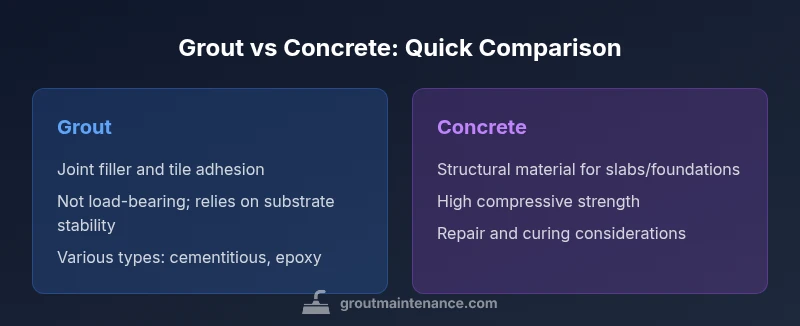
According to Grout Maintenance, the short answer to the question is nuanced: is grout stronger than concrete? Not for structural applications. Concrete is engineered to bear loads and serve as a foundational or slab material, while grout is a cement-based filler designed to lock tiles to substrates and seal joints. The strength of grout depends on the mix (cementitious, epoxy, or polymer-modified), curing conditions, and the substrate's stability. In practical terms, grout's role is to resist shrinkage, edge chipping, and moisture intrusion in joints rather than to carry compressive loads. For many homeowners and DIYers, the key takeaway is that you should judge grout strength by its performance in joints under expected movement and moisture, not by its ability to replace concrete in a structure. This distinction matters when planning bathrooms, kitchens, or exterior tile installations, where joint durability and grout color retention often matter more than any nominal strength rating.
How grout and concrete are used in practice
Grout is a cementitious or epoxy-based filler used to seal joints between tiles and to bond tiles to a substrate in a non-structural role. It helps resist moisture, transfers some shear forces at the surface, and provides a finished appearance. Concrete, by contrast, is a structural material used for foundations, slabs, columns, and beams. It bears significant compressive loads and provides the backbone of most buildings. In most residential settings, grout strength is a concern for long-term joint integrity and aesthetic performance, while concrete strength governs overall structural safety.
Material composition and properties
Concrete is a hydrating cementitious composite composed of cement, water, and aggregates (sand and gravel). It is designed to develop high compressive strength and can be reinforced with steel. Grout, in its common cementitious form, is a flowable cement paste with cement, water, and sometimes aggregates/detergents to improve flow and workability. Epoxy grout, a separate class, cures chemically and can offer excellent chemical resistance and lower water absorption. The performance of grout also depends on whether it is unsanded or sanded, as well as whether it is polymer-modified or epoxy-based. Each type has its own best-use scenario and durability profile.
Strength in context: structural vs non-structural roles
The strongest material on a project is typically concrete or reinforced concrete. Grout’s primary strength is its ability to lock tiles in place and resist moisture and stain when sealed properly. In terms of mechanical strength, grout provides limited resistance to bending and compression compared with concrete. Movement joints and proper substrate preparation remain essential. Understanding this distinction helps prevent misapplications, such as attempting to use grout as a structural substitute in floors or walls subject to heavy loads.
Factors that influence grout strength
- Mix type and ratio: Cementitious grout vs epoxy grout differ in final properties; epoxy often offers superior chemical and stain resistance but may be less forgiving in some substrates.
- Water-cement ratio: Higher ratios can reduce final strength and increase shrinkage.
- Curing conditions: Proper temperature and humidity aid strength development; improper curing can compromise performance.
- Additives and polymers: Polymer modifiers can improve adhesion and flexibility, reducing crack risk.
- Substrate movement: If the substrate shifts, grout is at risk of cracking; movement joints are essential.
Factors that influence concrete strength
- Mix design: The proportion of cement, aggregates, and admixtures defines strength, durability, and workability. Higher cement content generally yields higher compressive strength, while aggregates influence stiffness and crack resistance.
- Compaction and placement: Proper consolidation reduces voids that weaken the concrete.
- Curing: Moisture and temperature control during curing play a decisive role in strength development.
- Reinforcement: Rebar or mesh increases tensile strength and limits crack propagation.
- Environmental exposure: Freeze-thaw cycles and aggressive chemicals can degrade concrete over time, affecting long-term strength.
Common myths about grout strength
- Myth: All grout strengthens the tile installation as much as concrete strengthens a structure. Reality: Grout contributes to joint integrity but does not provide structural strength comparable to concrete.
- Myth: Epoxy grout is always the strongest option. Reality: While epoxy offers excellent chemical resistance and stain performance, installation requires careful handling and substrate compatibility.
- Myth: Sealing grout makes it as strong as concrete. Reality: Sealing improves moisture resistance and stain resistance, not structural strength.
- Myth: Grout can replace concrete in a floor. Reality: For load-bearing applications, use concrete or reinforced concrete.
Practical implications for DIY projects
When planning a DIY tile project, prioritize grout selection based on joint width, exposure, and movement expectations. For bathrooms and kitchens, cementitious grout with proper sealing can perform well, while epoxy grout may be warranted in wet or chemically exposed areas. In outdoor settings, select grout formulations with appropriate moisture and freeze-thaw resistance. Remember that substrate preparation, joint width, and movement tolerances largely determine long-term performance as much as the grout type itself.
How to compare options: grout types
- Cementitious grout (unsanded vs sanded): Most common; good for standard joints; requires sealing to protect against moisture.
- Epoxy grout: Higher chemical and stain resistance; more durable in challenging environments; more challenging to work with and more expensive.
- Polymer-modified cement grout: Improved adhesion and flexibility over basic cementitious mixes; a common middle ground for DIYers.
- Selection tips: Match the grout type to joint width, substrate movement, exposure to moisture, and maintenance preferences.
Assessing failure modes: cracks, shrinkage, efflorescence
Cracks often indicate substrate movement, improper joint spacing, or insufficient curing. Shrinkage can occur if grout dries too quickly or if water content is not properly controlled. Efflorescence indicates soluble salts leaching to the surface, usually from water moving through the grout or substrate. Identifying the root cause—movement, moisture, or improper sealing—helps determine whether resealing, regrouting, or substrate repair is required.
Maintenance tips to preserve grout strength
- Seal grout after curing to reduce moisture ingress and staining potential, especially for cementitious grouts.
- Clean with pH-neutral cleaners to avoid degradation of grout.
- Re-seal periodically, following manufacturer guidelines, to maintain moisture resistance.
- Inspect joints periodically for cracks and address substrate movement promptly.
- Consider epoxy grout in high-moisture environments where chemical resistance is paramount.
When to upgrade: replacing grout vs replacing concrete
Grout can be refreshed or replaced if joints crack or discolor, without removing tiles. If a slab or structural surface exhibits cracks, spalling, or significant deformation, concrete repair or replacement may be necessary, often requiring professional assessment. In most renovations, upgrading the substrate is a larger decision than simply regrouting, and the choice depends on the desired longevity and load-bearing requirements.
Authority sources
- https://www.concrete.org
- https://www.cement.org
- https://www.nist.gov