Difference Between Grout and Cement: A Practical Guide
Explore the difference between grout and cement, covering composition, uses, durability, and maintenance for tile projects. Learn when to choose each, how they perform in moisture-prone areas, and practical tips for homeowners and DIY enthusiasts.


TL;DR: Grout and cement are not interchangeable. Grout is a binding paste used to fill tile joints, often cementitious or epoxy-based, while cement is the binder used in concrete and some mortars. For most indoor tile work, cementitious grout is preferred for joints; cement is used for structural masonry. Choose based on moisture, maintenance, and durability needs.
What is grout and where does it fit in tile work?
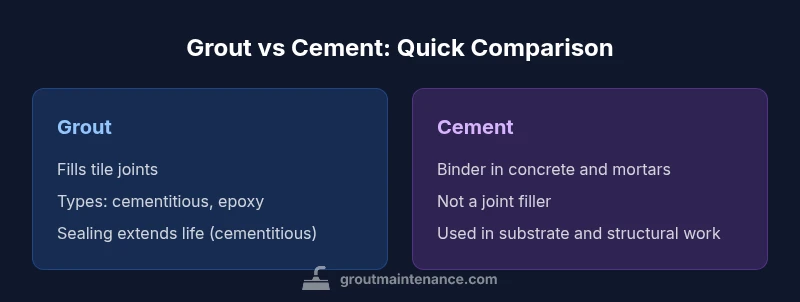
According to Grout Maintenance, the difference between grout and cement is a fundamental distinction that every homeowner should understand before starting a tile project. Grout is a paste used to fill the gaps between tiles, sealing edge joints and providing a finished look. It can be cementitious (made with cement and aggregates) or epoxy-based for improved performance. Cement, by contrast, is the binder used to make concrete, mortar, and other construction materials. It is not designed to fill tile joints in most cases, but is the primary ingredient in many tiling mortars used to affix tiles to a substrate. Understanding these roles helps you pick the right product for each job and avoid common failures like cracking, staining, or water intrusion.
Core components: cementitious vs epoxy grout
In modern tile installations, the two most common grout families are cementitious grout (cement-based) and epoxy grout. Cementitious grout blends cement with sands and additives; it cures through a hydration reaction and typically requires sealing in moisture-prone areas. Epoxy grout consists of epoxy resin mixed with filler, offering superior chemical resistance and almost impermeable joints. Cement itself is not a grout; it's a binding agent used in concrete, mortar, and many tiling substrates. The key takeaway is that grout choices influence joint durability, stain resistance, and maintenance needs, while cement's role is structural rather than purely cosmetic.
Cement in construction vs grout in tiling
Cement is the binding material that forms concrete and mortars, providing structural strength and rigidity. Grout, by contrast, is a specific filler used to seal joints between tiles, allowing for movement and slight substrate irregularities. In most tiling projects, cement is involved as part of mortars or substrate mixes, but it is not used as the tight, flexible filler that grout provides. Recognizing this distinction helps prevent misuse and future repairs stemming from joint cracking or water ingress.
Common grout types and what they mean for performance
There are three broad families homeowners should know: cementitious cement-based grout, cementitious epoxy grout, and pure epoxy grout. Cementitious grout is the most common and easiest to apply, while epoxy grout delivers excellent chemical and stain resistance in kitchens and bathrooms. Cement-based mortars used for tiling substrates are not substitutes for grout in joints. Movement, moisture, and cleaning regimes all interact with these choices, influencing long-term performance.
Moisture exposure: showers, kitchens, and exterior tiles
Moisture dramatically affects grout longevity. Cementitious grout relies on proper sealing and maintenance to resist water penetration; epoxy grout remains highly resistant to water and many chemicals. In damp areas such as showers, benches, or backsplashes, epoxy grout often provides the best durability, though proper preparation and installation are essential. Cement-based mortars used in substrates are not substitutes for grout in joints and should be used within their intended scope.
Color, texture, and finishing options
Grout color choices can dramatically alter the look of a tile installation, from high-contrast outlines to near-colored-matching joints. Cementitious grout accepts a broad palette, while epoxy variants tend to have stable colors and less water staining. Keep in mind that color consistency requires careful mixing and batch matching, especially with large projects. Cement used for mortars cannot replace the visual role of grout in joints.
Maintenance and sealing considerations
Most cementitious grout benefits from sealing after cure to limit staining and moisture absorption. Sealing helps terrazzo or white grout resist discoloration, mold, and mildew in damp spaces. Epoxy grout, by contrast, is dense and typically does not require sealing. However, it can be more challenging to work with and may cost more upfront. The need for sealing depends on the grout type, tile location, and cleaning routine.
Durability and failure modes
Joint durability depends on several factors: substrate preparation, movement joints, grout type, and maintenance. Cementitious grout can crack if movement is high or if the substrate flexes without proper expansion joints. Epoxy grout resists cracking better and is less susceptible to staining, but is sensitive to mixing ratios and cure times. Cement used in mortars remains integral to the structure but has no role in resisting joint movement.
Repair and replacement strategies
If grout joints crack or stain, replacement is often straightforward on cementitious grout; you can remove the damaged joint and reapply new grout. For epoxy grout, replacements are possible but more labor-intensive and usually more expensive. Cement-based mortars used for substrates generally require broader repair of the substrate, not merely replacing the joint material. Planning for expansion joints reduces future repair needs.
Cost and labor implications (non-numeric guidance)
Cost considerations often hinge on material type and installation difficulty. Cementitious grout is typically cheaper and faster to apply, making it attractive for DIY projects. Epoxy grout adds cost due to materials and mixing complexity but offers long-lasting stain resistance. Cement-based mortars for substrates are usually bundled into tiling projects and priced with other components; the key is to budget for labor and sealing where needed.
Environmental and health considerations
Cementitious products release cement dust during mixing; proper PPE is advised. Epoxy systems require careful handling of resins and hardeners. Both require clean workspaces, adequate ventilation, and proper waste disposal. From an environmental perspective, the up-front choice can influence long-term maintenance emissions (e.g., sealing products, replacements) but tile life is generally the primary environmental factor.
Practical decision framework and scenario-based guidance
When choosing between grout types and cement-based products, start by assessing moisture exposure, expected traffic, and maintenance willingness. For bathrooms and kitchens with frequent water exposure, epoxy grout often delivers long-lasting performance at higher upfront cost. For dry areas or budget-conscious projects, cementitious grout with proper sealing offers solid performance. Always follow manufacturer instructions for mixing, curing, and sealing, and plan for expansion joints to accommodate substrate movement. The difference between grout and cement is not just material; it is about functional role in your tile system.
Comparison
| Feature | Grout | Cement |
|---|---|---|
| Primary use | Fills and seals tile joints | Binds concrete/mortar (structural) |
| Common forms | Cementitious or epoxy grout | Portland cement-based mortars and binders |
| Moisture tolerance | Moderate-to-high when sealed; epoxy is highly moisture resistant | Low moisture tolerance unless used in structural binders or modified mortars |
| Maintenance needs | Sealing recommended for cementitious grout in many installations | Maintenance varies; generally not used as a joint filler |
| Repairability | Joins can be replaced/re-sealed | Structural repairs involve replacing cementitious mortar or substrate |
Pros
- Grout provides flexible joints and aesthetic options
- Cement is widely available and durable for structural work
- Epoxy grout offers superior stain resistance in wet areas
- Grout allows easy replacement of damaged joints and color customization
What's Bad
- Cementitious grout is porous if not sealed and stains easily
- Epoxy grout is more expensive and harder to work with
- Using cement where grout is required can lead to joint cracking and moisture issues
Grout is the practical choice for tile joints, while cement binds structural elements; epoxy grout offers the best moisture resistance but comes at higher cost and skill.
For most tiling projects, prioritize grout for joints and cement for structural work. In wet areas, epoxy grout provides the best resistance to stains and moisture, though installation is more complex. Consider maintenance willingness and budget when choosing a solution.
Got Questions?
What is the main difference between grout and cement?
Grout fills the gaps between tiles and seals joints, and it comes in cementitious or epoxy formulations. Cement is the binding agent in concrete and mortar, used for structural work and substrate bonding. They serve different roles, so you should not substitute cement for grout in joints.
Grout fills the gaps between tiles, while cement binds masonry and concrete; they’re not interchangeable.
Can cement be used as grout in tile joints?
No. Cement by itself is too brittle and porous for reliable tile joints. Cementitious grout blends cement with sands and additives to create a flexible, joint-filling material. Substituting cement in joints leads to cracking and moisture problems.
No—cement isn’t meant to fill tile joints; use grout designed for joints.
Is epoxy grout better than cementitious grout?
Epoxy grout offers excellent stain resistance and chemical durability, ideal for wet areas. Cementitious grout is cheaper and easier to apply but requires sealing and more maintenance. The best choice depends on moisture exposure, cleaning needs, and budget.
Epoxy grout resists stains best, but it costs more and is trickier to install.
Do grout joints require sealing?
Most cementitious grout joints benefit from sealing after curing to prevent staining and moisture intrusion. Epoxy grout generally does not require sealing due to its non-porous nature. Follow manufacturer guidelines for best results.
Yes, most cementitious grout should be sealed; epoxy grout usually doesn’t need sealing.
How do I choose grout for a bathroom?
In bathrooms, epoxy grout is often the best choice for high moisture and easier cleaning, though it costs more and can be harder to install. If budget is tight, cementitious grout with a good sealer is workable in less demanding layouts. Always ensure proper installation and venting.
For bathrooms, epoxy grout is a strong option for moisture resistance; otherwise, cementitious with sealant works.
The Essentials
- Grout fills joints; cement binds masonry.
- Epoxy grout resists stains in wet areas.
- Cementitious grout requires sealing for longevity.
- Choose based on moisture and movement.
- Repairing joints is easier with grout than structural cement.