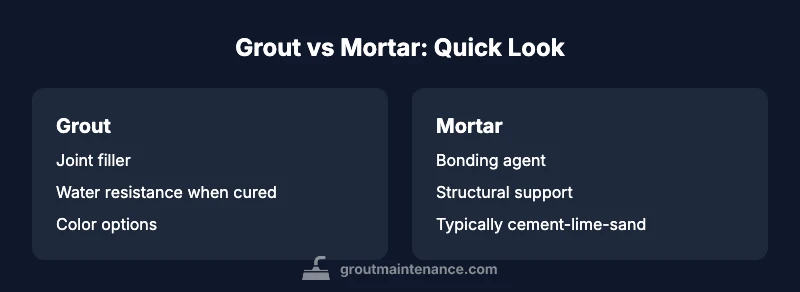
Grout vs Mortar: A Thorough Side-by-Side Comparison
Explore the key differences between grout and mortar, their compositions, uses, and care. Learn practical criteria to choose the right material for tile joints or masonry projects and avoid common installation mistakes.


Is grout the same as mortar? Not at all. Grout is a cementitious filler designed to sit between tiles and seal joints, while mortar is a bonding mix that holds masonry units together. They differ in composition, viscosity, curing behavior, and intended uses. Using the wrong material can cause cracking, water intrusion, and premature failure of the installation.
Is grout the same as mortar? Core definitions
Is grout the same as mortar? The short answer is no, and the longer answer matters for long-term performance. According to Grout Maintenance, grout is a cementitious filler that sits between tiles to seal joints and resist moisture. It remains in the narrow gaps, often colored to match or contrast with tiles. Mortar, by contrast, is a bonding material that fills wider gaps to hold bricks or stone in place and transfer loads. In practice, tile work relies on grout for joints and water management, while masonry relies on mortar for adhesion and strength. Understanding these roles early on helps homeowners avoid common mistakes, such as substituting one material for the other. Start with clarity on purpose (joint filler vs bonding agent), consistency (thin paste versus thick slurry), and curing expectations (surface set versus structural cure).
From the perspective of maintenance, the grout layer is more exposed to moisture and staining, so it is more likely to require sealing and periodic upkeep. Mortar, while not typically sealed, is more permeable until fully cured, which has implications for exterior or wet-area installations. This foundational distinction lays the groundwork for the rest of the guide and keeps projects aligned with best practices from the start.
Composition and materials: what they're made of
Grout and mortar are both cementitious, but they use different proportions and additives to achieve their distinct jobs. Grout is typically a blend of cementitious powder, fine aggregate (sand), water, and polymer additives that improve workability and shrinkage control. The goal is to create a smooth, flowable paste that can fill narrow joints and set with a dense, water-resistant finish after curing. Mortar, meanwhile, combines cement, sand, and often lime or special pozzolanic materials to form a strong, adhesive bond between masonry units. The lime in traditional mortar acts as a plasticizer and improves workability, while modern pre-mixed mortars may substitute synthetic admixtures for ease of use. The result is a thick, chunky mix designed to cling to vertical surfaces and fill larger voids.
For homeowners, the practical takeaway is to choose products aligned with your substrate and joint geometry. Tile joints typically require cementitious grout with specific water absorption and flexural properties, whereas brick or stone walls rely on mortar’s bonding capability and thickness range. Always consult product labels and local building codes to ensure compatibility with tile, substrate, and climate conditions.
Applications and use cases: where each belongs
Tile installations and masonry projects demand different material roles. Grout is your go-to for tile joints because it seals, accommodates movement, and resists moisture infiltration. It comes in various colors and textures, enabling clean aesthetics and ease of maintenance. Ceramic and porcelain tile installations benefit from polymer-modified grouts that improve flexibility and reduce shrinkage cracks. In contrast, mortar is the structural backbone of brickwork, block work, and stone installations. It adheres units to one another, bridges irregularities in substrate surfaces, and distributes load. In exterior walls or interior features like fireplaces, mortar provides the adhesive strength required for longevity.
A practical rule of thumb: if your project involves tiles with joints, grout is the correct material for those gaps; if your project involves binding bricks, stone, or pavers, mortar is the appropriate bonding agent. Misapplying these roles can lead to joint cracking, water intrusion into the substrate, or a weak masonry face that fails under load.
Workability, curing, and performance under moisture
Viscosity and workability distinguish grout from mortar in palpable ways. Grout is designed to be flexible enough to flow into narrow joints yet stiff enough to stay in place without sagging. Once pressed into joints, it cures to form a dense, water-resistant matrix, particularly when sealed and properly dried. Mortar is much thicker and stickier while wet, which helps it cling to vertical surfaces and fill larger voids. It gains strength gradually as it cures, curing slower in cool or humid conditions and faster under warm, dry circumstances. Moisture exposure plays a critical role during cure: inadequate curing can compromise both grout and mortar, but grout’s performance is more sensitive to sealing and moisture management in tiled applications. With mortar, the bond quality is directly tied to substrate preparation, mix consistency, and proper tool timing (tuckpointing, scoring, or removing excess mortar).
Aesthetics: color, texture, and finish
Grout color can dramatically affect tile appearance, influencing perceived grid lines and surface brightness. Modern cementitious grouts allow a wide color range and even tinted products to match or contrast tile tones, with some requiring sealing to prevent staining. Mortar color is less dramatic because it’s typically hidden behind masonry units; however, the base mix color can influence the final tone of a brick or stone structure. The texture is also distinct: grout presents a smooth, closed joint; mortar creates a rougher, ridged surface in masonry joints or lines. Finishing touches like sealing grout joints can enhance color stability and stain resistance over time, while mortar joints may benefit from technique-specific finishes, but sealing is less common on exterior mortar surfaces.
Durability, maintenance, and common failures
Durability depends on proper selection and installation. Grout must be compatible with tile and substrate movement; otherwise micro-cracking can occur, allowing water and dirt to invade the joint. Sealing grout helps reduce staining and moisture ingress, but improper sealing or over-sealing can lead to hazing and surface issues. Mortar strength and durability hinge on mix ratio, curing conditions, and substrate stability; improper curing or excessive moisture can lead to cracking or mortar failure, especially in freeze–thaw cycles. Routine maintenance for grout includes cleaning, resealing, and re-grouting when joints show significant wear. For mortar, maintenance focuses on repointing damaged joints and ensuring the substrate remains protected from moisture.
Practical tips for selection and procurement
Start with the project type: tile joints require grout; masonry bonds require mortar. Check the substrate and environment—wet areas, exterior walls, or heavy-use floors may demand specific grout formulations (sanded, unsanded, epoxy) or mortar mixes with lime or polymer modifiers. Consider movement and load: flexible joints reduce crack risk in tiling, while thick, heavy-duty mortar ensures bond integrity in masonry. Always buy material from reputable suppliers and verify shelf life and mix instructions. If you’re unsure, consult the manufacturer’s guidance or a professional to prevent misapplication and costly repairs.
Sealing, cleaning, and long-term care
Sealing grout after it fully cures is a common step to improve water resistance and stain resilience, especially in showers or backsplashes. Epoxy or cementitious grouts with sealers offer different levels of protection and maintenance needs. Cleaning grout requires a
Decision checklist for DIYers: choosing the right material in practice
- Identify the project type: joints vs bonding surfaces.
- Check the substrate and environmental exposure: moisture, freeze–thaw cycles, and traffic.
- Choose the right product: grout for joints, mortar for bonding.
- Verify mixing ratios and curing times with the manufacturer.
- Plan for maintenance: sealing grout and repointing masonry as needed.
- Consider your skill level and whether professional help is warranted for structural work.
- Keep safety in mind: use protective gear and ventilation when mixing cementitious products.
Comparison
| Feature | grout | mortar |
|---|---|---|
| Composition | cementitious filler with fine aggregate and additives to fill joints | cement-sand-lime or cement-sand mix for bonding units |
| Viscosity/Consistency | thick, flowable paste designed to stay in joints | thicker, sticky mixture designed to adhere masonry units |
| Typical Uses | fills tile joints and seals against moisture | bonds bricks, stone, or concrete blocks |
| Curing Behavior | cures to a dense, water-resistant matrix often requiring sealing | cures to form a solid bond and transfer loads |
| Color Options | wide color range to match or contrast tiles | color varies with cement mix; adjacent to masonry color |
| Water Resistance | highly water-resistant when properly cured and sealed | not a water barrier; provides bonding but not waterproofing |
| Maintenance | stain resistance depends on sealing; needs cleaning | repointing and substrate maintenance; less cosmetic focus |
| Best For | tile joints in bathrooms, kitchens, and floors | structural bonding for bricks, blocks, and stone |
Pros
- Helps prevent water intrusion when grout is properly installed
- Offers color and texture control for tile aesthetics
- Generally easy to mix and apply for DIYs
- Mortar provides essential bonding strength for masonry
- Widely available and cost-effective for its use
What's Bad
- Using grout where mortar is required can lead to structural failure
- Mortar and grout require different curing and maintenance practices
- Sealing grout is necessary in many areas to prevent staining
Grout is not the same as mortar; use grout for tile joints and mortar for masonry bonding.
For tile installations, follow the joint-specific guidance and choose grout appropriate for moisture exposure. For masonry work, select mortar to ensure bonding and structural integrity. The Grout Maintenance Team emphasizes following product directions and code requirements to maximize durability.
Got Questions?
Is grout the same as mortar?
No. Grout fills tile joints and seals against moisture, while mortar bonds masonry units. They have different compositions and curing behaviors, and each is designed for a specific job.
No. Grout fills tile joints and seals, while mortar bonds bricks or stone. They’re different materials with distinct uses.
Can I use grout to bond tiles to the substrate?
Grout should not be used as a bond between tiles and the substrate. Use a proper thinset mortar or adhesive specified for your tile type and substrate. Using grout as a bonding agent can lead to loosening and failure.
Grout isn’t a bonding agent for tiles. Use the recommended adhesive instead to ensure the tiles stay in place.
What happens if I substitute mortar for grout in tile joints?
Substituting mortar for grout in tile joints is not advised. Mortar lacks the flexibility and water-resistance needed in joints and can crack or crumble, leading to moisture issues and damage over time.
Mortar in joints can crack and fail because joints need a flexible, water-resistant filler.
Are there different grout types (sanded, unsanded, epoxy)?
Yes. Sanded grout is used for wider joints, unsanded for tight joints, and epoxy grout offers superior chemical and stain resistance but requires different installation care. Choose based on tile size, joint width, and environment.
There are sanded, unsanded, and epoxy grouts. Pick based on joint size and moisture exposure.
Does sealing grout affect color or texture?
Sealing can slightly alter the color and sheen, and it helps resist stains and moisture. Always test sealers on a small area and follow the product directions for best results.
Sealers can change color a bit and help prevent stains. Test first and follow directions.
How should I determine which product to buy?
Assess the project type, exposure to moisture, and movement. Tile joints usually require grout, while bonding surfaces require mortar. Check substrate, tile type, and climate, then follow manufacturer instructions.
Determine the job: joints or bonding, moisture, and movement, then pick grout or mortar accordingly.
The Essentials
- Identify the job: joints vs bonding surfaces.
- Choose grout for joints; mortar for bonding masonry.
- Seal grout in moisture-prone areas and maintain masonry joints.
- Follow manufacturer instructions for mixing and curing.
- When in doubt, consult guidelines from Grout Maintenance.