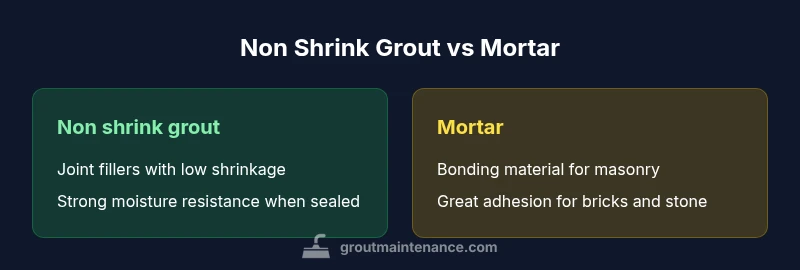
Non Shrink Grout vs Mortar: A Practical Guide
A thorough, evidence-based comparison of non shrink grout and mortar for tile joints, covering composition, performance, installation tips, sealing, and maintenance to help homeowners choose wisely.


TL;DR: In most tile installations, non shrink grout outperforms traditional mortar in joints because it resists movement and water exposure, and maintains tighter joints over time. Mortar is best for masonry work, brick, or stone backing where bonding strength matters more than a tight joint. This is the core of the non shrink grout vs mortar decision.
What are non shrink grout vs mortar, and why do builders compare them? In the world of tile installations, the phrase non shrink grout vs mortar comes up repeatedly because these materials serve different purposes. Non shrink grout is designed to fill joints between tiles and resist shrinkage during curing, helping prevent cracking and joint loss. Mortar, by contrast, is a cementitious bonding material used to set bricks, stones, and other masonry units or to anchor larger tile backings. According to Grout Maintenance, understanding these roles is essential for predicting how each material will perform in a given project. When homeowners explore the non shrink grout vs mortar comparison, the goal is to choose the product that maximizes joint integrity and substrate compatibility while minimizing maintenance in the long run.
Core differences at a glance
- Function: Non shrink grout fills joints; mortar bonds masonry units or tile backing.
- Movement tolerance: Grout accommodates little movement; mortar tolerates a masonry substrate but not the same joint complexities.
- Water exposure: Grout types designed for joints, especially when sealed; mortar is less water resistant in typical tile applications.
- Workability: Pre-mixed and epoxy grout options are common for joints; mortar typically comes as a powder mix that requires water and blending.
- Longevity: Properly installed non shrink grout can resist cracking in wet rooms; mortar excels at structural bonding in walls and exterior masonry.
These distinctions drive the non shrink grout vs mortar decision in most residential projects, where joints and substrates do not behave like masonry walls. The Grout Maintenance team emphasizes that the right choice depends on whether you need a joint filler or a bonding agent, and on the environment and movement your substrate will experience.
Use cases for non shrink grout in modern homes
Non shrink grout shines in wet or high-traffic areas where tile joints are expected to endure daily moisture and cleaning, such as showers, backsplashes, and bathroom floors. It resists shrinkage, which helps keep joints tight over time, reducing the risk of water intrusion and tile edge exposure. For installations with porcelain or ceramic tiles, non shrink grout vs mortar is a common comparison because homeowners want a durable, easily cleaned joint that won't crack easily during substrate movement. The non shrink grout vs mortar decision becomes clear when moisture, movement, and joint maintenance are primary concerns; a quality grout specifically formulated for joints frequently outperforms masonry mortars in these environments.
Use cases for traditional mortar in masonry tasks
Mortar remains the go-to material for masonry work and tile backings that require high bonding strength to hold bricks, stone veneers, or larger substrate assemblies. In a non tile joint context, mortar provides the bed and adhesion necessary for constructing walls or decorative facades where structural integrity takes precedence over joint aesthetics. While non shrink grout vs mortar is discussed primarily in tile settings, homeowners tackling brick or stone cladding may rely on mortar for long-term stability and load distribution. For exterior applications where weather exposure and substrate movement are factors, mortar’s bonding capacity can be advantageous when properly mixed and cured.
Mixing, consistency, and workability in practice
Non shrink grout often comes as a ready-to-use pre-mixed product or a cement-based powder that requires water and a precise mix ratio. Epoxy variants are also available for enhanced chemical resistance and easier cleaning. Mortar, on the other hand, is typically a bagged cement-lime-sand mix that must be blended with water to achieve the desired consistency. The non shrink grout vs mortar decision becomes practical here: grout products are designed for joints and rapid curing, while mortar mixes are designed for bonding masonry units and may require longer curing times in some climates. For tile projects, choose grout that matches your tile size, joint width, and moisture exposure. Grout density and design should align with the task at hand, especially in the non shrink grout vs mortar comparison.
Curing, movement tolerance, and substrate compatibility
Curing behavior differs significantly. Non shrink grout cures with minimal shrinkage, helping keep joints intact and preventing cracking when the substrate moves slightly or settles. Mortar’s curing is tied to the substrate’s moisture content and ambient conditions; improper curing can lead to hairline cracks or weaker bonds in masonry work. In moisture-prone areas, proper sealing after applying non shrink grout improves longevity. The non shrink grout vs mortar decision is highly influenced by expected substrate movement: tile joints prefer grout formulations designed to accommodate slight movement, whereas masonry walls tolerate movement within the constraints of the bond between units.
Waterproofing, sealing, and maintenance implications
Sealing plays a critical role in both approaches, but the needs differ. Non shrink grout must be sealed where recommended to prevent staining and water penetration, especially in high-moisture spaces. Mortar typically requires sealing and sometimes additional waterproofing considerations if used in exterior or damp interior applications. As homeowners weigh the non shrink grout vs mortar choice, they should consider how much maintenance they’re willing to perform; a sealed grout joint can be easier to clean than a porous mortar bed. The Grout Maintenance guidance often highlights sealing as a key step in maximizing the life of grout joints in wet areas.
Durability, cleaning, and long-term performance
Durability in tile installations depends on joint geometry, substrate rigidity, and material properties. Non shrink grout, when correctly mixed, cured, and sealed, resists cracking and keeps joints tight under normal expansion and contraction. Mortar provides excellent bonding for masonry structures but is not optimized for tile joints and can lead to cracking if used in joints without proper compatibility. Cleaning considerations also differ: grout joints are easier to wipe and maintain when using the right sealer, whereas mortar surfaces in masonry projects are cleaned and maintained with different tools and methods. The non shrink grout vs mortar decision thus hinges on whether your top priority is joint integrity in a tile installation or structural bonding in a masonry system.
Cost, availability, and installation time considerations
Prices and availability for non shrink grout vs mortar vary by region and product type. In general, grout products may be modest to premium in cost, depending on whether you choose traditional cementitious grout, pre-mixed products, or epoxy variants. Mortar costs are typically influenced by cement content, sand quality, and lime, with variations across masonry materials. Installation time can differ: grout products often cure more quickly in joints, enabling faster grouting timelines, while mortar-based masonry work may require longer setting times and additional curing. When budgeting, homeowners should account for labor and sealant needs alongside material costs.
Step-by-step decision guide for your project
- Define the job: Is this a tile installation or a masonry project? 2) Assess moisture exposure and movement potential. 3) Choose a material tailored for joints (non shrink grout) or for bonding (mortar). 4) Consider sealing strategies and maintenance plans. 5) Check substrate compatibility and manufacturer recommendations. 6) Plan for curing times and cleanup. The non shrink grout vs mortar decision becomes a practical workflow, not a theoretical choice.
Common mistakes and how to avoid them
Rushing the mix, using the wrong product for joints or backing, and skipping sealing are common missteps in the non shrink grout vs mortar decision. Always follow manufacturer guidelines for cure times, service conditions, and humidity. Inadequate substrate preparation, poor joint dimensions, or mismatched grout viscosity can lead to cracking and staining. To minimize risks, perform a small test patch before full installation and consult product datasheets for grout type compatibility with tile species and backing materials. The non shrink grout vs mortar choice should be guided by the specific project requirements and environmental conditions.
Quick decision framework: pick the right path for your project
If your priority is tight joints, moisture resistance, and long-term appearance in tiled surfaces, non shrink grout is typically preferred. If your goal is structural bonding for masonry units and you’re working on walls, veneers, or exterior masonry, mortar provides essential adhesive strength. The non shrink grout vs mortar decision should hinge on whether you need a joint filler or a bonding bed, the substrate, and the environment. Grout Maintenance’s practical guidance emphasizes aligning material properties with project goals for durability and ease of maintenance.
Comparison
| Feature | Non shrink grout | Mortar |
|---|---|---|
| Shrinkage behavior | Minimal shrinkage when cured | Higher shrinkage potential, depending on mix and cure |
| Strength after curing | High in joints when properly applied | Strong bonding for masonry, but not a drop-in replacement for tile joints |
| Water resistance | Excellent when sealed and used as a grout joint | Lower water resistance as a bonding material in joints |
| Ease of application | Often pre-mixed or epoxy variants; user-friendly for joints | Typically powder-based; requires careful mixing and tool handling |
| Flexibility/movement tolerance | Rigid joints; designed to handle minor substrate movement | Bonding material tolerates some movement of masonry but not tile joint movement |
| Best uses | Wet areas, backsplash, large-format tile joints | Masonry walls, brick veneers, exterior stone work |
| Cost and availability | Mid to premium, depending on type (cementitious vs epoxy) | Generally lower material cost but potentially higher labor hours |
Pros
- Helps create durable, water-resistant tile joints
- Offers predictable curing performance for joints
- A wide range of products (pre-mixed, cementitious, epoxy)
- Easier to seal and maintain in wet areas
- Provides consistent color and shrinkage control across joints
What's Bad
- Can be confusing to choose the right grout type for each tile job
- Some grout products require sealing and maintenance
- Mortar-based installations require more curing time in masonry contexts
- Maintenance can be higher if joints are exposed to harsh chemicals or abrasion
Non shrink grout generally wins for tile joints in moist environments; mortar remains essential for masonry bonding.
For tile installations, non shrink grout offers tighter joints and better water resistance when sealed properly. Mortar remains the go-to for structural masonry and bonding of bricks or stone, but it is not a direct substitute for tiled joints. The Grout Maintenance team recommends choosing based on whether your project needs joint filling or substrate bonding, then selecting the material that best matches substrate, movement, and moisture exposure.
Got Questions?
What is non shrink grout and how does it differ from mortar?
Non shrink grout is a cementitious or epoxy-based joint filler designed to minimize volume change during curing, preventing joint cracks. Mortar is a bonding material used for masonry units, not a joint filler for tiles. The non shrink grout vs mortar distinction comes from their primary function: fill joints versus bond masonry.
Non shrink grout fills joints and minimizes shrinkage; mortar bonds masonry units. For tile joints, grout is usually the better choice.
Can I use mortar in tile joints instead of grout?
Mortar is generally not recommended for tile joints because it is not designed to handle the constant moisture and movement typical of joints. It may crack and allow water intrusion. If you’re working with tiles on a backing that needs strong bonding, consult the manufacturer’s guidelines for exceptions.
Mortar isn’t meant for tile joints; grout is the better choice for joints, especially in wet areas.
Do I need to seal non shrink grout?
Sealing non shrink grout improves stain resistance and water repellency, especially in high-moisture areas. Some grout formulations are sealant-friendly, while others are already epoxy-based and don’t require sealing. Always follow the product’s sealing recommendations.
Sealing helps grout stay cleaner longer in damp spaces.
Is epoxy grout considered non shrink grout?
Epoxy grout is a type of non shrink grout with a resin matrix, offering superior stain resistance and durability but at a higher cost and more challenging installation. It behaves differently from cementitious grout in curing and flexibility.
Epoxy grout is a tough, non shrink option used in demanding areas.
How long does non shrink grout take to cure?
Cure times vary by product and climate, but many cementitious grouts set within 24 hours and cure fully over a few days with proper moisture control. Epoxy grout cures faster and is less affected by humidity but still follows manufacturer guidelines.
Curing times depend on product type and environment; follow the label.
Which is better for showers: non shrink grout vs mortar?
For showers and other wet areas, non shrink grout is typically the better choice because it’s designed to fill joints and withstand moisture when sealed. Mortar is less suitable for joints and can crack with movement or moisture exposure.
For showers, go with non shrink grout for joints.
Can I upgrade existing mortar-filled joints to grout later?
Yes, you can replace mortar-filled joints with grout, but the process involves removing old material, preparing the bed, and ensuring substrate stability. This is a renovation task and may require professional guidance to avoid damage.
You can replace old joints, but plan for removal and prep.
The Essentials
- Choose non shrink grout for tile joints in wet areas
- Use mortar for masonry bonding, not as a tile joint filler
- Seal grout joints to maximize longevity in moist environments
- Follow manufacturer guidelines for curing and maintenance
- Plan for substrate movement and movement allowances in the design