Non shrink grout vs hydraulic cement: A Practical Comparison for Tile Installations
Compare non shrink grout and hydraulic cement for tile joints. Learn setting times, durability, sealing needs, and best-use scenarios to choose the right grout material for your project.


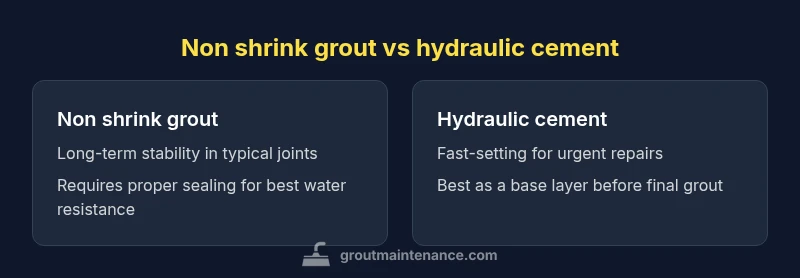
Non shrink grout vs hydraulic cement: a practical comparison. Non shrink grout generally offers better long-term crack resistance and joint stability for standard tile installations, while hydraulic cement provides rapid set capabilities for quick repairs. For most projects, non shrink grout is the safer choice, with hydraulic cement reserved for urgent fixes. See our full guide for details.
What the terms mean and why they matter
In tile installations, understanding the difference between non shrink grout vs hydraulic cement is essential for long-term performance. Non shrink grout refers to cementitious grout formulations that include shrinkage-compensation agents or polymers that minimize volume loss as the grout cures. Hydraulic cement, by contrast, hydrates with water and gains strength quickly, making it useful for rapid repairs. According to Grout Maintenance, choosing the right grout type hinges on substrate movement, joint width, and expected use. When these factors are misjudged, you risk cracking, water intrusion, or failed joints. This article uses a practical, evidence-based approach to compare the two materials, highlight their best-use cases, and provide decision guidance for homeowners and DIYers. The overarching principle is to match material performance to substrate movement and moisture exposure. The keyword non shrink grout vs hydraulic cement appears frequently in professional discussions, helping readers avoid common install errors and costly callbacks.
How non shrink grout works
Non shrink grout is a cementitious mixture designed to minimize shrinkage during curing. It often includes polymers, plasticizers, and shrinkage-compensation agents that allow the material to stay dimensionally stable in the field. The result is a grout that resists small movements in the substrate and maintains joint integrity over time. In typical installations, non shrink grout is applied into joints with moderate width, troweled to a defined profile, and cured under appropriate moisture and temperature conditions. Sealing after cure improves stain resistance and makes cleaning easier. The key advantage is long-term durability in environments where movement and moisture are expected, such as bathrooms and kitchens. Because it incorporates additives, the mix can be more forgiving when fault lines exist or when joints have irregularities. However, proper mixing, moisture control, and curing are still required to realize its full performance. When you compare this to hydraulic cement, the differences in setting behavior and flexibility become clear.
How hydraulic cement works
Hydraulic cement is a fast-setting material that hydrates quickly upon contact with moisture, gaining early strength. It is typically used for urgent repairs, gap filling, or stabilizing substrates before final grout is installed. Hydraulic cement forms a dense, hard matrix that resists water intrusion in the short term, but it can be less forgiving to substrate movement once fully cured. It is particularly useful for pinhole cracks, voids, or sudden settlement areas where rapid stabilization is needed. Because it sets quickly, work must be precise to avoid overfilling or misalignment. In directed use, hydraulic cement is often followed by a final grout or sealant to accommodate longer-term movement and humidity exposure. The essential takeaway is to recognize that hydraulic cement excels at speed and mechanical stabilization, while non shrink grout offers ongoing resilience in joint performance.
When to choose non shrink grout vs hydraulic cement in practice
The choice between non shrink grout vs hydraulic cement depends on movement, schedule, and exposure. For most residential tile installations with standard joints, non shrink grout provides durable long-term performance and is easier to finish with a sealed glaze. If a project demands a rapid fix—such as a leaking joint or a shallow void in a high-traffic area—hydraulic cement can deliver quick stabilization. In showers or outdoor areas with significant substrate movement or moisture fluctuations, combining a hydraulic cement repair with subsequent non shrink grout often yields the best balance of speed and durability. The decision framework hinges on anticipated movement magnitude, required cure timeline, and whether a final grout layer will be applied. In short, use non shrink grout for typical joints and hydraulic cement for urgent, rapid stabilization where final grout will follow after curing.
Setting times, curing, and early strength
Setting time describes how long before the material becomes usable; curing describes how long it takes to reach full strength. Non shrink grout typically requires a curing window aligned with the grout manufacturer’s recommendations, including maintaining moisture and avoiding premature drying. Hydraulic cement is known for rapid initial set, which reduces downtime for repairs but may demand more careful timing to integrate with subsequent grout work. In both cases, temperature, humidity, and substrate condition influence strength gain and final performance. Early strength is beneficial in high-use areas, but long-term durability comes from proper sealing, full cure, and consistent maintenance. The overall guidance: plan repairs to allow gradual strengthening and eventual sealing so that joints maintain integrity under traffic and moisture.
Durability, cracking, and maintenance considerations
Durability is a function of material properties and installation quality. Non shrink grout offers better tolerance to minor substrate movement and tends to resist cracking when joints are properly filled and sealed. Hydraulic cement provides initial stabilization but can be less forgiving if joints continue to move or if moisture breaches occur. Maintenance involves cleaning, resealing grout, and inspecting for cracks or gaps. Sealing treated grout improves water repellency and stain resistance; hydraulic cement typically serves as a base layer, followed by final grout. The long-term performance of either option improves with proper substrate prep, consistent joint widths, and mindful cleaning practices. For showers and moisture-prone areas, ongoing maintenance is essential to prevent mold and efflorescence.
Application steps and best practices
For non shrink grout: prep joints, clean dust, ensure dry substrate, mix per manufacturer, apply into joints with a grout float, remove excess, cure as recommended, seal as needed. For hydraulic cement: prepare and apply quickly to cracks or voids, smooth quickly, allow initial set, then follow with final grout if needed. Key best practices include mixing as directed, using clean tools, controlling humidity during cure, and protecting cured joints from foot traffic until fully set. Always wear protective gear and follow safety guidelines. The goal is to achieve uniform joint profiles and secure substrate integration.
Common issues and troubleshooting
Common issues include cracking due to substrate movement, efflorescence due to moisture carrying salts, and insufficient curing leading to reduced strength. Non shrink grout problems often relate to inadequate sealing or moisture exposure. Hydraulic cement issues stem from premature finishing or failing to follow the recommended cure window, which can cause surface dusting or crumbling. Troubleshooting steps include diagnosing movement sources, reapplying grout or repair material as needed, and applying a suitable sealant after full cure. For showers, inconsistent moisture loads require regular inspection and resealing. In many cases, addressing movement first resolves subsequent problems.
Cost, availability, and lifecycle considerations
Material costs vary by brand and region, but consider that non shrink grout generally sits in a mid-range price band and may require sealant materials for long-term performance. Hydraulic cement often costs less per repair but adds the cost of a follow-up grout layer. Availability is typically broad for both types through hardware stores and online retailers. Lifecycle considerations include maintenance intervals, resealing schedules, and potential replacement of grout in high-motion areas. A thoughtful cost/benefit analysis should include not only the material price but also labor, curing demands, and the cost of failure remediation.
Quick decision framework for homeowners
- Assess substrate movement: low/mid/high; choose accordingly.
- Plan cure time: if you need immediate use after repair, hydraulic cement; otherwise non shrink grout.
- Consider moisture exposure: bathrooms and showers may benefit from sealing and proper grout.
- Final grout layer: in most installations, apply non shrink grout plus a sealant; hydraulic cement as a repair base only if subsequent grout is planned.
- Safety and warranty: follow manufacturer guidelines and check warranties.
Environmental and health considerations
Both non shrink grout and hydraulic cement belong to cementitious systems that produce dust and require proper PPE. Ventilation, mask, gloves, and eye protection are recommended when mixing. Dispose of waste according to local regulations. Recycling and minimizing waste by precise batching helps reduce environmental impact. Always follow product-specific safety data sheets and local codes.
Case studies and real-world guidance
In a typical kitchen backsplash installation, homeowners found non shrink grout provided long-term stability with sealing, reducing maintenance needs. In a rental bathroom, rapid hydraulic cement repair allowed the space to regain use quickly, followed by a non shrink grout finish after cure. Across multiple projects, the best practice is to match material selection to movement, moisture, and schedule realities.
Comparison
| Feature | Non shrink grout | Hydraulic cement |
|---|---|---|
| Setting time | Slower curing with longer working time | Rapid initial set for quick stabilization |
| Best use case | Standard joints with movement and sealing needs | Urgent repairs or gaps where fast stabilization is required |
| Crack control | Typically superior crack-bridging in moving or static joints | Good stabilization but less tolerant to ongoing movement |
| Joint width compatibility | Widely used for typical joint widths in floors/walls | Suitable for small to medium gaps needing a quick fix |
| Water exposure and durability | Sealing improves long-term water resistance; durable when cured | Resists moisture in the short term but requires finishing with grout |
| Workability and mixing | More forgiving and easier to work with when finished properly | Stiffer mix that requires quick, precise placement |
| Cost considerations | Moderate cost; sealing materials may add to total price | Lower material cost per repair but potential follow-up costs |
Pros
- Non shrink grout offers better long-term stability and crack-bridging in typical joints
- Hydraulic cement sets quickly, reducing downtime on repairs
- Both materials can be effective when matched to joint movement and substrate prep
- Proper sealing and curing extend the life of either option
What's Bad
- Hydraulic cement can be less forgiving with ongoing substrate movement
- Non shrink grout requires proper sealing and longer cure times
- Choosing the wrong material can lead to premature cracking or water issues
Non shrink grout is generally the safer baseline choice for standard tile joints; hydraulic cement is ideal for urgent, rapid stabilization.
For routine installations, prioritize non shrink grout to maximize long-term durability. Reserve hydraulic cement for quick repairs where immediate stabilization is needed, followed by final grout when appropriate.
Got Questions?
When should I choose non shrink grout instead of hydraulic cement?
Choose non shrink grout for standard tile joints where long-term crack resistance and sealing matter most. It provides better durability under normal movement. Reserve hydraulic cement for situations requiring a fast set, such as urgent repairs, then follow with final grout when possible.
For most home projects, go with non shrink grout. Use hydraulic cement only when you need a quick fix and plan to finish with grout afterward.
Can I mix these materials in the same project?
Mixing these materials within the same project is uncommon and generally not recommended. Use hydraulic cement only where rapid stabilization is needed, then complete the installation with non shrink grout for long-term durability.
It's best to keep them in separate roles and steps, so the project follows a clear repair-to-finish sequence.
Are there color or sealing differences between the two?
Color outcomes depend on the final grout selected and the sealing regimen. Non shrink grout typically accepts standard sealants for color retention and stain resistance. Hydraulic cement is usually a repair base; follow with a final grout layer and sealant to achieve uniform color and durability.
Both can look great when sealed properly, but plan the sequence so the final color is uniform.
What are signs of failure for each material?
Non shrink grout failures commonly show cracking or staining from moisture intrusion. Hydraulic cement failures appear as surface cracking or crumbling if substrate movement continues after the repair. In both cases, diagnosing movement sources and ensuring proper cure and sealing helps prevent repeat issues.
Cracks and moisture leaks signal potential failure; address movement and seal properly.
Is hydraulic cement suitable for showers?
Hydraulic cement can be used for quick repairs in showers, but it should be followed by a proper grout finish after curing to ensure long-term water resistance. Do not rely on hydraulic cement as the final finishing system in a shower.
Yes for fast fixes, but finish with grout to keep water out long-term.
The Essentials
- Assess movement and moisture before choosing grout type
- Prefer non shrink grout for typical installations and long-term durability
- Use hydraulic cement for rapid stabilization in urgent repair scenarios
- Seal grout after curing to maximize lifespan and stain resistance
- Always follow manufacturer guidelines for mixing, curing, and sealing