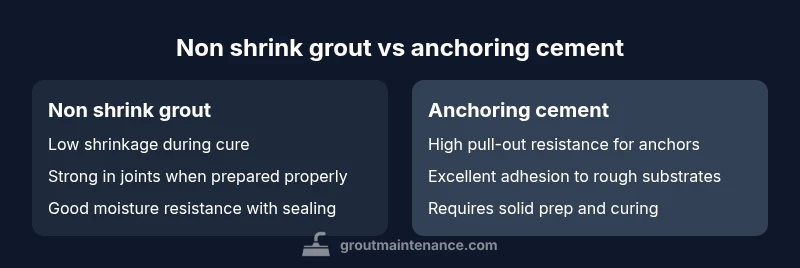
Non shrink grout vs anchoring cement: A practical comparison
A data-driven comparison of non shrink grout and anchoring cement, covering shrinkage, strength, adhesion, moisture resistance, curing behavior, and ideal tile-installation use cases.


Non shrink grout and anchoring cement serve distinct roles in tiling and construction. Non shrink grout is designed to fill joints while minimizing shrinkage under load, helping maintain joint width over time. Anchoring cement, by contrast, is formulated to create strong, durable bonds for fixtures and anchors. In this comparison, we evaluate shrinkage, strength, adhesion, moisture resistance, cure behavior, and best-use scenarios to guide choices.
What are non shrink grout and anchoring cement?
According to Grout Maintenance, non shrink grout and anchoring cement serve distinct roles in tiling and construction, but they are designed for very different tasks. Non shrink grout is a cementitious filler formulated to maintain volume as it cures, reducing voids and preventing joints from narrowing under load. It is commonly used to fill horizontal joints between tiles and to bridge minor substrate irregularities, providing a stable bed for tile surfaces. Anchoring cement, on the other hand, is engineered to form secure bonds between structural elements, metal anchors, and other fasteners. It often includes performance modifiers that improve adhesion to rough substrates and improve pull-out resistance.
From the perspective of a homeowner planning a bathroom remodel, the distinction can influence decisions about substrate preparation, sealing requirements, and maintenance. Grout Maintenance emphasizes that the correct choice depends on whether the goal is a stable tile joint without crack-inducing shrinkage or a reliable anchor for fixtures that bear weight. The two products are not interchangeable in most applications, and the best results come from selecting the right material for each job.
Key properties to compare
When weighing non shrink grout vs anchoring cement, several properties matter across both products, including how they handle movement, load, moisture, and substrate compatibility. The core criteria include shrinkage behavior, bond strength, moisture resistance, curing dynamics, and substrate versatility. Additionally, ease of use and compatibility with common tile types (porcelain, ceramic, glass) influence real-world outcomes. In practical terms, you want a material that fills joints evenly, adheres to the substrate without cracking, resists water intrusion, and remains stable as it cures. Grout Maintenance notes that while both products can deliver strong performance under the right conditions, the application context largely determines which material performs best in a given situation.
Shrinkage and dimensional stability
Shrinkage during curing is a critical factor for grout joints and structural pours. Non shrink grout is formulated to minimize volume loss as it hardens, helping keep tile joints defined and preventing crack propagation due to shrinkage gaps. By contrast, anchoring cement relies more on achieve a consistent, dense matrix that resists shrinkage-related gaps when pulled or pressed by fasteners. Real-world performance depends on ambient moisture, mixing ratios, curing conditions, and substrate flatness. For best results, ensure the substrate is clean, damp-proofed where needed, and the joints are properly prepared before applying either product. Grout Maintenance emphasizes that optimizing curing conditions reduces warping and keeps joints aligned, particularly in wet areas like showers or kitchens where movement is routine.
Bond strength and adhesion
Adhesion to tile backs and substrate surfaces is essential for long-term performance. Non shrink grout relies on a cementitious matrix that bonds to tile edges and the bedding layer, creating a steady, crack-resistant joint. Anchoring cement achieves higher pull-out resistance and adhesion to rough substrates, metal anchors, and masonry. The difference matters most when fixtures like towel bars, grab bars, or handrails are anchored into walls or floors. Both materials require proper surface preparation, including removing dust, priming if indicated, and ensuring the substrate is sound. The Grout Maintenance team notes that bond quality improves with compatible primers and approved setting materials, especially on epoxy surfaces or high-gloss tiles.
Moisture resistance and sealing considerations
Moisture is a primary adversary in wet environments. Non shrink grout benefits from proper sealing and periodic re-sealing where required by the product line, reducing water penetration into the grout joints. Anchoring cement is typically formulated for higher moisture exposure in anchor zones, but it still benefits from moisture barriers and proper sealing around penetrations. In both cases, selecting formulations rated for moisture resistance improves tile longevity. Grout Maintenance cautions that neglecting sealing or using non-moisture-rated products in showers can lead to efflorescence, mildew, and premature joint wear, particularly in areas with fast temperature changes.
Curing behavior and workability
Workability and curing behavior influence installation quality. Non shrink grout often remains workable for a defined period, allowing you to shape joints and ensure consistent width. Anchoring cement may require longer curing to reach full strength, and in some formulations, temperature and humidity affect cure rate. It is important to follow manufacturer recommendations for mixing ratios, water content, and pot life. Poor mixing or insufficient curing can compromise both products, leading to shrinkage cracking in joints or reduced anchorage strength around fasteners. Grout Maintenance advises aligning your technique with substrate and ambient conditions for reliable outcomes.
Substrate compatibility and tile types
Tile substrate compatibility varies by product. Non shrink grout typically adheres well to standard cement slabs, backer boards, and cementitious substrates used in both floors and walls. It may be less forgiving on highly porous substrates without a primer or bonding agent. Anchoring cement is designed to bond to rough, irregular, or mineral-rich surfaces, including concrete, masonry, and metal anchors embedded in substrate. It can work in both interior and exterior settings when properly sealed and protected from freeze-thaw cycles. When selecting either product, verify compatibility with tile types such as porcelain, ceramic, natural stone, or glass to prevent staining, etching, or grout haze. The Grout Maintenance team highlights that an appropriate primer can improve adhesion on tricky substrates.
Application contexts: joints vs anchoring
In most tile installations, non shrink grout is the go-to choice for joints because it fills gaps and maintains joint integrity without excessive dimensional change. Anchoring cement is reserved for anchoring hardware, fixtures, or structural supports that require a robust bond to the substrate. In bathrooms and kitchens, a common approach is to use non shrink grout for tile joints and dedicated anchoring cement for mounting points that bear weight or are subject to dynamic loads (such as grab bars or shelves). Always plan ahead for expansion joints and movement corridors, especially in exterior applications. The key is to match the product to the expected load, movement, and moisture exposure, ensuring a long-lasting installation. Grout Maintenance resources emphasize testing a small area first when uncertain.
Mixing, installation, and finishing tips
Follow manufacturer instructions for mixing ratios, water content, and mixing duration. Use clean tools to prevent contamination, and avoid over-watering to preserve workability and reduce shrinkage risk. Apply non shrink grout with a consistent thickness and fill joints fully to prevent hollow spots. For anchoring cement, ensure anchors are placed at the correct depth and that the substrate is solid before pouring or applying the cement. Finishing touches—like curing blankets or sealers for moisture-prone areas—help lock in performance. In both cases, avoid foot traffic on the new work until the material has achieved adequate early strength. Grout Maintenance suggests performing a mock-up test on a small area to validate color match and performance before scaling up.
Common mistakes and how to avoid them
Rushing the installation or neglecting substrate preparation are frequent errors when using non shrink grout or anchoring cement. Do not mix with improper water ratios, as this can lead to shrinkage-induced gaps or poor setting. Avoid mixing products for incompatible substrates or attempting to bond to glossy or non-porous surfaces without primers. Do not prematurely expose wet joints to movement or heavy loads; failures often appear as cracking or loosening around fixtures. Finally, ignore warnings about sealing or moisture resistance; unsealed joints in wet environments can degrade faster than expected. Grout Maintenance emphasizes that a methodical approach—checking substrate flatness, following cure times, and using compatible sealers—reduces the risk of failure.
Maintenance, longevity, and inspection
Regular maintenance extends the life of grout joints and anchors. Inspect joints for hairline cracks, staining, or efflorescence, and re-seal joints and penetrations as recommended for the product in use. Address any looseness around anchors promptly, since movement can worsen over time if left unchecked. Both non shrink grout and anchoring cement benefit from consistent cleaning and moisture management. It is important to keep joints filled and anchors secure, while monitoring for signs of substrate movement or water intrusion. Proactive maintenance reduces costly repairs and helps preserve tile installations for years to come.
Environmental considerations and sustainability
Choosing formulations with lower environmental impact can improve the overall sustainability of a tile project. Look for products with reduced volatile organic compounds (VOCs) and lower embodied energy in their production. Consider longevity and maintenance requirements; longer-lasting joints and secure anchors reduce the need for frequent replacement. Proper disposal and recycling of packaging materials also contribute to a greener installation. Grout Maintenance recommends selecting products from reputable manufacturers who publish environmental data and offer responsible product stewardship programs.
Comparison
| Feature | Non shrink grout | Anchoring cement |
|---|---|---|
| Shrinkage tendency | Low shrinkage when mixed and cured correctly | Moderate shrinkage risk if mixed improperly |
| Bond/adhesion strength | Strong in joints with proper substrate prep | Excellent for anchors on rough substrates |
| Moisture resistance | Good with sealing; varies by product line | High resistance when properly sealed and protected |
| Workability / pot life | Predictable workability under standard conditions | Longer setting window in cool/humid environments |
| Best use case | Tile joints and movement mitigation | Anchoring fixtures and structural connections |
| Required prep | Clean, damp-proofed substrate; priming as needed | Clean, sound substrate; anchor locations prepped |
Pros
- Low shrinkage helps maintain joint width and reduces cracks
- Strong anchorage for fixtures when used appropriately
- Sealing and moisture resistance can be enhanced with proper products
- Predictable performance with correct substrate preparation
- Versatile across interior and exterior settings with proper formulation
What's Bad
- Wrong choice can lead to bond failure or joint cracking
- Anchoring cement requires proper cure time and surface prep
- Sealing requirements add maintenance steps
- Higher skill level needed for correct mixing and placement in some cases
Non shrink grout is preferred for joints subject to movement, while anchoring cement is best for securing fixtures and anchors.
For most tile joints, use non shrink grout to maintain joint width during movement and moisture exposure. Reserve anchoring cement for mounting points and structural connections, especially where pull-out resistance matters. The Grout Maintenance Team recommends evaluating project specifics—load, movement, and substrate—before choosing.
Got Questions?
What is non shrink grout?
Non shrink grout is a cementitious filler designed to minimize volume loss as it cures, helping joints stay defined and reducing crack formation. It is used to fill tile joints and compensate for minor substrate irregularities. Proper curing and sealing enhance long-term performance.
Non shrink grout is a cement-based filler that stays dimensionally stable as it cures, keeping tile joints uniform and crack-free when installed correctly.
What is anchoring cement used for?
Anchoring cement is formulated to bond fixtures to substrates, offering high pull-out resistance for anchors and fasteners. It is ideal where hardware must be securely attached to walls or floors. Proper surface preparation and curing are essential for maximum strength.
Anchoring cement bonds fixtures to the substrate with strong pull-out resistance; prep and cure properly for best results.
Can non shrink grout replace anchoring cement?
No. Non shrink grout and anchoring cement serve different purposes: grout fills joints and resists shrinkage, while anchoring cement provides a robust bond for fixtures and anchors. Using the wrong product can compromise both joint integrity and attachment safety.
Grout and anchoring cement aren’t interchangeable—use grout for joints and cement for anchors.
Do I need to seal non shrink grout and anchoring cement?
Sealing needs depend on the product and environment. Many non shrink grouts benefit from moisture barriers, and sealing around penetrations improves longevity. Anchoring cement may also benefit from sealers in moisture-prone zones to protect against degradation.
Sealing can improve moisture resistance for both products; follow manufacturer guidance for your specific formulation.
Is there a price difference between the two?
Prices vary by brand, formulation, and regional availability. Generally, both materials have similar cost ranges, but premium, high-performance formulations can shift costs. Plan for project-specific needs rather than assuming price alone.
Costs depend on brand and formulation; budget for the specific performance you require rather than a blanket price.
The Essentials
- Assess movement and load before material selection
- Prepare substrates properly and follow cure recommendations
- Seal joints in moisture-prone areas to extend life
- Use non shrink grout for joints, anchoring cement for fixtures
- Monitor and maintain joints and anchors over time