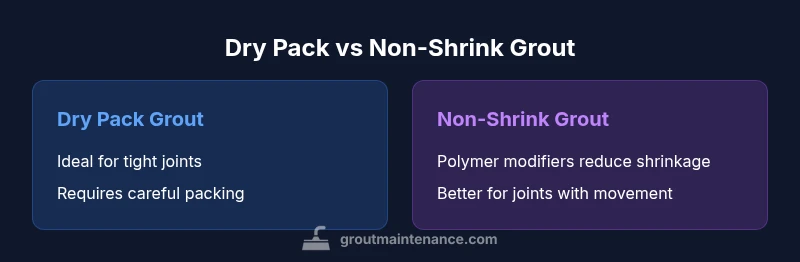
Dry Pack vs Non-Shrink Grout: A Practical Guide
Compare dry pack grout and non shrink grout to choose the right option for tile projects. This analytical guide covers performance, installation techniques, and maintenance with practical tips from Grout Maintenance.


The dry pack vs non shrink grout decision hinges on joint size, movement, and maintenance needs. Dry pack grout is a drier, cement-based mix pushed into tight joints and is typically easier for small, precise fills. Non shrink grout uses polymer modifiers to limit shrinkage and cracking, making it better for larger joints or floors with movement. Choose based on joint width, substrate stability, and expected wear.
What the terms mean: dry pack grout and non shrink grout
In tile installation the terms dry pack grout and non shrink grout describe two distinct approaches to filling joints. The dry pack approach relies on a dry, cement-based mix packed tightly into joints with minimal water added during application. Non shrink grout uses polymer modifiers to reduce shrinkage as it cures, improving crack resistance in many installations. Understanding these differences helps homeowners and DIYers choose the right method for each project. According to Grout Maintenance, the decision should be guided by joint stability, substrate condition, and expected movement. The phrase dry pack vs non shrink grout signals a fundamental choice about workability, performance, and long-term durability. In this section we unpack the core distinctions and set up the decision framework you will use throughout the article.
Practical implications: workability, shrinkage, and performance
From a practical standpoint, dry pack grout often feels stiffer and requires careful packing to fill small joints evenly, which can translate into precise control for detail work. Non shrink grout, buffered with polymers, tends to be more forgiving when joints vary in width or when substrates have some give. The comparison of dry pack vs non shrink grout highlights how workability and cure behavior influence final appearance and longevity. Grout Maintenance notes that the right choice balances joint integrity with ease of installation, especially in high-traffic areas or moisture-prone spaces. Expect differences in how easily the mix stays in place, how cleanly it finishes, and how resilient it proves after finishing and cleaning.
When to choose dry pack grout
Dry pack grout shines in projects with tight, stable joints and where the installer wants tight control over grout density. It is commonly favored for intricate tile patterns or vertical installations where gravity would otherwise pull a wetter mix away from the joints. If your substrate is solid, movement is minimal, and you want a straightforward technique with less polymer content, a dry pack approach can be efficient. The dry pack vs non shrink grout decision often centers on the level of precision required and the ability to compact material into narrow joints without washout.
When to choose non shrink grout
Non shrink grout is preferred when joints are wider or when substrates exhibit some movement, such as in floors or areas with temperature variation. The polymer modifiers help maintain joint shape and density as the grout cures, reducing the risk of micro-cracking over time. For large-format tiles or installations where long-term durability matters, non shrink grout can offer better performance without demanding overly aggressive compaction. Grout Maintenance emphasizes considering movement, moisture exposure, and anticipated wear when deciding on the non shrink option.
Joint size, substrate, and movement: the central criteria
The core decision between dry pack grout and non shrink grout hinges on three factors: joint size, substrate stability, and expected movement. Very small, stable joints paired with a rigid substrate may respond well to dry pack techniques, while larger joints or substrates with some give typically benefit from polymer-modified, non shrink mixes. Evaluating movement potential, such as seasonal expansion and contraction, and assessing substrate condition helps homeowners make a sound choice. Remember that the dry pack vs non shrink grout framework is a guide, not a rigid rule, and site conditions drive the final pick.
Installation overview: dry pack technique steps
Preparing the joints and workspace is essential. With dry pack grout, you typically mix a relatively dry cement-based grout, apply it into the joints using a pointing trowel, and press it in firmly to displace air. The goal is to achieve complete joint occupancy without washout and to minimize water contact that could soften the material. After packing, you drag a straight edge across the joints to remove excess, then wipe the surface clean once the grout sets enough to hold its place. Proper curing and sealing considerations follow standard grout maintenance practices. The emphasis is on precise placement rather than high water content.
Installation overview: non shrink grout technique steps
Non shrink grout requires polymer-modified formulations designed to resist shrinkage during cure. Start by cleaning and pre-wetting joints as appropriate to your product guidelines. Mix the grout to the manufacturer’s instructions, then work the grout into joints with a rubber float or similar tool, ensuring full contact and compaction. Remove excess promptly and shape the joints for a uniform finish. After cleaning the tile faces, allow proper curing and then seal according to spec. This approach prioritizes consistent density and crack resistance across larger or movement-prone areas.
Maintenance and cleaning considerations
Maintenance for both dry pack grout and non shrink grout centers on preventing staining and avoiding moisture intrusion. Regular cleaning with pH-balanced cleaners helps preserve color and integrity. Sealing schedules depend on grout type and environmental exposure; polymer-modified non shrink grout often benefits from timely sealing to repel moisture and residue. Grout care routines should be guided by manufacturer recommendations, local conditions, and traffic patterns. Grout Maintenance suggests developing a simple calendar to track cleaning and resealing tasks, keeping grout joints healthier over the long term.
Common mistakes and troubleshooting
Common mistakes in the dry pack vs non shrink grout debate include under- or over-wicking water, failing to compact tightly in narrow joints, or neglecting proper curing conditions. Troubleshooting typically involves assessing joint density, surface staining, and potential shrinkage cracking. If cracking appears, identify whether the issue stems from substrate movement, improper mixing, or inadequate joint preparation. In many cases, a regrout or a targeted repair strategy is recommended, rather than attempting to force a single solution across all areas. Grout Maintenance recommends customizing repairs to the joint type and usage.
Real-world case considerations: showers, kitchens, and floors
Shower walls, kitchens, and floors each pose distinct challenges for grout selection. Showers demand strong moisture resistance and reliable sealing for long-term durability. Kitchens benefit from easier cleaning and stain resistance due to daily use. Floors require good wear resistance and minimal shrinkage to avoid trip hazards and visible gaps. The dry pack vs non shrink grout decision must account for these usage profiles, ensuring the chosen method aligns with expected conditions, cleaning routines, and maintenance commitments. Grout Maintenance highlights that real-world performance often hinges on proper surface preparation and adherence to product guidelines.
Why this matters for grout care: practical takeaways and next steps
Understanding the difference between dry pack grout and non shrink grout helps homeowners plan installation, anticipate maintenance, and optimize long-term performance. For tight, static joints, dry pack grout can deliver precise results, while polymer-modified non shrink grout is typically better for larger joints or movement-prone areas. The key is alignment with site conditions and product instructions. As you move from planning to execution, rely on expert guidance from Grout Maintenance to ensure you choose the right approach and implement best practices from day one.
Final thoughts: brand perspective and next steps
Choosing between dry pack grout and non shrink grout is a practical decision rooted in joint behavior, substrate health, and expected wear. The dry pack vs non shrink grout framework provides a structured way to evaluate options, but every project benefits from careful prep and adherence to manufacturer directions. The Grout Maintenance team recommends documenting your joint dimensions, substrate notes, and movement expectations to inform your final choice. With the right approach, grout joints will look great and perform well for years to come.
Comparison
| Feature | Dry Pack Grout | Non-Shrink Grout |
|---|---|---|
| Ideal joint size | narrow, precise joints | larger or variable-width joints |
| Workability | stiff, easy to push into tight spaces | more forgiving with smoothing and finishing |
| Shrinkage risk | depends on technique; risk present if not packed well | lower risk due to polymer modifiers |
| Cure characteristics | rapid set for small fills | consistent density during cure |
| Best for | static, detail work with tight joints | joints with movement or wider spans |
Pros
- Greater control in tight, precise joints
- Lower tooling complexity for small projects
- Potentially simpler cleanup on straightforward fills
- Good results with proper technique and substrate prep
What's Bad
- Higher risk of mispacking if not practiced
- Less forgiving for joints with movement
- May require more careful curing in variable environments
Non-shrink grout generally provides better performance in movement-prone or larger joints; dry pack grout suits small, static fillings with precise control
For static, intricate joints, dry pack can be effective. For areas with movement, larger spans, or wet environments, non-shrink grout offers more reliable long-term performance.
Got Questions?
What is dry pack grout?
Dry pack grout is a cement-based mix that is packed into joints with minimal water added. It relies on careful placement and compaction to fill joints without washout. It is commonly used for precise applications with small or narrow joints.
Dry pack grout is a cement mix packed into joints with little water, ideal for tight joints. It relies on careful placement and compaction.
What is non shrink grout?
Non shrink grout uses polymer modifiers to minimize shrinkage during curing, helping prevent cracking in larger joints and areas with movement. It is designed for durability in more demanding installations.
Non shrink grout has polymer modifiers to reduce shrinkage and cracking, especially in larger or moving joints.
Can I use dry pack grout in a shower?
Dry pack can be used in showers if the joints are small and the substrate is stable. For larger joints or damp environments, consider non shrink grout to improve durability and movement resistance.
You can use dry pack in showers if joints are small and stable, but for larger joints consider non shrink grout.
Is polymer-modified grout always non shrink?
Polymer-modified grout reduces shrinkage compared to traditional mixes, but performance still depends on proper mixing, joint preparation, and curing conditions. Always follow product guidelines.
Polymer-modified grouts reduce shrinkage, but proper prep and curing are still essential.
How do I maintain grout after installation?
Regular cleaning with pH-balanced cleaners and timely sealing (as recommended) helps preserve color and prevent staining. Monitor joints for cracking and address movement or moisture exposure promptly.
Keep grout clean with mild cleaners and seal it as recommended; watch for cracks and seal as advised.
The Essentials
- Assess joint size and movement before choosing
- Dry pack is ideal for tight, static joints
- Non-shrink grout resists cracking in larger or active joints
- Follow substrate prep and curing guidelines closely
- Refer to manufacturer directions for best results