Grout vs Concrete: A Practical Comparison for Homeowners
Explore the core differences between grout and concrete, including composition, uses, installation, and maintenance. Get practical guidance from Grout Maintenance on choosing the right material for tiles, slabs, and repairs.


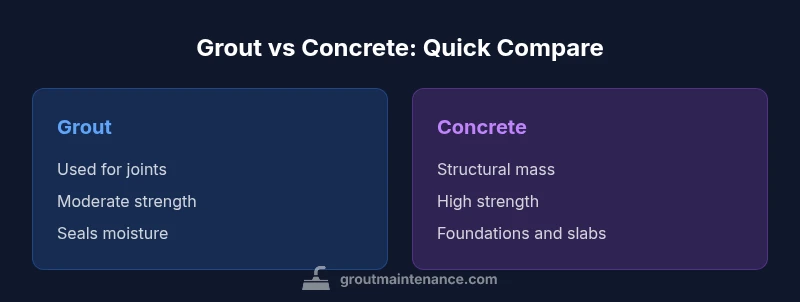
The quick answer to is grout the same as concrete? No. Grout is a thin cementitious filler used to seal joints between tiles, bricks, or stones, often with additives to improve flow and moisture resistance. Concrete is a structural material made from cement, water, and aggregate that hardens into a solid mass capable of bearing loads. While both are cement-based, they serve different roles in construction.
What makes grout different from concrete
The key question: is grout the same as concrete? Not at all. Grout is a fine cementitious filler designed to seal joints between tiles, bricks, or stones. It is typically fluid enough to be pressed into narrow gaps and often contains polymers or latex to improve flexibility and water resistance. Concrete, by contrast, is a structural composite made from cement, water, and coarse aggregates that hardens into a rigid mass capable of bearing loads. In practice, this difference in purpose drives divergent properties, installation methods, and maintenance needs. Homeowners should not swap one for the other; understanding the distinct roles helps prevent costly mistakes.
Composition and chemistry: grout vs concrete
Grout and concrete share a common cementitious base, but their chemistry diverges after mixing. Grout is usually a low-viscosity slurry designed to fill, seal, and bond at tile joints. It often includes latex or acrylic additives to accommodate movement and to improve water resistance. Concrete combines cement with water and aggregates (sand and gravel or crushed stone). The aggregate content gives concretes its strength, thermal mass, and stiffness. When new, grout cures by drying and chemical reactions, but its strength remains far lower than that of concrete. In practice, the ratio and additives determine how the material behaves in the field.
Typical uses and when to choose each material
Choosing between grout and concrete starts with function. Tile installations rely on grout to create tight seams and prevent moisture intrusion behind the surface. Concrete is chosen for structural components like footings, slabs, and foundation walls where load-bearing capacity matters. In many projects, both materials appear in the same site but in different roles: concrete provides the backbone while grout completes the joints. DIY enthusiasts should plan for proper curing and moisture management to prevent long-term failures.
Workability, installation, and curing differences
Workability sets grout apart in non-structural applications. Grout must be mixed to the right consistency so it flows into joints but does not slump out. Finishing typically requires striking excess and sealing after cure. Concrete requires careful mixing ratios and can be placed in forms; it cures through moisture loss and chemical hydration, often with extended curing periods. Temperature, humidity, and curing conditions influence both materials, but the potential for cracking is greater with improper grout installation due to movement in substrates.
Durability, maintenance, and vulnerabilities
Durability varies dramatically. Grout, particularly epoxy or cementitious blends used in showers, resists moisture but is susceptible to cracking and staining if joints are not properly sealed or if substrate movement occurs. Concrete excels in strength for structural elements but can crack with shrinkage or improper curing; surface wear may expose aggregate and require resurfacing. Regular maintenance for grout includes cleaning, resealing, and regrouting as needed, while concrete maintenance focuses on crack repairs, sealing, and addressing wear over time.
Color, appearance, and aesthetic considerations
Color is often a driver in choosing grout. Many homeowners prefer grout colors that either blend with tile or create contrast for a decorative effect. Grout color is typically achieved with pigments; some premium blends resist staining more than standard cementitious grout. Concrete coloration options are broader in industrial or decorative contexts, including integral pigments and surface finishes that alter shade, texture, and reflectivity. The choice affects maintenance, since certain colors show stains or wear differently.
Common mistakes and how to avoid them
A common error is using grout where concrete is needed, particularly in structural openings or support elements. Another pitfall is ignoring substrate preparation, moisture control, and appropriate sealing, which can reduce grout life and lead to joint failures. Conversely, pouring concrete without proper formwork or curing constraints can lead to cracks, delamination, and uneven surfaces. Understanding the limits of each material helps homeowners plan for long-term durability.
A homeowner's quick decision guide
When you face a tile joint versus a concrete slab, use a simple rule of thumb: if it bears weight or serves as a structural element, choose concrete; if it fills or seals gaps, choose grout. For DIY projects, invest in proper sealers for grout and acceptable curing conditions for concrete. Always follow manufacturer guidelines for mixing ratios, additives, and sealing products. When in doubt, test a small area before committing to a full installation.
Practical testing and identification tips
Identifying grout versus concrete on-site is often a visual/texture exercise. Grout appears as a soft paste that binds tile joints and remains flexible with movement. Concrete is a solid mass with recognizable aggregate and measurable density. If you need to verify, perform a simple hardness test on an exposed edge or edge cut: concrete is significantly harder to scratch. When possible, refer to project plans or product labels for definitive identification.
Case study scenarios: when you might confuse the two
Consider a kitchen renovation where you see a tiled backsplash on a wall with a concrete slab substrate. The confusion arises from both cementitious appearances; however, grout forms the joints while concrete provides the substrate. In a garage floor, a cementitious coating may look like grout but acts as part of the structural surface. Analyzing the purpose, not just the look, solves most mix-ups.
Care and maintenance overlap: sealing and cleaning
Both materials benefit from proper care, though in different ways. Grout sealing reduces moisture penetration and staining in joints, while concrete sealing reduces porosity and surface wear. Cleaning methods differ: grout joints respond to gentle scrubbing and pH-neutral cleaners; concrete often tolerates more aggressive cleaners but may require curing and resurfacing if damaged. Regular inspection helps catch early signs of movement or wear.
Comparison
| Feature | Grout | Concrete |
|---|---|---|
| Composition | Cementitious filler with water and additives | Cement, water, and aggregates (sand/stone) |
| Typical uses | Joint filling and sealing between tiles/bricks | Structural elements (slabs, foundations, walls) |
| Consistency when applied | Fluid paste that fills narrow gaps | Rigid mass after curing |
| Curing behavior | Curing dries; strength is moderate | Hydration-based; generates substantial strength |
| Water resistance | Depends on sealing; moisture-prone if unsealed | In solid mixes, high resistance; depends on mix |
| Aesthetics | Color through pigments; joints visible | Solid color or formed finish; less visible joints |
| Durability | Low to moderate strength; designed for joints | High strength; structural durability |
| Maintenance practices | Sealing/regrouting over time | Surface sealing/repair as needed |
Pros
- Clarifies usage to prevent misapplications
- Supports durable, long-lasting installations when used correctly
- Often cost-effective for non-structural work
What's Bad
- Misuse risk leads to failures and safety concerns
- Maintenance required to prevent moisture intrusion or wear
- Non-interchangeable with structural elements even if similar in appearance
Grout and concrete have distinct roles; don’t substitute one for the other.
Concrete provides structural strength; grout provides joints and moisture sealing. The right choice depends on function, not appearance.
Got Questions?
What is grout used for in tile installations?
Grout fills gaps between tiles and creates a water-resistant seal. It supports tiling stability and helps prevent moisture ingress behind the tile surface.
Grout fills tile gaps to seal joints and protect against moisture.
What is concrete used for in home construction?
Concrete is used for structural elements like foundations, slabs, and walls. It provides compressive strength and supports loads.
Concrete is the main structural material for foundations and slabs.
Can grout substitute concrete in any project?
No. Grout is not designed to bear structural loads. Substituting grout for concrete can lead to cracks, failures, and safety risks.
Grout can’t replace concrete for structural work.
How can I tell if a material is grout or concrete?
Grout is a cementitious paste used in joints; concrete is a solid, heavy mass used for structural elements. Visual cues, texture, and the site purpose help determine the material.
Grout is runny and used in joints; concrete is a solid mass for structure.
Are there materials that blend properties of both?
Some composites exist (like cementitious fillers with specialized aggregates), but they still serve distinct roles. They are not interchangeable with pure grout or standard concrete.
There are blends, but they’re not substitutes for grout or concrete.
The Essentials
- Know each material's primary role before starting
- Use grout for joints; concrete for structure
- Seal grout regularly to prevent moisture damage
- Inspect and regrout as needed to maintain performance
- Plan for curing and moisture control in both materials