Mortar vs Grout vs Concrete: A Practical Comparison for Home Projects
Explore the differences, uses, and installation tips for mortar, grout, and concrete. This objective comparison covers suitability for tiling, masonry, and slabs, with practical guidance for homeowners and DIY enthusiasts from the Grout Maintenance team.


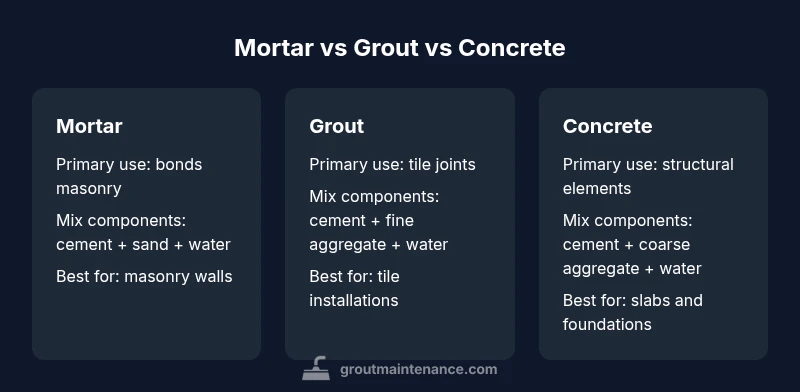
Mortar binds bricks and stones in masonry, grout fills tile joints, and concrete forms structural elements like slabs and foundations. For most home tiling projects, grout is the between-tile filler while mortar sets the tile; concrete is used for slabs and structural work. Understanding mortar vs grout vs concrete helps you choose correctly and avoid failed installations.
What are mortar, grout, and concrete?
According to Grout Maintenance, these three cementitious materials share a common base—cement and aggregates—but they are engineered for very different tasks. Mortar acts as the adhesive binder in masonry, joining bricks or stones with workability that allows gaps to be filled and aligned. Grout, by contrast, is a flowable filler designed to occupy joints between tiles or between trim pieces, often with a finishing color and texture. Concrete is a larger, structural composite that uses a coarser aggregate to achieve high compressive strength for foundations, slabs, and structural elements. For homeowners, the key distinction is simple: use mortar when you need adhesion and bond in masonry, use grout to seal gaps between tiles, and reserve concrete for load-bearing parts of a project. The Grout Maintenance team highlights that selecting the right material from the outset prevents movement, cracking, or moisture problems down the line.
In practical terms, mortar and grout are often mistaken for one another due to their cementitious nature, but they live in different parts of the assembly. Mortar holds bricks or stone together, offering thickness and plasticity during placement. Grout fills the spaces created by tiling and can be color-matched to the tile for a seamless finish. Concrete forms the substrate of a floor, a footing, or a structural element that must withstand loads and environmental exposure. Understanding the mortar vs grout vs concrete relationship helps you plan correctly, source the right product, and apply it with appropriate tools and curing conditions.
nil
Feature Comparison
| Feature | Mortar | Grout | Concrete |
|---|---|---|---|
| Primary use | Binds bricks/stones in masonry | Fills tile joints and beds tiles | Forms structural elements like slabs and foundations |
| Typical mix components | Cement + sand + water (lime-based mortars exist) | Cement + fine aggregate + water (often polymer-modified) | Portland cement + coarse aggregate + water (with additives) |
| Flexibility/movement handling | Moderate; designed to accommodate limited movement in masonry | Rigid after set; movement can cause cracks (epoxy variants offer higher resistance) | Rigid; strong under compression but limited tensile flexibility |
| Water exposure performance | Porous; usually requires sealing for exterior use | Depends on mix; cement-based is porous; epoxy grout resists moisture well | Depends on mix and curing; sealed concrete improves water resistance |
| Best for | Masonry walls and veneers | Tile installations and joints | Foundations, floors, driveways, and structural elements |
| Common pitfalls | Cracking if movement occurs or mixing is incorrect | Cracking or discoloration from moisture or improper sealing | Cracking from shrinkage or improper curing |
Pros
- Clearly defined roles for each material based on project type
- Wide product availability and robust DIY guidance
- Options across cementitious formulations (including epoxy variants) for moisture resistance
- Durability when mixed, cured, and installed correctly
- Relatively straightforward tools and processes for common home projects
What's Bad
- Misapplication is common and can lead to failure or costly repairs
- Cementitious mixes can crack with movement or improper curing
- Sealing requirements add maintenance steps and ongoing cost
- Not all mixes are interchangeable across applications, risking poor performance
Mortar for masonry, grout for tile joints, and concrete for structural work.
Choose mortar when bonding bricks or stones; grout when filling gaps between tiles; concrete when you need a durable structural element like a slab. The Grout Maintenance team emphasizes matching material properties to the task to prevent premature failures and moisture issues.
Got Questions?
What is the main difference between mortar, grout, and concrete?
Mortar bonds masonry units like bricks, grout fills joints between tiles, and concrete provides structural strength for slabs and foundations. Each serves a distinct role in a project, and using the wrong material often leads to failure or costly repairs.
Mortar bonds masonry, grout fills joints, concrete provides structural strength.
Can I substitute grout for mortar in a masonry wall?
Substituting grout for mortar in masonry is not advised. Grout is designed to fill gaps between tiles, while mortar provides adhesive strength and bonding for bricks or stones. Using grout in place of mortar can compromise durability.
Grout isn’t a substitute for mortar in masonry.
Is epoxy grout better than cement-based grout for wet areas?
Epoxy grout tends to perform better in moisture-prone areas due to its chemical resistance and water tightness. Cement-based grout requires sealing and can be more susceptible to staining and moisture-related issues over time.
Epoxy grout resists moisture better but costs more.
Do I need to seal concrete slabs?
Sealing concrete slabs can improve moisture resistance and stain resistance, especially for indoor floors or exterior slabs exposed to weather. The need depends on the concrete mix and the environment.
Sealing helps protect concrete from moisture and stains.
Can concrete be used for interior tile installations?
Concrete is not used to set tiles; it forms the substrate. Tile is set with mortar, and the grout fills and seals the joints between tiles. For specialty applications, you might see decorative concrete as a surface, not a tile setting bed.
Tile isn’t set on concrete; use mortar for setting.
What factors most influence the longevity of mortar, grout, and concrete?
Curing quality, movement, moisture exposure, and sealing (where applicable) are the main longevity drivers. Proper substrate prep, correct mix ratios, and appropriate finishing significantly extend life.
Curing, movement, moisture, and sealing affect longevity.
The Essentials
- Match material to the task: masonry, tiling joints, or structural elements
- Plan for movement and moisture with the right mix and sealing strategy
- Epoxy variants of grout offer superior moisture resistance in wet areas
- Follow proper mixing, curing, and maintenance practices to maximize longevity