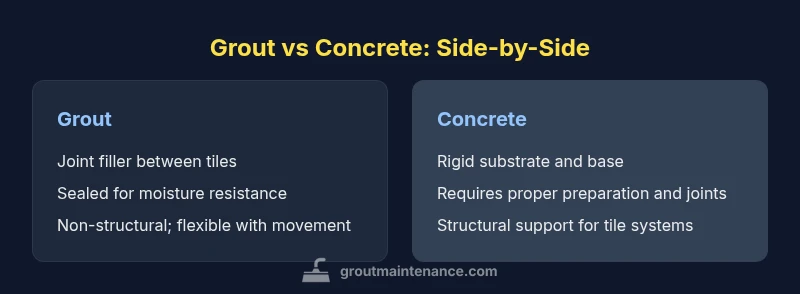
Grout vs Concrete: A Practical Home Guide
A practical, analytical comparison of grout and concrete for tile installations, detailing definitions, properties, maintenance, and scenarios to help homeowners choose the right material for joints and bases.


Grout and concrete serve distinct roles in tile projects, and understanding grout vs concrete helps prevent common failures. Grout fills joints between tiles, providing movement tolerance and water resistance when sealed; concrete forms the rigid setting bed or substrate for the tile system. For most indoor installations, grout is the finishing material, while concrete acts as the foundational base.
grout vs concrete: defining roles in tile installations
In most residential tile projects, you’re balancing two very different materials: grout and concrete. Grout is the paste that fills the gaps between tiles, while concrete is used as the setting bed, substrate, or foundational layer. When you think about grout vs concrete, the distinction is not just about strength; it’s about function within the system. According to Grout Maintenance, recognizing these distinct roles helps homeowners prevent common failures such as cracked joints, loose tiles, and water intrusion.
Grout sits between tiles and cures with movement; it tolerates tiny shifts without transferring stress to the tiles themselves. Proper grout is more than a sealant—it's a flexible, moisture-aware joint that can contribute to the overall waterproofing when sealed appropriately. Concrete, by contrast, is a dense, load-bearing material that locks the tile system in place. It provides stiffness, a flat reference surface, and in many installations a thermal mass that can influence expansion and contraction. The two materials are not interchangeable: replacing grout with concrete in a joint is not feasible, and substituting concrete for grout would compromise movement tolerance and moisture management. Understanding this relationship sets the stage for smarter install choices and longer tile life.
Key material properties that matter when choosing grout vs concrete
When evaluating grout vs concrete, understanding material properties helps predict performance over time. Grout is a cementitious or epoxy-based paste that sits between tiles. It is designed to be flexible enough to absorb minuscule movements without transferring stress to the tiles. Concrete, by contrast, is a dense, cementitious matrix used as a substrate, setting bed, or structural base. Its rigidity provides even support but can transmit stress if joints and movement are not properly accommodated.
Two properties drive performance in most homes: porosity and bonding. Porosity affects moisture handling; cementitious grout is porous until sealed, while epoxy grout is inherently non-porous and highly moisture resistant. Bonding refers to how well the material adheres to tile edges and the underlying substrate. Proper adhesion prevents tile debonding. Thermal movement is another factor; in rooms that heat and cool seasonally, grout joints must accommodate expansion and contraction. Movement tolerance is usually higher in properly mixed cementitious grout when sealed and cured correctly. A well-prepared concrete substrate complements the tile layout by providing flatness and stiffness, but it should never replace the joint filler. The Grout Maintenance team emphasizes using the right grout type for the joint material and environment. For example, areas with heavy moisture may benefit from epoxy grout or cementitious grout with a high-quality flexible sealer, while dry interiors can use standard cementitious grout with routine sealing.
Wet environments: sealing, moisture, and maintenance
Wet environments demand careful attention to how grout and concrete interact with moisture. Grout joints are a primary line of defense against water penetration around tiles; sealing is a critical step to minimize stains and efflorescence and to extend service life. Epoxy grout offers superior moisture resistance and lower maintenance in wet areas, but it can be more expensive and tougher to work with than cementitious options. Cementitious grout requires a quality sealant that matches the environment—shower stalls, backsplashes, and exterior installations benefit from seals designed for humidity, temperature swings, and cleaning agents. Concrete substrates, if unsealed, can absorb moisture and may wick water to the tile system, potentially affecting adhesion and longevity. The choice between grout types should consider exposure, cleaning frequency, and maintenance willingness. As a practical rule, projects in consistently damp spaces benefit from epoxy or highly water-resistant cementitious grout, paired with a careful sealing regimen.
Durability, maintenance, and repair implications
Durability for tiled surfaces depends on both the filler and the substrate. Grout joints are under constant exposure to foot traffic, cleaners, and moisture; with proper sealing and timely maintenance, they resist cracking and staining. When joints crack, it’s often due to substrate movement or improper installation. Regrouting is sometimes necessary to restore aesthetics and performance. Concrete substrates provide long-lasting rigidity but can crack if movement is not properly accommodated or if the substrate was not properly prepared. In high-traffic or exterior environments, a reinforced substrate with proper expansion joints reduces risk of tile and grout damage. Grout maintenance reduces long-term issues by protecting joints, whereas substrate care preserves the base structural integrity. The Grout Maintenance team notes that proactive maintenance—such as resealing grout and inspecting substrate flatness—can significantly extend tile life.
Cost, installation complexity, and time considerations
Cost and complexity are often the deciding factors in grout vs concrete choices. Concrete bases can increase upfront costs due to substrate preparation, leveling, and curing time, especially in renovations where space or access is limited. Grout costs are usually modest by comparison, but the total budget includes tile adhesive, sealants, and grout type selection. Maintenance costs depend on the grout choice: epoxy grout reduces staining and cleaning time but is more expensive upfront and requires skilled installation. Cementitious grout with standard sealer is cheaper upfront but may demand more frequent maintenance and sealing. Grout Maintenance analysis shows that investing in higher-grade grout or epoxy formulations often pays off in reduced upkeep over the tile system’s life. When budgeting, consider not only material costs but also labor, longevity, and the ongoing care required to sustain performance.
Practical scenarios: bathrooms, kitchens, exteriors
Every space has different demands. In a bathroom with a humid shower, epoxy grout between wall and floor tiles can minimize maintenance and staining, while a cementitious grout with a high-quality sealant might suffice in a dry powder room. Kitchens with frequent spills benefit from epoxy grout for their stain resistance, while backsplashes with minimal moisture exposure may be well-served by standard cementitious grout with routine sealing. Exterior tiling introduces temperature shifts and moisture challenges; a sealed concrete setting bed with a properly sealed joint system reduces water intrusion and movement-related cracking. Grout Maintenance emphasizes planning for expansion joints in any outdoor or sun-exposed area to accommodate thermal cycling and substrate movement, ensuring long-term tile integrity.
DIY vs professional installation: when to hire a pro
Grout and concrete work both benefit from professional evaluation, particularly in complex layouts or wet environments. While basic tile installations with standard cementitious grout can be within DIY reach, issues like substrate flatness, proper adhesive selection, and epoxy grout work demand experience. A pro can assess substrate conditions, verify slope and drainage, and ensure expansion joints are correctly placed. Grout types beyond standard cementitious mixes, such as epoxy or polyurethane blends, require technical handling and curing controls that are best managed by experienced installers. The Grout Maintenance team notes that investing in professional installation for critical wet areas reduces the likelihood of costly repairs later and improves overall performance.
Long-term care: sealing schedules and inspection
Ongoing maintenance for grout and concrete surfaces centers on inspection and sealing. Regularly inspect grout joints for cracks, discoloration, or efflorescence and address issues promptly. Sealing grout in appropriate environments helps resist moisture, stains, and cleaning agents, extending service life. Concrete substrates benefit from moisture barriers and periodic checks for cracking or spalling. Developing a routine—such as a seasonal visual inspection and seal checks for high-use areas—helps catch problems early. Grout Maintenance recommends maintaining a documented care plan, including sealant type, reapplication intervals, and any observed performance changes, to optimize durability and appearance over time.
Common mistakes and how to avoid them
Common mistakes include mixing grout incorrectly, choosing the wrong grout for the environment, and neglecting substrate preparation. Rushing the curing process or skipping expansion joints can lead to premature cracking and tile misalignment. Another frequent pitfall is sealing grout without ensuring full curing or using incompatible sealants with epoxy grout. On the substrate side, insufficient flatness or moisture management in concrete bases leads to tile migration and joint failures. A methodical approach—confirm substrate flatness, select appropriate grout, seal where indicated, and plan for expansion joints—helps avoid these problems and improves overall tile system longevity.
Comparison
| Feature | Grout | Concrete |
|---|---|---|
| Composition & role | Joint filler between tiles; non-structural when sealed | Dense setting bed / substrate; structural base for tiles |
| Water interaction | Sealed grout provides moisture resistance in joints (epoxy or sealant-dependent) | Concrete resists moisture with proper sealing but is porous without treatment |
| Movement tolerance | Flexible joints that tolerate minor tile movement | Rigid base; requires proper substrate preparation and expansion joints |
| Durability in wet areas | High when using epoxy or well-sealed cementitious grout | Very durable as substrate, but joints require proper filler and maintenance |
| Maintenance | Periodic sealing and resealing depending on grout type | Substrate maintenance; inspect for cracks and moisture issues |
| Best use | Tile joints, showers, backsplashes with appropriate sealing | Setting beds, load-bearing bases, exterior foundations with proper moisture control |
Pros
- Clarifies material roles to reduce installation errors
- Supports proactive maintenance planning
- Helps predict long-term upkeep and life-cycle considerations
What's Bad
- Grout requires sealing and periodic maintenance
- Concrete bases can add upfront cost and complexity
- Epoxy grout options raise material costs and require skill
Grout is generally preferred for joints; concrete remains essential for base layers
In most tile installations, use grout for joints with proper sealing to minimize water intrusion. Reserve concrete for the setting bed and structural support. The Grout Maintenance team recommends evaluating environment and movement demands when choosing materials.
Got Questions?
What is the primary function of grout in tile installations?
Grout fills the gaps between tiles, allowing for movement and moisture control while forming a finished surface. It is not a structural material. Proper sealing is essential to maintain moisture resistance and prevent staining.
Grout fills the gaps between tiles and helps seal the surface, but it isn’t a structural material. Sealing is important for moisture control.
Can grout be used instead of concrete as a base layer under tiles?
No. Grout cannot replace a concrete base or substrate. It sits between tiles and does not provide the required stiffness or load-bearing support that a proper substrate delivers.
No—grout isn’t a substitute for a concrete base; it’s meant for joints, not structural support.
Is epoxy grout always better than cementitious grout?
Epoxy grout offers superior stain and moisture resistance but comes at a higher cost and can be harder to install. Cementitious grout is easier to work with but may require more frequent sealing and maintenance.
Epoxy grout resists stains and moisture better but costs more and is tougher to install.
How should I seal grout in wet areas?
Seal grout in wet areas according to the sealant’s instructions and the environment. Some spaces benefit from epoxy grout that doesn’t require sealing, while others use cementitious grout with dedicated sealants to reduce moisture infiltration.
Seal grout as recommended; some environments do better with epoxy grout, others with cementitious grout plus sealant.
When should I consider regrouting?
Consider regrouting when joints show cracks, significant discoloration, or when sealing no longer restores performance. Regrouting can restore aesthetics and improve moisture resistance.
If joints crack or discolor and sealing isn’t enough, regrouting is worth considering.
Do I need expansion joints with grout-filled tiles?
Yes. Even with grout-filled joints, expansion joints are essential in large or exterior installations to accommodate dimensional changes and prevent cracking.
Yes—expansion joints are important in larger or outdoor projects to handle movement.
The Essentials
- Define each material's role before starting.
- Seal grout properly to maximize moisture resistance.
- Choose concrete for substrate stability and load-bearing needs.
- Consider epoxy grout for high-stain environments to reduce maintenance.
- Plan expansion joints and future repairs early.