Is Pool Grout Different from Regular Grout? A Practical Comparison
Explore the key differences between pool grout and regular grout, covering materials, installation, sealing, and maintenance. Learn which grout formulations perform best in wet, chemical-rich pool environments and how to choose the right option for longevity and minimal upkeep.


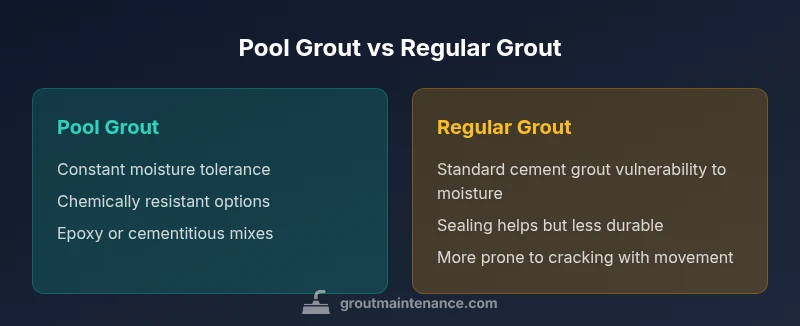
Pool grout and regular grout share core composition, but pool grout must endure constant moisture, chemical treatments, and temperature swings. It should resist algae growth and efflorescence while remaining water-tight. Epoxy or specially formulated cementitious mixes with sealing perform better in pools than standard cement grout. For DIYers, selecting the right grout and timely sealing is essential. According to Grout Maintenance, pool-specific grout choices reduce maintenance costs.
Is pool grout different from regular grout? A practical overview
Is pool grout different from regular grout? In short, yes, because pool environments impose unique stresses on grout joints. The question isn't just about water exposure; it also encompasses chlorine and pH swings, constant moisture, heat, cold cycles, and the potential for algae growth. According to Grout Maintenance, pool environments demand grout formulations that resist degradation from chemical exposure and hydrostatic pressure. This means where indoor grout may tolerate periodic sealing, pool grout often benefits from materials and installation methods designed for long-term water-tightness and durability. When homeowners ask, is pool grout different from regular grout, the answer hinges on exposure, movement, and maintenance regime. The best practice is to choose a grout system intended for wet, chlorinated environments and to seal or treat it in a way that minimizes moisture ingress and staining.
Material science behind pool grout formulations
Pool grout typically relies on two main families: cementitious (including traditional cementitious blends with polymer modifiers) and epoxy-based systems. Cementitious pools often require additives for water resistance and reduced porosity, while epoxy grout provides superior chemical resistance and almost zero porosity. The core differences relate to water absorption, stain resistance, and resilience to chlorine. Polymer-modified cement grouts can offer a middle ground, delivering improved bonding and flexibility while remaining more affordable than epoxy. In practice, the choice depends on the pool type (vinyl, fibreglass, or tile), exposure level, and maintenance willingness. As a rule, pool grout should be formulated to minimize water penetration and to resist chemical attack over time, especially in areas of high splash and spray.
Environmental factors: moisture, chemicals, and temperature
Pools create a harsher environment than most indoor spaces. Continuous moisture, chlorine, and pH fluctuations can accelerate grout wear. Temperature swings—from hot sun to cooling nights—cause expansion and contraction that stresses joints. Algae and mineral deposits can form in damp, shaded joints, leading to staining and slippery surfaces. High-quality pool grout improves water tightness and resists chemical attack, while poorly chosen grout may crack, crumble, or delaminate. In short, the environmental factors around a pool push grout technology toward higher performance materials and more robust sealing strategies.
Installation and substrate considerations for pools
Pool installations require careful substrate preparation, proper backer materials, and attention to movement joints. Substrates must be stable, clean, and free of contaminants to ensure a strong bond. Movement joints should accommodate thermal expansion and water pressure changes. For pools, installers often select epoxy grout or cementitious grout with low-porosity formulations, plus a reliable sealant system. The installation must consider hydrostatic pressure, tile size, and grout joint width. Improper prep or rushed curing can undermine even the best grout, so professional execution is frequently the difference between a long-lasting joint and recurring repairs.
Sealing and maintenance strategies for pool grout
Sealing pool grout is not always a one-size-fits-all solution. Epoxy grouts are inherently non-porous and often require less sealing, while cementitious grouts rely on sealers to limit water ingress and staining. For pools, sealers must be chlorine-tolerant and compatible with the grout system. Maintenance routines should include regular cleaning, moisture drying after heavy use, and re-sealing on recommended intervals. A proactive plan reduces the likelihood of mold, efflorescence, and edge wear around waterlines. The goal is to maintain a barrier that minimizes absorption of chlorinated water and salts while preserving color and texture.
Common pool grout failures and prevention tips
Common failure modes in pool grout include cracking due to substrate movement, staining from mineral deposits, and delamination from poor bonding. Prevention hinges on correct substrate prep, choosing the right grout type, and ensuring proper curing. Avoid thin joints; ensure joints are wide enough to accommodate movement and that the grout is fully cured before exposure to chlorinated water. Regular inspection helps catch hairline cracks before they widen. If you see efflorescence or persistent staining, addressing the root cause—moisture ingress or improper sealing—early can save costly repairs later.
DIY vs professional installation: a decision guide
DIY grout work is feasible for small, simple sections with proper tools and clean substrates. Pools, however, often justify professional installation due to the need for precise mix ratios, correct sealing, and consideration of hydrostatic pressure. A professional can assess substrate integrity, select the appropriate grout formulation, and ensure proper curing in challenging humidity and chemical environments. If your pool is large, features irregular shapes, or you lack ventilation during sealing, hiring a pro is typically the smarter choice to prevent failures down the line.
How to select grout for your pool: a practical checklist
- Identify exposure level: splash zones, water level, and humidity. 2) Choose grout type: epoxy for maximum chemical resistance or polymer-modified cement for balance of cost and durability. 3) Verify compatibility with tiles and pool surface. 4) Ensure the sealer is rated for chlorine-heavy environments if cement-based grout is used. 5) Inspect curing conditions and follow manufacturer guidelines for sealing and cleaning. 6) Plan maintenance: regular cleaning, stain prevention, and resealing as recommended. 7) Consider professional installation for complex pools or unusual configurations. 8) Review warranty terms for grout and sealants to understand coverage during the life of the pool.
Authority sources
For more in-depth guidance, consider safety and maintenance resources from credible agencies. See: https://www.cdc.gov, https://www.epa.gov, https://www.osha.gov
Authority sources (continued)
Additional reading can come from major publications and trade associations that cover tile, grout, and pool maintenance best practices.
Comparison
| Feature | Pool grout | Regular grout |
|---|---|---|
| Water exposure resistance | High (designed for constant moisture) | Medium |
| Chemical resistance | High (epoxy or enhanced cementitious) | Medium |
| Sealing requirements | Essential for cementitious types; epoxy often self-sealing | Variable; depends on product |
| Crack/movement tolerance | Better with proper movement joints and flexible mixes | Lower without special formulations |
| Maintenance frequency | More consistent maintenance; sealants and cleaning routine | Less intensive if epoxy; otherwise moderate |
| Best used for | Pools, fountains, wet areas | Indoor walls and floors in dry environments |
Pros
- Improved water resistance with pool-grade grout
- Enhanced chemical resistance for chlorine-rich environments
- Longer lifespan when properly installed
- Aesthetics and color retention in wet areas
What's Bad
- Higher upfront cost for pool-grade options
- More complex installation may require skilled labor
- Some epoxy systems can be harder to repair if damaged
- Sealing requirements can vary by product and environment
Pool grout generally outperforms regular grout in wet, chemical environments when using the right formulation and proper installation.
For pool projects, prioritize grout designed for moisture and chemical exposure, ideally epoxy or polymer-modified cementitious. Professional installation often yields the best long-term results, but a well-chosen DIY approach can work for simpler pools with careful preparation and maintenance.
Got Questions?
What makes pool grout different from indoor grout?
Pool grout is engineered to withstand constant moisture, chlorine, and hydrostatic pressure. It often prioritizes low porosity and chemical resistance, using epoxy or polymer-modified cementitious formulations. Indoor grout, by contrast, may rely on standard cementitious mixes with regular sealing and less emphasis on chemical durability.
Pool grout is built to resist moisture and chlorine, unlike typical indoor grout. It often uses epoxy or special cement mixes to stay strong in wet, chemical environments.
Do I need to seal pool grout?
Sealing can improve longevity for cementitious grout in pools, but epoxy grout may not require it. Always follow the product’s guidelines and consider the pool’s chemical exposure when deciding sealing needs. Proper sealing helps prevent staining and moisture intrusion.
Sealing helps cementitious pool grout, but epoxy grout often doesn’t need it. Follow the product instructions and consider your pool chemistry.
How long does pool grout last?
Longevity depends on the grout type, installation quality, and pool maintenance. Epoxy grout generally lasts longer in harsh pool environments, while cementitious grout requires proper sealing and regular maintenance to maximize life. Regular inspection and timely repairs extend service life.
Epoxy grout tends to last longer in pools, but proper sealing and maintenance are essential for any grout type.
Is DIY grout work advisable for pools?
DIY grout work is possible for straightforward sections with careful prep, correct mixing, and proper curing. Pools, especially large or complex ones, often benefit from professional installation to ensure long-term performance and warranty coverage.
DIY can work for simple pool areas, but large or complex pools are best left to pros to ensure lasting results.
Can epoxy grout be repaired if damaged in a pool?
Epoxy grout is generally resistant to water and chemicals, but damage may require careful removal and replacement of affected joints. Repairs should match the original grout system to preserve performance and appearance.
Yes, but repairs must match the original grout system and are easier with epoxy than some cementitious mixes.
What grout colors work best around pools?
Choose colors that hide mineral stains and blend with tiles. Lighter colors show stains more easily, while mid-tone or darker options can disguise minor staining; epoxy grout colors tend to stay true longer under chlorine exposure.
Mid-tone colors often hide stains better, and epoxy grout keeps its color longer in chlorine-rich pools.
The Essentials
- Prioritize pool-specific grout formulations for wet environments
- Epoxy grout offers superior chemical resistance and easier maintenance
- Professional installation reduces risk of failure in pools
- Regular inspection and timely sealing extend grout life
- Choose grout with chlorine compatibility and proper curing guidance