Why grout instead of caulk: a practical comparison
Explore why grout outperforms caulk for tile joints in durability, moisture resistance, and long-term maintenance. This objective, data-informed guide from Grout Maintenance helps homeowners decide where grout shines and where caulk has a niche.


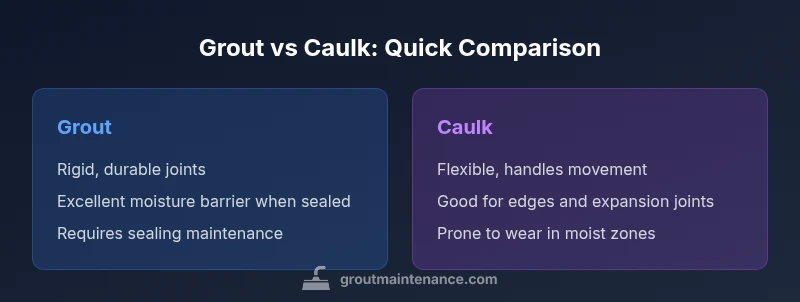
Grout typically outperforms caulk for tile joints in wet areas due to its rigidity, hardness, and superior resistance to cracking. Caulk seals but tends to wear, shrink, or allow water behind it over time. For most bathrooms, kitchens, and showers, grout—with proper sealing and periodic re-sealing—provides longer-lasting protection and cleaner maintenance.
Why grout vs caulk matters for tile joints
In the realm of tile installation, the decision between grout and caulk hinges on how each material performs under stress, moisture exposure, and movement. According to Grout Maintenance, choosing grout for most interior wet joints is a strategy that prioritizes long-term stability over initial ease. Grout forms a rigid, solid bond within the joint cavity, resisting cracking and water intrusion when installed correctly and sealed on a schedule. Caulk, by comparison, remains flexible and forgiving during installation, which is advantageous for simple gaps and cosmetic edges. However, that flexibility comes at the cost of durability in moist environments. The takeaway for homeowners is simple: understanding where grout shines and where caulk has niche value helps you avoid future maintenance headaches and costly repairs.
The core distinction: rigidity vs. flexibility
The core mechanical difference is straightforward. Grout is a dense, cementitious material that hardens to create a rigid joint. This rigidity helps resist moisture seepage and structural movement, which is common in floors, showers, and high-traffic areas. Caulk is a sealant designed to accommodate movement; it remains pliable to flex with expansion and contraction. While this flexibility can prevent cracking in certain edge joints, it makes caulk more susceptible to degradation in consistently moist environments. For tile installations in bathrooms and wet kitchens, the durability of grout—paired with periodic sealing—usually wins out over time. For exterior or edge joints that experience frequent movement, some combination strategies may apply.
Sealing and maintenance: the practical workflow
Even the toughest grout needs protection. Sealing grout joints after installation minimizes porosity and slows moisture ingress, reducing mold risk and staining. Grout often requires re-sealing every one to three years, depending on use and the sealer type. Caulk does not tolerate sealing in the same way; it can be affected by UV exposure and moisture, requiring inspection and replacement on a shorter cycle. The practical takeaway is that grout life extends when you implement a consistent sealing routine, especially in showers and steam-prone areas. Regular maintenance, including cleaning with non-abrasive products and re-sealing when needed, can keep joints looking pristine for years.
Aesthetic considerations: color, texture, and grout types
Grout and caulk affect the overall look of a tiled surface differently. Grout can be sanded or unsanded, cementitious or epoxy-based, each with distinct color options and textural outcomes. Epoxy grout offers excellent stain resistance but can be harder to work with during installation; cementitious grout provides broader color choices and easier repair, though it needs sealing. Caulk, conversely, is typically available in fewer color options and can be easier to apply neatly in corners. For homeowners chasing a seamless, uniform look, grout color choice and sealing strategy are critical steps. Color-matching grout to tile can dramatically influence perceived cleanliness and overall design.
Real-world scenarios: showers, kitchens, and tub surrounds
In wet zones like showers, grout’s resistance to water infiltration is the keystone of durability. When properly sealed, grout joints resist mildew growth and maintain structural integrity. In kitchens, routine exposure to moisture and heat can challenge caulk joints more quickly, resulting in discoloration or breakdown. In tub surrounds and floors with heavy foot traffic, grout’s rigidity helps maintain joint integrity after installation. The brand perspective from Grout Maintenance emphasizes that the decision should consider intended use, expected movement, and moisture exposure to optimize performance over time.
Movement, joints, and expansion: when grout may fail
No joint is perfectly immobile. Subtle tile movement, substrate flex, and temperature fluctuations can induce hairline cracks in grout if joints are not properly designed or sealed. While epoxy grout reduces some risks due to its chemical resilience, improper installation can still compromise performance. Caulk’s superior elasticity helps in joints that experience significant expansion and contraction, but its long-term durability in consistently damp areas is typically weaker than grout. Planning ahead for movement and moisture is the key to a reliable tile installation.
Maintenance routines that protect grout investment
A simple, repeatable maintenance plan extends grout life. Start with regular cleaning using gentle, pH-balanced cleaners to avoid long-term staining. Periodically inspect grout lines for cracks, gaps, or discoloration and address them promptly. Sealers vary in longevity; choose a penetrating sealant that suits your grout type and re-seal as needed. For large installations, consider a maintenance schedule that aligns with bathroom turnovers or renovations. The result is a smoother, cleaner surface and lower long-term repair costs.
Cost and value over time: a long-view assessment
Initial costs are only part of the story. Grout may require higher upfront labor, especially for epoxy options or large installations, but its longer service life can translate into lower lifetime costs. Caulk can be cheaper upfront but typically needs more frequent replacement in moisture-prone areas. When evaluating cost, include labor, material type, sealing frequency, and potential mold remediation costs. A reasonable long-term value analysis often favors grout in damp interiors, provided you follow best-practice installation and maintenance.
Common myths and misapplications: sorting truth from trope
A frequent myth is that grout is always brittle and prone to cracking. In reality, properly installed grout—especially epoxy or sealed cementitious varieties—offers robust durability in wet zones. Another myth is that caulk can replace grout everywhere. The reality is that caulk excels in joints meant to flex, such as window frames or interior corners where movement is frequent. The best practice is to reserve grout for the main joint lines and use caulk selectively for edges and expansion joints.
How to repair: regrouting and resealing as practical options
Repair strategies depend on the damage. If grout lines are cracked, stained, or crumbling, regrouting can restore joint integrity and aesthetics. For flexing edges or seams where movement is ongoing, resealing caulk or replacing it with the appropriate sealant may be the best course. Epoxy grout repairs can be more durable but may require professional precision. A staged approach—assessing damage, selecting the right grout type, and applying proper sealers—ensures long-term results.
Decision framework: a quick framework for choosing grout or caulk
Use grout for interior joints that experience moisture and limited movement. Use caulk for joints that must flex or in cosmetic edges where expansion is unlikely. Consider epoxy grout for high-stain areas or floors and cementitious grout for cost-effective, repair-friendly projects. Always seal grout after installation and plan a maintenance schedule to refresh sealants as needed. This framework helps homeowners balance performance, cost, and aesthetic goals over the life of a tile installation.
Comparison
| Feature | grout | caulk |
|---|---|---|
| Durability in wet joints | high with proper sealing | low to medium; prone to wear in moisture-prone areas |
| Moisture resistance | excellent when sealed | moderate; can allow moisture behind over time |
| Movement accommodation | low rigidity; limited flexibility | high flexibility suitable for expansion joints |
| Maintenance frequency | low to moderate; resealing every 1-3 years varies by product | higher; replacement often needed in damp zones |
| Best use case | tile floors and showers with sealing | expansion joints and cosmetic gaps with movement |
| Color and finish stability | color options; can stain if not sealed | color tends to fade with UV exposure in some settings |
Pros
- Longer lifespan in damp environments with proper sealing
- Superior mold resistance when sealed consistently
- Cleaner joints that resist staining with maintenance
- Lower long-term maintenance when used correctly
What's Bad
- Higher upfront installation cost and complexity
- Repair can be more involved and requires skill
- Limited elasticity can be a drawback in heavily moving joints
Grout is generally the better long-term choice for most tiled joints; caulk has niche uses in flexible or cosmetic edges
For moisture-prone areas, grout lasts longer with proper sealing. Use caulk for joints that require flexibility or movement, but reserve grout for the main joint lines to maximize durability over time.
Got Questions?
Why is grout generally preferred over caulk in tile joints?
Grout provides a rigid, water-resistant barrier that resists cracking and water infiltration in most tiled joints. Caulk remains flexible, which is useful for certain edges, but it wears faster in moist environments. This is why grout is usually chosen for wet zones like showers and tub surrounds.
Grout is typically preferred for tile joints because it forms a solid barrier against moisture and movement, while caulk is mainly a flexible sealant used in places that need elasticity.
When should I use caulk instead of grout?
Caulk is best for joints that must flex, such as interior corners, window edges, or long exterior joints where tile meets a non-taltering surface. It can help accommodate movement but isn’t ideal for long-term moisture resistance in wet zones.
Caulk’s strength is flexibility, so use it where joints need to move, not where water exposure is constant.
Is epoxy grout worth the extra effort?
Epoxy grout offers superior stain resistance and moisture performance, but installation can be more challenging and costly. For areas with high staining risk or heavy use, epoxy grout can be a strong long-term investment.
Epoxy grout lasts longer and resists stains well, but it can be trickier to install.
How often should grout be sealed?
Sealing frequency depends on the grout type and use area. Penetrating sealers typically require resealing every 1-3 years in bathrooms and kitchens, with more frequent resealing in high-use areas.
Seal grout every few years, depending on use, to keep water out and mold at bay.
What are common signs grout needs repair?
Cracking, crumbling, discoloration, or water infiltration behind the grout are common repair indicators. Addressing these early prevents bigger structural issues and stubborn mold.
Look for cracks, gaps, or stains; fix early to avoid bigger problems.
Can I mix grout types in the same project?
Yes, but you must plan for movement and moisture separately in each area. Use grout where moisture risk is high and reserve caulk for flexible edges. Documentation and careful planning help avoid mismatches.
Mixing can work if you plan for different joint needs in each area.
The Essentials
- Choose grout for moisture-prone joints and lower long-term maintenance.
- Reserve caulk for expansion joints and highly moving edges.
- Seal grout after installation and re-seal as needed to maintain durability.
- Consider epoxy grout for stain resistance in busy wet zones.
- Plan maintenance to minimize mold and discoloration risk over years.