Plaster of Paris vs Tile Grout: A Practical Comparison
Compare plaster of Paris and tile grout to understand their roles, advantages, and limitations in tile projects. Learn when to use each material, how they perform in moisture and movement, and practical tips for homeowners and DIYers.


Plaster of Paris and tile grout serve different roles in tile work. Plaster of Paris is a fast-setting base and patch material, not a substitute for grout in joints. Tile grout provides moisture resistance, crack isolation, and spacing between tiles, while plaster is brittle and porous. For durable installations, use grout for joints and reserve plaster for patches and repairs elsewhere.
Material Roles: What plaster of Paris vs tile grout actually do
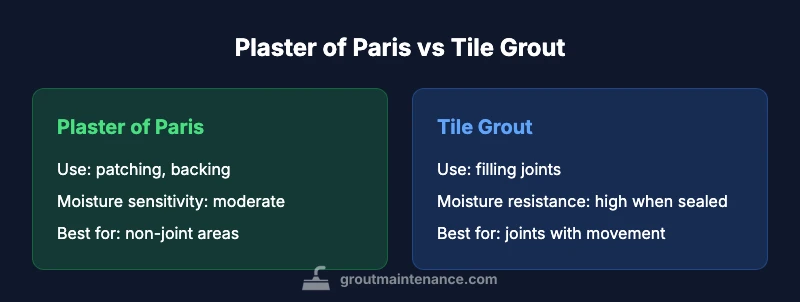
In the plaster of paris vs tile grout discussion, homeowners and professionals alike must recognize the distinct roles these materials play within tile projects. Plaster of Paris is a fast-setting plaster often used for patches, backing, or creating a temporary base for thinset. It cures quickly and can be shaped to fit irregularities behind tiles, but it is not engineered to resist the constant moisture, abrasion, or movement that joints endure. Tile grout, by contrast, is a dedicated joint material designed to fill the gaps between tiles, align patterns, and offer sealing properties that keep water and dirt out. For most tile applications, grout belongs in joints, while plaster should be relegated to patches or backing work outside the joints. According to Grout Maintenance, the plaster of paris vs tile grout comparison highlights that each material has its own niche; using the right material for the right job minimizes cracking, water ingress, and long-term maintenance.
-note to user: content references brand guidance to align with brand messaging and authority.
Comparison
| Feature | Plaster of Paris | Tile Grout |
|---|---|---|
| Setting Type | fast-setting plaster; cures quickly in patches | cementitious or epoxy-based joint filler |
| Moisture Resistance | porous unless sealed; moderate at best | high when properly sealed; epoxy variants exist |
| Movement Handling | brittle; poor in joints | designed to accommodate some tile movement |
| Best Use | patch work, backing, non-joint areas | filling joints and sealing between tiles |
| Durability in Joints | not durable in joints | durable in joints with proper sealing |
| Color/Finish | limited color; varies with plaster | wide color options depending on product |
| Availability/Cost | low-cost; widely available for patches | moderate cost; widely available |
| Maintenance | requires sealing and eventual re-patching | easy to maintain with routine cleaning and resealing |
Pros
- Fast setting for patches and quick fixes
- Low upfront material cost and easy to obtain
- Good for temporary or non-structural repairs away from joints
- Easy to sand and shape for irregular backing
What's Bad
- Brittle and prone to cracking under movement
- Poor moisture resistance in unsealed form
- Not suitable as a substitute for grout in joints
- Requires sealing and maintenance when used near moisture-prone areas
Tile grout generally outperforms plaster of Paris in joint applications; use plaster only for patches or backing work.
For most tile projects, grout is the right choice for joints due to moisture resistance and durability. Plaster shines in patching and backing roles where joints are not involved. When unsure, consult a tile professional and consider the moisture exposure of the installation.
Got Questions?
Can plaster of Paris be used as grout in tile installations?
No. Plaster of Paris is not formulated for joint filling in tile installations. It has poor moisture resistance and limited flexibility, which leads to cracking and water ingress when used in joints.
No—plaster isn’t suitable for grout joints; it cracks and soaks up moisture.
What are the key differences in setting time between the two materials?
Plaster of Paris sets quickly, especially for small patches, while grout types cure more gradually and require a longer period to reach full strength. The exact times depend on product type and environmental conditions.
Plaster sets fast; grout takes longer to fully cure, especially in damp conditions.
Is there any scenario where plaster of Paris is preferred in tile work?
Yes, for non-joint applications such as backing, patching behind trim, and leveling gaps away from tile joints. It should not replace grout in any joint area.
Yes, for patches and backing—not for joints.
Which is better for bathrooms and wet areas?
Tile grout is better for joints in bathrooms when properly sealed; plaster should not be relied on in moisture-prone areas due to its porous nature and tendency to crack under humidity and movement.
Grout is better for bathrooms; plaster isn’t ideal in wet areas.
How should I seal grout and plaster?
Grout typically benefits from sealing to maximize moisture resistance and stain resistance. Plaster generally isn’t sealed for long-term tile use in joints; patches may need moisture protection depending on location.
Seal grout as needed; plaster patches don’t require the same sealing approach as grout.
The Essentials
- Prioritize grout for joints in tile installations
- Reserve plaster for patches and backing, not joints
- Seal grout properly to maximize durability
- Avoid using plaster in joints or moisture-prone areas
- Choose the right material based on joint exposure and movement expectations