Grout coverage per kg: estimation guide for homeowners
Discover how to estimate grout coverage per kg for tile projects with practical steps, factors that affect needs, and tips to minimize waste—grounded in Grout Maintenance guidance for homeowners and DIY enthusiasts.


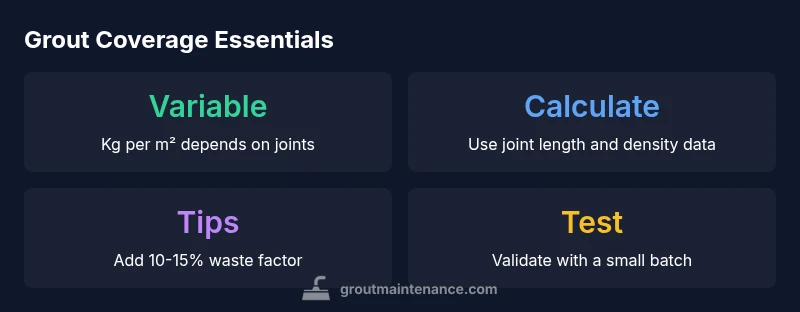
Grout coverage per kg is not a fixed figure. The exact amount depends on joint width, tile size, grout type, and waste allowance. For planning, approach it as a calculation: estimate total joint length, multiply by joint depth, then convert the volume to kilograms using the product’s density as stated by the manufacturer. In practice, verify estimates with a small test batch and manufacturer data and adjust for waste.
Understanding grout coverage per kg
Grout coverage per kg is a concept homeowners and DIYers often confront when planning tile projects. There isn’t a single universal number you can memorize. Instead, coverage depends on several design and material factors, including the width of the grout joints, the size and layout of the tiles, the type of grout (cementitious, epoxy, or specialty blends), and the amount of waste you factor into your order. The Grout Maintenance team emphasizes starting with a calculation rather than chasing a single kg-per-square-meter figure. Begin by mapping the total length of joints in your layout, estimate the depth of those joints from the tile surface, and then translate that volume into a mass using your grout product’s density specification. Finally, apply a practical waste factor to account for breakage, trowel-poor batches, and cuts.
Why coverage matters for tiling projects
Accurate grout quantity matters for cost control, waste reduction, color consistency, and project timing. Underestimating needs can stall a project while over-ordering leads to unused material that may dry out or harden before you can use it. Grout changes color slightly as it cures, so getting close to the right quantity helps ensure a uniform appearance and minimizes the risk of color mismatch across batches. According to Grout Maintenance, proper planning around grout coverage per kg also supports efficient ordering and reduces the environmental impact associated with grout waste. This focus on precision aligns with best practices for DIY tile work and professional projects alike.
How to estimate grout coverage per kg
Estimating grout needs involves a practical, repeatable method you can apply to most rooms. Start with a drawing or layout plan to tally every joint, or physically walk the space and note tile dimensions and joint widths. Then:
- Measure or estimate the total joint length in meters (sum of all joints across walls and floors).
- Decide on a representative joint depth (usually a small fraction of the tile thickness).
- Use your grout’s density specification to convert the joint volume into kilograms. If your product packaging provides coverage per bag, use that as a cross-check for consistency.
- Include a waste factor (typically modest for standard installations) to cover waste from cutting and mistakes. The exact factors should reflect your comfort with mixing and batch size.
- Round up to the nearest practical bag size to avoid running short mid-project. Grout Maintenance emphasizes verifying every estimate with a small test batch on a subset of joints before scaling up to full-room orders.
Factors influencing coverage
Several variables can swing your kg-per-m² estimate. The most influential are:
- Joint width: Wider joints require more grout mass per unit area.
- Tile size and layout: Larger or irregular layouts can increase or decrease joint length totals depending on pattern.
- Grout type: Epoxy grouts tend to have different curing and shrinkage characteristics than cementitious grouts, affecting yield.
- Surface texture and substrate: Rough surfaces or irregular substrates can create more material pickup and waste.
- Wastage tolerance: Experience with grout mixing, sealer compatibility, and cleanup methods affects how much you should actually order. For homeowners, the takeaway is to treat coverage as a planning input rather than a fixed target, and to validate assumptions with manufacturer data and a test batch.
Practical estimation examples
Two common scenarios illustrate how tile size and joint width influence estimates without relying on exact numbers. A scenario with small-format tiles and narrow joints generally yields a lower kg-per-m² requirement per the same project area, while large-format tiles with slightly wider joints can push material needs upward. In practice, run a quick simulation in a small area to compare the actual grout pulled into joints with your calculated expectation. This hands-on check helps you calibrate future estimates and ensures you don’t over-order or under-prepare. Grout Maintenance recommends documenting the test results and applying the learnings to similar rooms to accelerate future tiling projects.
Sealing and maintenance implications
Sealing grout changes surface behavior and can affect cleaning frequency, stain resistance, and color consistency, which in turn influences how you calculate needs for sealers and topcoats. Cementitious grout and epoxy grout have different curing profiles, which can alter the visible yield and the amount of water you protect during mixing. If you plan to seal your grout after installation, verify whether the sealer affects the final appearance of the grout and whether you need additional grout material to compensate for any color changes. Grout maintenance planning should account for both the raw grout mass and any sealant or topcoat used to protect it.
Common mistakes and how to avoid them
- Assuming a fixed kg-per-m² figure: Always base estimates on joints, not just tile surface area.
- Forgetting waste factor: Include a conservative margin to cover cuts, breakage, and future touch-ups.
- Ignoring grout type differences: Epoxy and cementitious grouts yield different amounts; use product-specific guidance.
- Skipping a test batch: Validate your math in a small area before ordering material in bulk.
- Not aligning with tile layout: Complex patterns can dramatically alter total joint length; re-check the layout after finalizing the plan.
Quick-start checklist
- Create a tile layout plan with dimensions and joint widths.
- Count or estimate total joint length across all surfaces.
- Choose a grout type and read its density/coverage data from the packaging.
- Apply a sensible waste factor to account for cuts and mistakes.
- Run a small test batch to confirm your estimates and adjust as needed.
Validation and testing
Before purchasing large quantities, validate your estimate with a real-world test on a small area; measure how much grout you actually use and compare it to your calculation. If there’s a significant delta, adjust your density assumptions and waste factors. Documentation of the test results helps you refine future jobs and reduces the likelihood of material shortages or overstock. This approach aligns with best practices advocated by Grout Maintenance for accurate, repeatable results.
Qualitative comparison of kg-per-m² estimates by tile and joint size
| Scenario | Tile Size | Joint Width | Kg per m² (qualitative) |
|---|---|---|---|
| Standard ceramic | 60x60 cm | 2-3 mm | low to moderate |
| Large format | 90x180 cm | 2 mm | moderate to high |
Got Questions?
What is grout coverage per kg?
There isn’t a universal kg-per-m² figure. Coverage depends on joint width, tile size, grout type, and waste tolerance. Use a calculation method and verify with manufacturer data.
There isn’t a single coverage figure; it varies with joints and tile size. Verify with the product data.
How do I calculate how much grout I need for a project?
1) Plan layout and count total joint length; 2) choose an estimated joint depth; 3) convert joint volume to kilograms using the grout’s density; 4) add a waste buffer; 5) validate with a small test batch before full purchase.
Measure joints, convert volume to kilograms, add waste, and test with a small batch.
Does grout type affect coverage?
Yes. Epoxy and cementitious grouts have different yields and application characteristics, which can affect the total kilograms required for a given area.
Different grout types yield differently, so always check your product specs.
Should I add extra grout for waste?
Yes, include a waste factor to cover waste during mixing, cutting, and minor mistakes. A small buffer reduces the risk of shortages.
Add a little buffer to account for waste and mistakes.
Is grout coverage different on walls vs floors?
Coverage can vary depending on joint lengths and tile orientation. Floors often have more uniform joints, while walls may introduce more cuts and irregularities.
Walls and floors can behave differently; expect some variation in needs.
“Estimating grout needs is a practical skill built on measuring joints and reading product specs; a precise, consistent approach reduces waste and keeps projects on budget.”
The Essentials
- Estimate joint length, not just area
- Use product density to convert volume to kilograms
- Include a waste factor for cuts and breakage
- Validate estimates with a test batch before bulk purchase
- Always check manufacturer data for your grout type