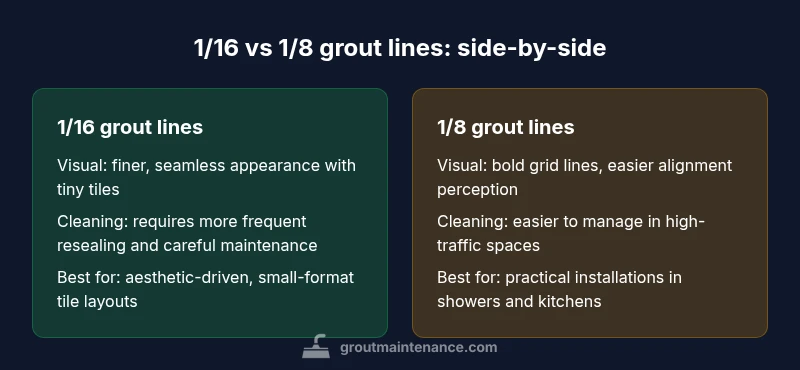
1/16 vs 1/8 grout lines comparison: which width is right for your tile project
A practical, analytical comparison of 1/16 and 1/8 grout lines for tile projects, covering aesthetics, cleaning, durability, installation, and maintenance—by Grout Maintenance.


In the 1/16 vs 1/8 grout lines comparison, the narrower 1/16 inch width delivers a finer, more contemporary look for small-format tiles, but it demands higher installation precision and more vigilant maintenance. The 1/8 inch width offers easier cleaning, greater tolerance for substrate irregularities, and better reliability in high-traffic areas. This TL;DR contrasts aesthetics, cleaning, durability, and cost to help homeowners decide which width fits their tile project.
Why grout line width matters
Grout line width is more than a design choice; it governs how a tile installation looks, how easy it is to clean, and how it holds up over time. In this 1/16 vs 1/8 grout lines comparison, homeowners weigh aesthetics against practicality, especially in moisture-prone areas like showers and backsplashes. Narrow gaps create a near-seamless, refined look, particularly with small-format tiles and mosaics. They also enforce exacting standards for tile flatness and spacing. Grout maintenance becomes more conspicuous with ultra-narrow lines, so sealing, stain resistance, and routine cleaning take on heightened importance. The Grout Maintenance team emphasizes that width decisions cascade into substrate prep, mortar type, spacing accuracy, and sealing strategies across bathroom and kitchen projects alike.
The goal of this article is to provide a clear, evidence-based framework you can apply to real-world installations, from coastal gray subway stacks to glossy ceramic mosaics. By the end, you’ll understand how 1/16 grout lines comparison translates into appearance, upkeep, and long-term value for your space. The analysis also highlights when a wider line may be the smarter choice, reducing maintenance burdens without sacrificing style. This is not about chasing a single trend but about matching width to tile format, environment, and your DIY or professional capabilities.
mainTopicQuery2(ignored)
Comparison
| Feature | 1/16 grout lines | 1/8 grout lines |
|---|---|---|
| Visual impact | Delicate, almost seamless look that can maximize tile surface for tiny formats | Bolder outlines that define each tile edge, often enhancing mid-size to large formats |
| Cleaning ease | More grout surface to clean per area; subtle staining can be more visible | Easier wiping and scrubbing with thicker grout where dirt pools less visibly |
| Installation tolerance | Requires higher precision; small variations are more noticeable | More forgiving of substrate irregularities and spacing tolerances |
| Durability and movement | Narrow lines can crack if substrate shifts; movement is more visible | Wider lines tolerate some movement without showing cracks as readily |
| Maintenance frequency | May require more frequent sealing and stain prevention in porous grouts | Typically longer reseal intervals if cement-based grout is well sealed |
| Cost and labor | Slightly longer installation time due to tighter tolerances | Comparable material costs with faster grouting in practice for installers |
| Best for | Aesthetic-focused projects; small-format tiles; contemporary looks | High-traffic spaces where cleaning practicality matters and ease of maintenance is key |
Pros
- Narrow 1/16 lines deliver a refined, contemporary look that suits small tiles
- 1/8 lines offer easier maintenance and cleaning in busy areas like showers or kitchens
- Narrow lines maximize tile surface area on tiny formats, producing a cleaner overall appearance
- Wider lines provide more tolerance for installer variability and substrate irregularities
- Both widths can be sealed to improve stain resistance when chosen with appropriate products
What's Bad
- 1/16 lines demand higher installation precision, increasing labor time
- Narrow lines stain more visibly and may require more frequent sealing
- 1/8 lines can appear busier on very small tiles, potentially reducing a minimalist look
- Maintenance costs can add up if regular sealing and cleaning are neglected
Choose 1/16 grout lines for a sleek, contemporary look on tiny tiles when you can ensure precise installation; opt for 1/8 grout lines for practicality and easier maintenance in high-traffic spaces.
The 1/16 option excels in aesthetics with small tiles, but hinges on skilled workmanship and diligent care. The 1/8 option sacrifices some visual sharpness for resilience against movement and simpler upkeep. Your choice should balance tile format, expected wear, and your maintenance plan.
Got Questions?
What are the visual differences between 1/16 and 1/8 grout lines?
Visually, 1/16 grout lines appear finer and can make small-format tiles look almost like a solid surface. 1/8 lines are more prominent, which can enhance the grid pattern and tile edges, especially with mid-size tiles. The choice affects perceived tile size and overall room brightness.
1/16 lines look sleek and subtle, while 1/8 lines emphasize the grid and tile edges.
Are 1/16 grout lines more prone to staining?
Narrower lines have more grout surface area per tile row, which can make staining and sealant wear more noticeable if the grout is porous. Proper sealing and cleaning routines reduce this risk significantly.
Yes, they can stain more clearly if not sealed well, so regular maintenance helps.
Which width is better for showers?
For showers, 1/8 inch lines are often preferred because they are easier to clean and seal, and they handle moisture exposure with less risk of visible staining from mildew and soap scum.
In showers, 1/8 inch is usually the safer, more maintenance-friendly choice.
Can you retrofit existing grout to a different width?
Modifying grout width in an existing installation typically requires removal and regrouting. The process is labor-intensive and preferable to plan during initial installation when possible.
Regrouting to a different width is usually a full replacement task.
How do tile format and spacing affect width choice?
Tiny tiles or mosaics benefit visually from 1/16 lines, while larger formats and irregular sets often work better with 1/8 lines to hide slight misalignments. Always verify tile flushness and use proper spacers.
Tile size and spacing guide the width choice.
What maintenance steps extend the life of narrow grout?
With narrow grout, use high-quality sealants, clean regularly with pH-neutral cleaners, and reseal on schedule. Address any cracking early to prevent deeper damage.
Seal it well and clean gently to keep narrow grout looking great.
The Essentials
- Match width to tile size for optimal aesthetics
- Expect higher precision and sealing needs with 1/16 lines
- Prefer 1/8 lines for high-traffic, maintenance-heavy areas
- Consider substrate quality and installation skill before choosing
- Budget time and labor when planning for narrow joints