Hard grout vs soft grout: A practical guide for DIY tile projects
Explore hard grout vs soft grout, including durability, sealing needs, cleaning, and repair considerations for tile projects. Learn which option fits kitchens, bathrooms, and outdoor spaces with practical guidance from Grout Maintenance.


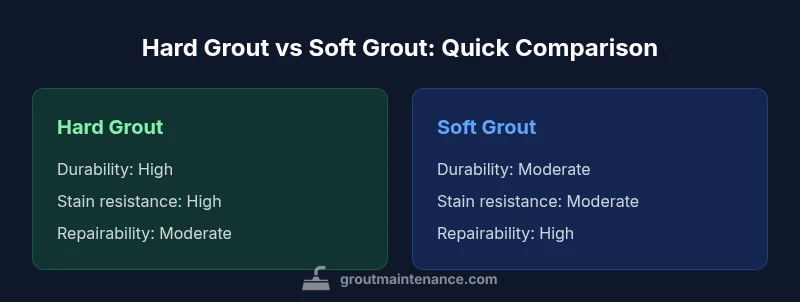
Hard grout generally delivers superior durability and stain resistance, but it can be harder to apply and repair. Soft grout is easier to work with and more forgiving on renovations, yet it tends to wear faster and absorb moisture more readily. This comparison highlights key differences in performance, maintenance, and value to help homeowners decide which to use for tile projects.
What hard grout vs soft grout actually means
Hard grout and soft grout terms describe different material properties and performance patterns in tile installations. In practice, hard grout often refers to epoxy or specially reinforced cementitious mixes that cure into a dense, rigid matrix. Soft grout typically means traditional cementitious grout, which remains a bit more flexible and easier to compress into joints. According to Grout Maintenance, understanding these distinctions helps homeowners predict maintenance needs, installation difficulty, and long-term results across kitchens, bathrooms, and outdoor surfaces. When you hear the phrase hard grout vs soft grout, think durability and ease of care rather than mere appearance. The choice you make should align with room usage, budget, and willingness to perform upkeep.
Durability and wear: how hardness affects longevity
Durability is often the primary reason homeowners choose hard grout over soft grout, or vice versa. Hard grout types, including epoxy and high-quality cementitious mixes, resist micro-scratches and abrasion better over years of foot traffic and chair wheels. They tend to maintain their surface integrity in humid environments, reducing the risk of crumbly joints and crumbling edges. Soft grout, while easier to install and repair, can show wear more quickly in high-traffic zones or with heavy cleaning. Over time, color consistency may drift as dirt particles settle into micro-cracks. When evaluating hard grout vs soft grout for a foyer or shower surround, consider how many days per week the space sees use, whether heavy cleaning products will be used, and whether you expect joint movement from shifting substrates.
Stain resistance and moisture management
Stain resistance is another key difference. Hard grout types with dense matrices repel many stains better than traditional soft grout, especially when properly sealed. In wet areas like showers or mudrooms, a dense hard grout helps minimize moisture intrusion, reducing the potential for efflorescence and mold. Soft grout, even when sealed, retains more porosity and can show discoloration from water spots or mineral deposits over time. Regular cleaning with pH-neutral cleaners and avoiding harsh acids protects either type, but space design matters: vertical surfaces may experience more runoff, while horizontal joints collect grime. Grout maintenance routines should factor in whether the area has hard water or frequent spills.
Installation, cure time, and repairability
Hard grout generally requires more careful mixing, surface preparation, and precise application. Epoxy grout is less forgiving of sloppy joints, and repair can be more complex if chips occur. Many craftsmen prefer a dedicated epoxy toolset and proper ventilation because the resin-based matrix cures quickly and can be resistant to solvent cleanup. Soft grout installation is typically faster and more forgiving, making it popular among DIYers. Repairs are easier because material can be chipped out and re-sealed without significant surface recovery. However, some cementitious grouts may shrink or crack if joints aren’t properly prepared or if substrate movement occurs. In both cases, use clean tools and follow manufacturer guidelines for curing times and temperature ranges.
Sealing, cleaning, and maintenance implications
With hard grout, sealing may be less critical for some epoxy formulas, yet many epoxy blends still benefit from routine cleaning and occasional resealing of the surrounding tiles. Cementitious soft grout often requires sealing to improve stain resistance and water resistance, especially in moist environments. The sealing choice affects how easy cleaning will be over time: hard grout is more resistant to staining but can show soap scum more visibly if not cleaned regularly; soft grout reveals dirt quicker and may require more frequent color sealers in distinctive colors. Cleaning strategies should center on non-abrasive brushes, gentle detergents, and avoiding harsh chemicals that degrade the grout matrix. Regular inspections for cracks or gaps help catch problems early.
Repair scenarios across rooms
Room-specific factors change how hard grout v. soft grout performs in practice. In bathrooms, where moisture is persistent, hard grout often outperforms soft grout by resisting staining and moisture in joints. Kitchens benefit from durable, stain-resistant grout near sinks and backsplashes, but cost and installation complexity must be weighed. Living areas with radiant floor heating may experience subtle joint movement that soft grout handles more gracefully, while hard grout’s rigidity could complicate repairs. Outdoor spaces introduce UV exposure and weathering; some hard grout formulations offer superior fade resistance, but repairs can require more effort. The key is to anticipate joint movement, moisture exposure, and accessibility for repairs when deciding between hard and soft options.
Cost considerations and value over time
Price is a practical driver in most renovations. Soft grout typically has a lower upfront material cost and lighter labor requirements, making it attractive for quick updates. Hard grout, particularly epoxy alternatives or reinforced cementitious products, commands higher material costs and skilled labor, which translates into higher initial investment. Yet the longevity and lower maintenance frequency of hard grout can offset the upfront expense in bathrooms and high-traffic floors. When comparing hard grout vs soft grout, homeowners should estimate the total cost of ownership over the tile’s expected life, including sealing, cleaning products, and potential regrouting projects. A well-chosen grout can pay for itself through reduced upkeep.
Real-world testing and best practices
In practice, many homeowners report mixed results with hard grout vs soft grout depending on implementation. Real-world tests emphasize proper substrate prep, joint width, and the correct sealant or grout system for water exposure. Best practices include clear communication with suppliers about room conditions, following recommended mixing ratios, and using the appropriate tools for your chosen grout type. In high-humidity rooms, consider grouts with moisture resistance ratings and compatibility with existing tiles. The Grout Maintenance team often recommends a small, trial section before committing to a full installation, especially for DIY projects. This approach helps you observe performance across a few months and adjust maintenance routines as needed.
Common myths and misperceptions
A common myth is that all hard grout automatically lasts longer without maintenance. While hard grout can offer superior durability, improper sealing, cleaning, or substrate preparation can shorten its lifespan. Another misconception is that soft grout cannot be effective in modern homes; with correct sealing and careful maintenance, soft grout remains a strong choice for certain tile layouts and budgets. Some enthusiasts assume that epoxy grout never needs maintenance; in reality, even epoxy varieties benefit from routine cleaning to prevent buildup and discoloration on light-colored joints. Finally, many assume that color consistency is assured with hard grout; color variation can occur if the grout mix isn’t uniform or if joints are too wide.
Choosing for the space: kitchen, bath, or outdoor area
Selecting between hard grout vs soft grout starts with the space and function. For showers and backsplashes where moisture and staining are concerns, hard grout frequently delivers better results and longer intervals between regrouting. In busy kitchens, a balanced choice between durability and workability can guide your decision; some projects benefit from a semi-hard or reinforced cementitious option that allows for easier repair while still offering good resistance. Outdoor installations must account for weather cycles, UV exposure, and temperature changes; certain hard grout formulations resist fading and cracking better under these conditions. Always verify compatibility with tile type and substrate, and plan a maintenance schedule that aligns with usage.
Summary of performance traits
The hard grout vs soft grout comparison boils down to a few measurable traits: durability under wear, moisture and stain resistance, ease of application and repair, and long-term value. Hard grout excels in durability and stain resistance, particularly in wet zones, making it a strong choice for showers and floors with high traffic. Soft grout shines in ease of installation and cost, appealing to DIY projects or spaces with limited access for maintenance. Both options can deliver satisfactory results if selected with room conditions in mind and if maintenance routines are observed. This nuanced view supports homeowners in choosing a grout strategy that matches their goals and capabilities.
Maintenance planning and long-term care
Effective maintenance is the hinge that determines whether hard grout vs soft grout reaches its full potential. Establish a routine that fits the grout type, room humidity, and usage. For hard grout, schedule periodic cleaning with non-abrasive tools and consider tint sealers or color-enhancing products to preserve appearance. For soft grout, emphasize prompt moisture control, regular resealing, and timely regrouting when joints begin to show cracks or color loss. Record maintenance dates, products used, and observed performance to guide future upgrades. By aligning maintenance with the grout system, homeowners can maximize life expectancy and minimize costly repairs over time. The Grout Maintenance team reminds readers that proactive care is a practical, achievable strategy for most homes.
Comparison
| Feature | Hard grout | Soft grout |
|---|---|---|
| Durability / wear | High, best for high-traffic areas | Moderate, more prone to wear over time |
| Moisture resistance | Excellent with dense matrix (esp. epoxy) | Good when sealed, but more porous |
| Stain resistance | Excellent, especially with proper cleaning | Moderate to good; stains can show more readily |
| Ease of installation | Challenging; often requires skilled installation | Easier for DIYers; faster curing |
| Repairability | More difficult; repairs can be invasive | Easier; patches and resealing are common |
| Cost (material/labor) | Higher upfront cost and specialized labor | Lower upfront cost; labor-friendly |
| Best for | Moisture-prone, high-traffic areas (showers, floors) | Budget-conscious projects, simple renovations |
Pros
- Durable and long-lasting in wet areas
- Excellent stain resistance with proper cleaning
- Low maintenance when properly selected for the space
What's Bad
- Harder to install and repair, especially for DIYers
- Higher upfront material and labor costs
- Limited flexibility in some remodeling contexts
Hard grout is often the better long-term choice for moisture-prone, high-traffic spaces; soft grout remains viable for simple projects where ease of installation matters
The Grout Maintenance team recommends choosing based on space, use, and maintenance willingness. For showers and wet areas, hard grout is often preferred, while soft grout works well for DIY-friendly projects. The Grout Maintenance team's verdict is to balance durability with installability for best results.
Got Questions?
What is hard grout vs soft grout?
Hard grout usually refers to epoxy or reinforced cementitious mixes that cure into a dense, rigid matrix, while soft grout denotes traditional cementitious grout that remains more flexible. In practice, hard grout excels in durability and stain resistance, whereas soft grout offers easier installation and repair. Your space, budget, and maintenance willingness should guide the choice.
Hard grout is a dense, durable option often epoxy-based; soft grout is the standard cementitious choice that’s easier to install but wears faster. Your project should balance toughness with ease of work.
Which grout type lasts longer in moist rooms?
In moist rooms, hard grout (especially epoxy) tends to last longer due to its low porosity and resistance to moisture-related staining. Soft grout can perform well with proper sealing and maintenance, but it remains more susceptible to moisture intrusion over time.
Hard grout typically lasts longer in damp spaces, but proper sealing helps soft grout too.
Can you convert to hard grout later after installation?
You can switch to a harder grout by removing the existing soft grout and regrouting with a harder formulation, but this is a full rework. Plan for downtime and substrate preparation. It’s best to decide early and install the preferred system the first time.
You can switch later, but it means a full regrout job and time without tiled surfaces.
Does epoxy grout require sealing?
Epoxy grout typically does not require sealing because of its non-porous matrix. However, some epoxy blends benefit from routine cleaning and occasional maintenance to prevent buildup and ensure color retention. Always follow the manufacturer’s guidance.
Epoxy grout usually doesn’t need sealing, but keep it clean to prevent buildup.
What cleaning methods work best for hard and soft grout?
Use non-abrasive brushes and pH-neutral cleaners for both grout types. Avoid acidic or caustic products that can degrade the grout matrix. For hard grout, a non-scratch pad helps keep the surface bright; for soft grout, gentle cleaning minimizes wear.
Gentle cleaning with a soft brush and a pH-neutral cleaner works best for both.
How long does grout typically last before replacement?
Lifespan depends on usage, environment, and maintenance. In moisture-rich areas, hard grout often outlasts soft grout, but proper cleaning and timely resealing or regrouting are key for any system. Plan for periodic inspections and proactive upkeep.
Durability varies, but hard grout often lasts longer in wet areas with good upkeep.
The Essentials
- Assess usage and moisture exposure before choosing grout
- Hard grout offers durability but can be harder to install
- Seal or choose epoxy grout for moisture-prone spaces
- Plan maintenance to maximize grout life