High Performance Grout vs Sanded Grout: Which Is Best for Your Tile Project?
A thorough comparison of high performance grout and sanded grout, focusing on durability, joint width, maintenance, cost, and best-use scenarios for homeowners and DIY enthusiasts.


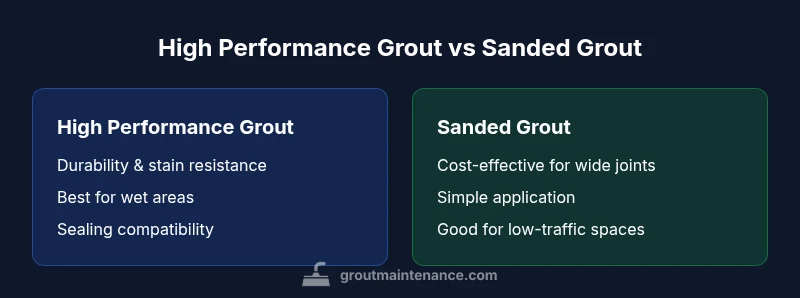
TL;DR: High performance grout usually offers greater durability, stain resistance, and long-term stability than standard sanded grout, especially in wet or heavy-use areas. Sanded grout remains a cost-effective option for typical wide joints and low-traffic spaces. The best choice hinges on joint width, exposure, and maintenance plans. According to Grout Maintenance, evaluating porosity, hardness, and cleaning frequency helps you decide which grout to use.
Understanding the basics of high performance grout vs sanded grout
High performance grout and sanded grout are designed to fill joints between tiles, but they use different chemistries and serve different purposes. High performance grout typically contains advanced polymers and micronized cement blends that improve flexibility, stain resistance, and water absorption control. Sanded grout relies on cementitious binders with larger aggregates that add strength but can be more abrasive to delicate tile edges. According to Grout Maintenance, homeowners and DIYers should start by identifying the joint width and tile material before choosing a grout family. In practice, this means you’re often deciding between a product that prioritizes long-term wear resistance and color stability (high performance) versus a more economical option for standard joints (sand). The distinction isn’t merely marketing: the chemistry affects curing, cleaning, and future repairs. For tiles in wet areas such as showers, kitchens, and backsplashes, the performance gap between these grouts is most visible in stain resistance and resilience to soap scum, mold, and mineral deposits. Review the project’s exposure — the room’s moisture, temperature swings, and foot traffic — because these factors drive long-term outcomes more than short-term appearance. Throughout this guide, you’ll see how the two grout options handle different conditions and how to align choice with your goals.
In this comparison we’ll break down the core differences, provide practical guidelines, and show how to decide between high performance grout vs sanded grout for different tile types and environments.
How joint width and tile type influence grout choice
Joint width is often the most important practical factor when deciding between high performance grout vs sanded grout. Narrow joints, typically under a quarter inch, benefit from the enhanced density and reduced shrinkage of high performance formulations, which also help prevent cracking that can occur with coarser aggregates. Wider joints, on the other hand, can tolerate sanded grout’s texture and easier tooling, while keeping costs down. Tile type matters too: glazed porcelain and dense ceramic tiles may resist staining better with a high performance formula, while natural stone often requires sanded grout for mechanical grip and to minimize edge scratching by grit. You should also consider grout color uniformity, as pigment-rich high performance mixes can offer steadier hues when exposed to daily cleaning routines. Always test a small sample and check cure times in the manufacturer’s spec, especially if you’re converting from one grout type to another on an existing installation. The goal is a consistent color, durable texture, and predictable cleaning results over time. The decision should balance performance needs with budget constraints and installation practicality.
Durability and stain resistance: what the numbers tell you
Durability in grout is a function of compressive strength, porosity, and resistance to abrasion, with high performance grout typically engineered to resist moisture intrusion and soap scum more effectively than standard sanded mixes. In practical terms, this translates to longer intervals between deep cleans and fewer visible discolorations in high-traffic zones. Stain resistance is particularly relevant in kitchens and showers, where acidic cleaners, mineral deposits, and dyes from foods and beverages can alter appearance. While sanding grit provides physical strength, it can trap dirt in the joints and harbor mildew if the grout becomes faded or cracked. From a maintenance perspective, high performance grout often accepts semi-sealing or penetrating sealers better, facilitating easier cleanup and longer-lasting color. However, some specialty high performance blends may require specific sealers or cleaning regimens; always follow the manufacturer’s guidelines to avoid voiding warranties. For many homeowners, high performance grout vs sanded grout is a decision about how much maintenance you’re willing to perform over time.
Application and maintenance: mixing, curing, sealing
Selecting between high performance grout vs sanded grout begins with correct mixing ratios and consistent particle distribution. High performance formulas frequently require precise water addition and sometimes slower curing to achieve maximum strength and crack resistance. Sanded grout, while more forgiving in handling, benefits from thorough compaction and vibration to minimize voids. Cure times depend on ambient temperature and humidity; high humidity can slow curing but improve durability as moisture assists polymer hydration. Sealing decisions vary by grout type and tile substrate: many experts recommend sealing with a penetrating grout sealer for glass or polished stone, while epoxy-style or polymer-modified sanded grouts may offer inherent moisture resistance. If you do seal, choose a product compatible with your grout type to avoid hazing or color changes. In this section, you’ll see practical steps: prepare joints, mix to the recommended consistency, apply evenly, clean excess grout promptly, and maintain a routine cleaning schedule to protect color and texture over time. The emphasis is on proper technique to maximize performance in real-world conditions.
Cost, value, and lifecycle considerations
When homeowners plan a tile project, cost is often a decisive factor. High performance grout typically commands a higher upfront material price and may require more careful installation, which can influence labor costs. Sanded grout provides a more economical option for large-area floor installations or maintenance rounds, especially where joint widths allow for simpler tooling. Over the lifecycle, many users find that high performance grout delivers better stain resistance and longer intervals between regrouting or deep cleaning, translating into savings in maintenance time and product usage. In moisture-prone spaces, the durability and reduced discoloration of high performance mixes can offset initial price differences; in dry, low-traffic areas, sanded grout may be perfectly adequate. It’s important to weigh not just the sticker price but the total cost of ownership: expected lifespan, frequency of resealing or recoating, and the cost to restore color if you later switch tile colors or remove the installation. This is where the debate of high performance grout vs sanded grout becomes practical: value is determined by how you use and care for the grout over time.
Practical scenarios: best fits by room and tile material
In showers and backsplashes with consistent moisture, high performance grout often wins on long-term cleanliness and color stability. For large, dry-floor kitchens and laundry rooms with broad tile patterns and standard joint widths, sanded grout can be the sensible choice. For natural stone tiles that may be subject to etching or staining, consider a high performance grout that is compatible with stone and resists mineral deposits. For small-format tiles in a bathroom with narrow joints, a high performance blend provides smoother grout lines and reduced maintenance. If you are regrouting an older installation, evaluate whether the existing grout is cementitious or epoxy-based; some projects require removing old material before applying a compatible product. Ultimately the best decision relies on joint width, tile type, moisture exposure, and your willingness to perform routine cleaning and periodic resealing. Grout maintenance routines should reflect which grout type you choose and how aggressively you want to preserve color and texture.
Quick-start decision framework: a 5-step checklist
Step 1: Measure joint width and note tile material. Step 2: Assess moisture exposure and expected wear. Step 3: Consider color stability and cleaning frequency. Step 4: Compare manufacturer specs for durability, mold resistance, and cure times. Step 5: Decide based on total lifecycle cost and maintenance load. This framework helps you avoid choosing based only on price or appearance. Remember, high performance grout vs sanded grout is not a universally fixed rule; it’s a practical choice tuned to your project’s demands. The Grout Maintenance approach emphasizes testing, planning, and aligning with long-term maintenance goals.
The role of seals, cleanliness, and regrouting planning
Seals and routine cleaning can extend the life of either grout type, but high performance formulations often respond better to sealing in terms of color retention and mold resistance. Cleaning strategies should be compatible with the grout’s chemistry to avoid hazing or wear to the surface. Planning for eventual regrouting or color changes is part of responsible project management: if you anticipate updating tile colors or expanding a space, choose a grout with easier color restoration or replacement options. In short, the choice between high performance grout vs sanded grout should be made with an eye toward long-term maintenance, not only initial aesthetics.
Comparison
| Feature | high performance grout | sanded grout |
|---|---|---|
| Joint width suitability | Excellent for narrow joints; reduces risk of cracking | Better for wider joints; more forgiving and economical |
| Moisture and stain resistance | Typically superior in wet areas and stain resistance | Good for dry areas; moderate moisture resistance |
| Durability under abrasion | High resistance to wear and color retention | Strong but can show wear in heavy traffic pockets |
| Color options and finish | Often maintains color with proper sealing and cleaning | Color can vary with mineral content and usage |
| Ease of application & cure time | May require precise mixing and longer cure | More forgiving in mixing and faster curing in some blends |
| Lifecycle cost / maintenance | Higher upfront cost but lower long-term maintenance in tricky areas | Lower upfront cost but more frequent maintenance in some installations |
| Best for | Wet areas, high traffic, stone or epoxy alternatives | Budget projects, wide joints, dry spaces |
Pros
- Better durability and stain resistance in wet and high-use areas
- Longer lifespan reduces maintenance frequency
- Improved mold resistance with proper sealing
- More predictable color retention when maintained
What's Bad
- Higher upfront material and installation costs
- Requires careful mixing and curing; user error can degrade performance
- Limited color options in some blends
- Some products may require sealing or specialty cleaners
Grout Maintenance Team recommends high performance grout for wet and high-traffic areas; sanded grout remains suitable for budget projects.
In challenging environments like showers or busy kitchens, choose high performance grout. For flat-price decisions or dry-space installations with wide joints, sanded grout is a viable alternative. The best approach often blends both: prioritize high performance in critical zones and reserve sanded grout for broader, lower-risk areas.
Got Questions?
What is the key difference between high performance grout and sanded grout?
The key difference is chemistry and performance: high performance grout uses polymers and refined cement blends for improved durability and stain resistance, while sanded grout relies on larger aggregate particles and may be more economical. Both require proper sealing and maintenance to maximize lifespan.
High performance grout offers better durability and stain resistance, while sanded grout can be a cheaper choice for standard joints. Both need proper sealing and maintenance.
Where is high performance grout most beneficial?
High performance grout is most beneficial in wet areas, high-traffic zones, and installations using delicate or porous tiles. It helps prevent staining, cracking, and color changes over time.
Best in wet areas and high-traffic spots; it keeps colors longer and resists stains.
Can sanded grout be used in wet areas?
Sanded grout can be used in some wet areas, but it may show wear and discoloration sooner than a high performance alternative. Choose based on joint width and maintenance willingness.
It can work in wet areas, but may wear faster than high performance grout.
Do I always need to seal grout?
Sealing is recommended for most cementitious grouts, especially in porous or natural stone settings. Some modern high performance blends are less porous, but sealing can still help with color longevity and mold resistance.
Most grouts benefit from sealing to keep colors true and prevent mold.
How long does grout typically last with proper maintenance?
With proper maintenance, grout can last many years. The exact lifespan depends on joint width, tile type, exposure, and cleaning frequency. High performance grout often extends the time between deep cleans and regrouting.
If you maintain it well, grout lasts for many years, especially the high performance type.
The Essentials
- Assess joint width first to guide grout choice
- Prioritize moisture exposure for durability decisions
- Consider lifecycle cost, not just upfront price
- Follow manufacturer mixing and sealing guidelines