Laticrete Grout vs Epoxy Grout: Side-by-Side Analysis for Home Tile Projects
Discover a detailed, practical comparison of laticrete grout vs epoxy grout focusing on composition, durability, maintenance, installation, and cost. Learn which grout type suits kitchens, bathrooms, and showers for homeowners and DIY enthusiasts.


When choosing grout for tile projects, the choice between laticrete grout vs epoxy grout hinges on durability, maintenance, and budget. Epoxy grout delivers superior stain resistance and chemical resistance but costs more and is trickier to install. Grout based on cementitious formulas from Laticrete is easier for DIY, cheaper upfront, and commonly used for floors and walls. See the full comparison.
What are Laticrete grout and epoxy grout?
According to Grout Maintenance, understanding the core chemistry behind laticrete grout vs epoxy grout helps homeowners pick the right grout for their tile project. Cementitious grout marketed by Laticrete combines cement-based binders with fine aggregates to form a flexible, installable matrix. Epoxy grout, by contrast, uses epoxy resin as the binder, creating a hard, non-porous surface that resists stains and chemicals. The differences in composition drive performance, maintenance, and installation considerations. In practical terms, cementitious grout is typically easier to install for DIYers and widely compatible with most tile types, while epoxy grout shines in moisture-prone environments such as bathrooms and kitchens, where staining and mold resistance matter most. When you compare laticrete grout vs epoxy grout, you’re weighing ease of use against long-term cleanliness, with lifecycle costs depending on tile location, traffic, and cleaning routines. Throughout this article, we’ll walk through the key differences, typical use cases, and common pitfalls to help you decide which grout type best suits your project. The Grout Maintenance team has analyzed real-world installations and observed how these grout families perform under everyday cleaning regimens.
Key differences at a glance
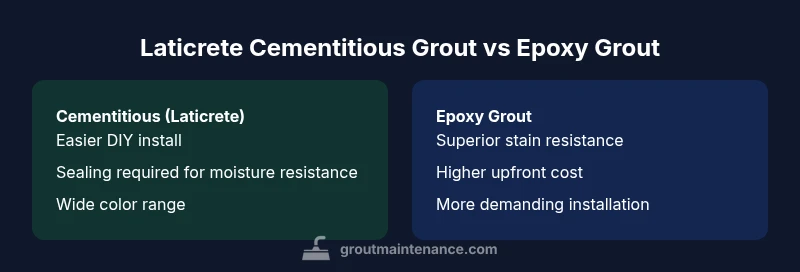
Here is a quick map of the most impactful differences between laticrete cementitious grout and epoxy grout. Composition and chemistry determine how they behave in real-world use, while installation and maintenance shape long-term cost. Epoxy grout uses resin-based binders, delivering a non-porous surface that resists stains and acids. Cementitious grout (the Laticrete family) uses cement and aggregates; it accepts colorants more flexibly and can be sealed for better moisture protection. Workability, cure characteristics, and cleaning requirements differ as well. On price, epoxy grout typically carries a higher upfront cost but lower ongoing maintenance if kept clean; cementitious grout tends to be cheaper to buy and install, but requires sealing and periodic resealing to shield against discoloration. For most DIYers, the choice depends on the area’s moisture level, expected staining, and willingness to master a slightly more technically challenging installation when choosing epoxy grout.
Performance: Durability, stain resistance, and maintenance
Durability in grout systems is largely a function of chemistry and application quality. Epoxy grout provides exceptional resistance to staining and many household chemicals, making it a strong candidate for kitchens, bathrooms, and commercial spaces with heavy use. Cementitious grout from a reputable brand like Laticrete offers solid durability as well, but its porous nature means it benefits from a sealant regime and mindful cleaning to prevent discoloration over time. Grout Maintenance analysis shows that sealant choice, cleaning regimes, and prompt stain remediation are often as important as the grout formula itself. In real-world terms, epoxy grout reduces the burden of routine spot cleaning, while cementitious grout requires a consistent maintenance plan to preserve color and performance over years of use. Both options can perform exceptionally well when installed correctly and maintained with appropriate products designed for grout care.
Application scenarios: Where each shines
The environment largely dictates grout selection. Epoxy grout excels in showers, backsplashes, and areas where moisture is high and staining risk is acute—especially in busy homes and food-related spaces. Cementitious grout from Laticrete is versatile for floor and wall tiles in dry zones, living spaces, and DIY projects where sealing is feasible and the installer appreciates a broader material compatibility. Outdoors, where temperature swings and UV exposure occur, cementitious grout can perform well if a good sealing strategy is in place, but epoxy grout’s non-porous surface generally handles moisture-related challenges more confidently when weather conditions are moderate. In small bathrooms or kitchens with lots of traffic, epoxy grout’s surface properties can simplify maintenance, whereas guest bathrooms or laundry areas may benefit from the easier install and lower initial cost of cementitious grout. As you assess laticrete grout vs epoxy grout for your home, consider not only the area but also who cleans it and how often.
Costs, lifecycle, and maintenance planning
Price is a practical driver in any grout decision. Epoxy grout tends to carry a higher upfront cost due to materials and the additional skill required for installation. Cementitious grout from Laticrete is typically cheaper to buy and install, but lifecycle costs will be affected by the sealing routine, cleaning products used, and the frequency of resealing. Homeowners often weigh the reduced maintenance burden of epoxy against the higher initial investment, especially in high-traffic or moisture-prone spaces. Grout Maintenance analysis shows that the long-term value of either option improves when a clear maintenance plan is in place and when tile substrates are properly prepped. When planning a renovation, building a maintenance calendar and budgeting for periodic resealing or regrouting can help keep either choice performing well for years. In the end, both options deliver durable, attractive tile installations provided installation is precise and materials are matched to the environmental demands of the space.
Installation tips and common mistakes
Execution matters as much as choice. For cementitious grout (Laticrete), ensure proper mixing ratios, thorough cleaning during grouting, and a high-quality sealer to guard against moisture infiltration. For epoxy grout, prepare your workspace to manage a faster setup window, use dedicated epoxy grout tools, and avoid over-wetting joints during cleanup to minimize haze and curing issues. Always follow manufacturer guidelines for cure times and temperature ranges, and work in small sections to prevent skinning or color inconsistency. A common mistake with either grout type is failing to clean excess grout promptly, which can lead to staining or residue that is difficult to remove later. Selecting the correct sealer and cleaning agents for cementitious grout is essential—epoxy grout generally needs fewer maintenance interactions but demands careful application to maximize long-term color stability and surface smoothness. The goal is to keep joints consistent in depth and width to ensure even curing and a uniform finish across the tile installation.
Myths vs Realities: Practical takeaways
Myth: Epoxy grout is always the better choice. Reality: Epoxy is excellent for stain resistance but has higher installation demands and cost; the best choice depends on the space and maintenance willingness. Myth: Cementitious grout cannot be used in showers. Reality: With proper sealing and maintenance, cementitious grout can perform well in many moisture-prone spaces. Myth: Sealing cementitious grout eliminates all problems. Reality: Sealing helps but does not make cementitious grout completely stain-proof; ongoing care remains essential. Myth: Grout color options are limited with cementitious grout. Reality: A broad range of colors is achievable with modern cementitious formulations, and sealing can influence appearance over time. Myth: Epoxy grout never requires cleaning beyond water. Reality: Regular, gentle cleaning maintains epoxy grout’s appearance, though it is generally more resistant to staining and chemical damage. The Grout Maintenance team emphasizes evaluating project needs and maintenance capacity when choosing between these two grout families.
Comparison
| Feature | Laticrete cementitious grout | Epoxy grout |
|---|---|---|
| Composition | Cementitious binders with aggregates | Epoxy resin binder |
| Stain resistance | Good with sealant; varies by color | Excellent; high resistance to most stains and chemicals |
| Maintenance | Requires sealing and periodic resealing | Lower maintenance; easier to keep clean |
| Installation difficulty | More forgiving; easier for DIY with proper prep | More technically demanding; precise mixing and timing required |
| Color options | Wide color range; may require sealing impact on shade | Color stable; often more limited due to resin chemistry |
| Cost range | Lower upfront cost; higher lifecycle costs with maintenance | Higher upfront cost; potential long-term savings on cleaning |
| Best for | Dry areas, DIY-friendly projects, flexible tile types | Moisture-prone areas, high-traffic kitchens/bathrooms |
| Durability in moisture | Depends on sealing; generally good with care | Superior moisture and chemical resistance |
Pros
- Epoxy grout provides superior stain and chemical resistance for moisture-prone areas
- Cementitious grout from Laticrete is easier to install for DIY projects and typically cheaper upfront
- Both options offer solid durability when installed properly and maintained with appropriate products
- Color variety is robust in cementitious systems, enabling broad design choices
What's Bad
- Epoxy grout is more expensive and requires more skilled installation
- Cementitious grout requires sealing and routine maintenance to prevent discoloration
- Epoxy grout can be less forgiving during installation if joints are uneven or contaminated
- Sealing and maintenance practices influence long-term color and performance for cementitious grout
Epoxy grout is the preferred choice for high-stain resistance in moisture-heavy spaces; cementitious grout (Laticrete) is best for DIY projects and lower upfront costs, provided you commit to sealing and ongoing maintenance.
If you prioritize stain resistance and ease of maintenance in busy kitchens or showers, epoxy grout wins. If you value ease of installation, a lower initial cost, and are willing to seal and maintain, cementitious grout is a strong, cost-effective option.
Got Questions?
What is the main difference between cementitious grout and epoxy grout?
The main difference is in chemistry: cementitious grout uses cement and aggregates, while epoxy grout uses epoxy resin. Epoxy offers superior stain and chemical resistance, but is harder to install and more expensive. Cementitious grout is easier for DIY projects but requires sealing for moisture protection.
Cementitious uses cement and aggregates; epoxy uses resin. Epoxy lasts longer against stains but is harder to install.
Is epoxy grout worth the extra cost?
Epoxy grout is worth it in high-stain or high-moisture areas like showers and busy kitchens. If you value maintenance ease and have budget constraints, cementitious grout with proper sealing can be a practical choice.
Epoxy pays off where stain resistance matters, but assess your space and budget first.
Can I use epoxy grout outdoors?
Epoxy grout can be used outdoors in many climates, but you should confirm UV and temperature ratings for your specific product. For some exterior installations, cementitious grout with a durable seal can be a viable alternative.
Outdoor use depends on product specs; check manufacturer guidelines.
Do I need to seal cementitious grout?
Yes. Sealing cementitious grout helps repel water and stains, extending its life. Re-sealing periodically is often recommended to maintain color and protection.
Yes, sealing is important for cementitious grout to keep it looking good longer.
How long does epoxy grout take to cure?
Cure times vary by product and conditions, but epoxy grout generally sets quicker than cementitious grout. Always follow the manufacturer’s instructions for curing and cleaning.
Cure times depend on product and conditions; follow the guide.
What maintenance routine extends grout life?
Regular cleaning with pH-neutral cleaners, prompt stain treatment, and a scheduled resealing of cementitious grout help extend its life. Avoid harsh chemicals that can degrade grout surfaces.
Clean gently, seal as needed, and treat stains quickly.
The Essentials
- Choose epoxy when moisture and staining risk are high
- Opt for Laticrete cementitious grout if you want DIY-friendly installation
- Sealing cementitious grout is essential for long-term color and durability
- Epoxy grout reduces maintenance surprises but costs more upfront
- Plan maintenance schedules to maximize grout performance over years