Grout Like Cement: Cementitious vs Epoxy Grout — A Comparison
Compare cementitious grout that resembles cement with epoxy grout, focusing on durability, stain resistance, sealing needs, and cost. Grout Maintenance analyzes pros and cons to help homeowners choose the right grout for tile projects.


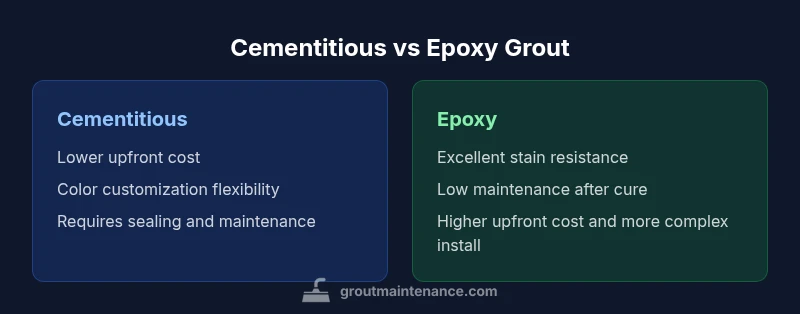
Cementitious grout that resembles cement is cheaper upfront but needs sealing and ongoing maintenance. Epoxy grout lasts longer, resists stains, and requires less sealing, but costs more and can be harder to install. Choose based on your tolerance for maintenance versus upfront investment. In showers and high-traffic areas, epoxy often wins; for budget-focused projects with proper sealing, cementitious grout remains a solid option.
Understanding the phrase 'grout like cement' and the main grout families
The phrase grout like cement describes cementitious grout that mirrors the look and texture of traditional cement. In practice, there are two dominant families homeowners consider: cementitious grout (either sanded or unsanded) and epoxy grout. Cementitious grout relies on cement and sand with additives, while epoxy grout uses a cured resin system with silica filler. The Grout Maintenance team notes that many tile projects—especially those aiming for a rugged, industrial aesthetic—target the cement-like appearance, but the performance footprint is different for each choice. This article compares the two paths, emphasizing practical outcomes for showers, backsplashes, and floors, and offering guidance on appearances, maintenance, and cost. As you plan, remember that grout like cement is achievable, but the best choice depends on moisture exposure, cleaning routines, and everyday wear. The goal is to align appearance with durable performance. According to Grout Maintenance, the relationship between look and function is driven by the material science behind each grout type. A careful selection now reduces headaches later.
Material science: cementitious vs epoxy composition
Cementitious grout blends cement, fine silica sand, water, and polymers to create a workable mix. It comes in sanded and unsanded forms, with colorants added to achieve the desired shade. Epoxy grout uses a two-part epoxy resin and hardener with a silica filler, yielding a dense, chemical-resistant matrix. Additives improve workability, shrinkage control, and stain resistance for both types, but the inherent chemistry drives performance. Cementitious grout benefits from relatively simple mixing and broad compatibility with many tile types, while epoxy grout emphasizes durability, stain resistance, and less porosity. In practice, the cement-like look is most often achieved with a cementitious formula, which lets you customize colors and textures more readily, whereas epoxy offers a smooth, glassy finish with fewer maintenance steps if sealed properly.
Durability and stain resistance: real-world performance
Durability and stain resistance are the core trade-offs. Cementitious grout provides good long-term performance when sealed and maintained, but it remains porous enough to absorb stains and moisture if the seal is compromised. Epoxy grout, by contrast, forms a dense matrix that resists water and most household chemicals, reducing the need for frequent sealing in many environments. Grout Maintenance analysis shows that epoxy formulations generally deliver superior stain resistance and fewer maintenance cycles, especially in kitchens and bathrooms with heavy use. However, the installation requires careful mixing, precise timing, and expert finishing to avoid crumbling or poor adhesive bonds. In practical terms, expect cementitious grout to require re-sealing over time, while epoxy grout may deliver longer intervals between maintenance but comes with higher material and labor costs. Both options can perform well if installed correctly and matched to environmental demands.
Maintenance and sealing implications
Maintenance is the deciding factor for many homeowners. Cementitious grout typically demands regular sealing to limit water absorption and staining; even with sealers, porous grout remains more vulnerable to mold and mildew in damp spaces. Epoxy grout tends to require less sealing and easier daily cleaning, given its low porosity and chemical resistance. Nevertheless, routine cleaning with non-abrasive products remains important to preserve color and prevent surface abrasion. The choice often hinges on whether you’re willing to invest time in periodic resealing versus accepting a higher upfront cost for built-in stain resistance. If you’re regrouting a shower, the choice becomes particularly consequential: epoxy can simplify routine maintenance, while cementitious grout can offer easier repair options if damage occurs.
Installation and curing differences
Installation differences drive the project timeline and success. Cementitious grout is forgiving for DIY installers with standard tools, and curing times are predictable under normal conditions; mistakes are easier to fix with patching and re-sealing. Epoxy grout, by contrast, demands meticulous mixing, precise ratios, and faster working time. Cleanup is more demanding due to the epoxy’s tenacity and the need for specialized cleaners. Achieving a smooth, crack-free finish with epoxy requires experience, and improper curing can compromise color uniformity and adhesion. The learning curve is steeper, but the payoff is longer-lasting performance and less maintenance in moisture-prone areas.
Cost and value for money over time
Cost considerations span material and labor. Cementitious grout generally offers a lower upfront price, with ongoing sealing costs and periodic maintenance adding to the long-term expense. Epoxy grout carries a higher initial price, but its maintenance footprint is smaller in many environments, potentially lowering total cost of ownership over the life of the installation. When evaluating value, consider the tile environment (wet vs dry), expected wear, cleaning routines, and whether you have access to skilled installers who can properly finish epoxy joints. The right balance depends on how you weigh initial cost against lifetime performance.
Aesthetic options: color, texture, and matching
Aesthetics drive many decisions. Cementitious grout provides extensive color-matching flexibility, which helps achieve the exact cement-like look that many homeowners want. Textural variations can also be introduced through sanded mixes, providing a tactile surface that mimics traditional cement. Epoxy grout offers a glossy, uniform appearance with fewer texture variations and more consistent color under various lighting conditions. Both options have color guides and catalog options from manufacturers, but cementitious grout typically allows easier custom color matching. For those pursuing a true cement-like appearance, selecting a cementitious mix with appropriate sealant and maintenance is usually the most reliable route.
Use cases: showers, backsplashes, floors
Showers benefit from epoxy’s moisture resistance when properly installed, though cementitious grout can perform well if sealed and maintained. Floors require consideration of traffic, wear, and cleaning products; cementitious grout may be preferred for cost-conscious large-area projects, while epoxy can provide superior stain resistance and longevity in busy spaces. Backsplashes often favor cementitious grout for color-matching and a consistent, matte finish that resembles concrete. Each room presents unique challenges, and the best choice balances appearance with maintenance demands and accessibility to skilled labor for installation.
Common issues and troubleshooting
Common issues with cementitious grout include moisture intrusion, color inconsistency, cracking due to substrate movement, and staining when sealant fails. Epoxy grout issues are rarer but can include hazing if improper cleanup occurs, color inconsistency due to UV exposure in some formulations, and difficulty repairing damaged joints without replacing surrounding sections. Preventative measures include selecting the right grout type for the space, using high-quality sealants for cementitious variants, and ensuring proper substrate preparation and cure conditions. Routine inspection and timely maintenance can prevent minor problems from becoming major repairs.
Decision framework: how to choose for your project
To decide, start with the space’s moisture exposure, cleaning regimen, and warranty expectations. If you want the lowest maintenance and strongest resistance to stains and chemicals, epoxy is typically the better long-term choice, especially in showers and kitchens. If cost is the primary constraint and you’re prepared to seal and maintain the grout, cementitious alternatives can deliver a cement-like appearance with good performance. Consider the tile type and grout width, since movement and flex can influence cracking risk. Finally, assess your comfort level with installation complexity and your access to skilled installers who can deliver a durable epoxy joint.
Practical maintenance plan and timeline
A practical maintenance plan aligns with your grout choice. For cementitious grout, schedule regular resealing based on the product and environment, typically annually or biennially, and perform routine cleaning with pH-balanced cleaners to preserve color. For epoxy grout, focus on periodic surface cleaning and inspect joints for any signs of wear rather than frequent resealing. Establish a simple routine that fits your household, document observations, and address issues early with professional assessment if needed. This proactive approach supports longer-lasting joints and preserves the cement-like aesthetic over time.
Comparison
| Feature | Cementitious grout | Epoxy grout |
|---|---|---|
| Durability | Moderate to high durability with proper sealing | Very high durability and chemical resistance |
| Stain resistance | Moderate; depends on sealant effectiveness | Excellent; highly resistant to stains and chemicals |
| Sealing needs | Typically requires regular sealing to minimize porosity | Minimal sealing required; lower maintenance in many environments |
| Maintenance ease | Requires ongoing maintenance and re-sealing | Easier to clean; less maintenance after curing |
| Installation difficulty | More forgiving for DIY and standard tools | More demanding; precise mixing and fast work time |
| Best for | Budget-conscious projects seeking cement-like look | Moisture-prone areas and high-traffic spaces |
Pros
- Lower upfront material costs compared with epoxy when using cementitious options
- Familiar installation process for DIYers
- Wide color options and easy customization with cementitious mixes
- Good compatibility with a broad range of tile substrates
What's Bad
- Requires regular sealing and maintenance to prevent staining
- Porosity means higher risk of moisture intrusion when seals fail
- Repairs can be challenging if joints crack or crumble
Epoxy grout is generally the winner for moisture-prone spaces; cementitious grout wins on upfront cost and customization.
Choose epoxy for bathrooms and kitchens when stain resistance and long-term maintenance are priorities. Choose cementitious for budget projects where sealing and maintenance plans are feasible and the cement-like aesthetic is essential.
Got Questions?
What does 'grout like cement' mean in practice?
It refers to cementitious grout that mimics the look of cement. The look is important, but functional performance depends on the grout mix, sealant, and environmental conditions. Understand that the aesthetic is achievable with cementitious mixes, while durability depends on sealing and maintenance.
Grout like cement is about the look, but performance depends on the grout type and maintenance.
Is cementitious grout suitable for showers?
Yes, but it requires a good sealant and regular maintenance to prevent moisture ingress and staining. If you keep up with sealing and cleaning, cementitious grout can perform well in showers while delivering the cement-like aesthetic.
Cement grout can work in showers, but sealing and maintenance are essential.
Do I need to seal cementitious grout regularly?
Yes. Sealing reduces water absorption and staining potential. Frequency depends on the product and environmental exposure, but annual or biennial sealing is common in many installations.
Seal grout regularly to keep it looking good and performing well.
How many color options are available for epoxy grout?
Epoxy grout offers a wide range of colors, but typically within the offerings of manufacturers. Cementitious grout often allows broader customization, including custom color mixing.
Epoxy has many colors, but cement grout can be more customizable.
Can I repair epoxy grout easily if damaged?
Repairs are possible but can be tricky. Damaged epoxy joints may require patching and color-matching or complete replacement of the affected area.
Repairs can be doable but more involved than cement grout.
Is there a compromise option that looks like cement but behaves differently?
There are cement-look grout formulations that blend properties. Check with manufacturers for products marketed to mimic cement while offering enhanced performance.
Some hybrids mimic cement's look with different performance.
Which grout type is best for someone who wants minimal maintenance?
Epoxy grout generally requires less ongoing maintenance, especially in damp areas, due to its low porosity and chemical resistance.
Epoxy grout usually requires less ongoing maintenance.
The Essentials
- Assess moisture exposure before choosing grout type
- Epoxy grout offers best stain resistance with minimal sealing
- Cementitious grout provides lower upfront cost and customization
- Seal cementitious grout to extend life and limit staining
- Proper installation matters as much as material choice