Unsanded Grout vs White Cement: A Practical Comparison
Explore key differences between unsanded grout and white cement-based grout, focusing on joint width, appearance, maintenance, and installation for homeowners and DIYers.


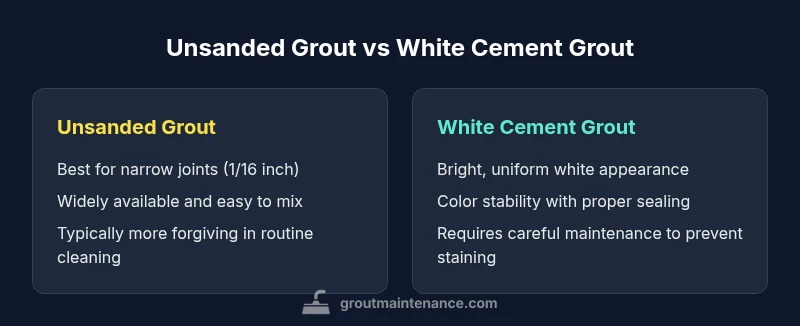
Unsanded grout vs white cement are two common grout options for tile installations. Unsanded grout is the standard choice for narrow joints because it lacks sand, which helps it slide into tight gaps. White cement-based grout delivers a bright, uniform color and can be pigmented to match tile or décor, but it often requires careful sealing and maintenance to prevent staining or discoloration in moisture-prone areas. In most homes, unsanded grout is the default for everyday tiling; white cement-based mixes excel when a pristine white look and color consistency are paramount. This comparison highlights when to choose each option and how they perform in kitchens, bathrooms, and other living spaces.
Understanding the core materials: unsanded grout vs white cement\n\nIn tile installation, choosing the right grout is as important as selecting the tile itself. The phrase unsanded grout vs white cement captures the central decision homeowners face when balancing color, joint width, and long-term performance. Unsanded grout is a cementitious mix that omits sand, designed for joints typically 1/16 inch to 1/8 inch wide. White cement, on the other hand, refers to a white, cementitious binder that is used to produce pale grout options when pigment is added. According to Grout Maintenance, this distinction matters most in small-format tiles and high-visibility installations where texture, finish, and cleaning behavior are critical. The team notes that the two materials differ in curing behavior, resistance to staining, and sealing needs, which translates into real-world decisions about where to use each option. The goal is to match joint width, tile type, maintenance capability, and color goals, rather than chasing the newest trend.
wordCountInBlock":null},
Comparison
| Feature | Unsanded grout | White cement grout |
|---|---|---|
| Joint width suitability | Best for very narrow joints (often 1/16 inch or less) | Suitable for narrow joints (up to ~1/8 inch) depending on formula |
| Color and appearance | Standard grout colors; easily pigmented to a range of hues | Bright white base with pigments; color uniformity depends on mix and sealing |
| Sealing and maintenance | Sealing commonly recommended; lower maintenance in non-moist areas | Sealing strongly recommended; color stability depends on pigments and exposure |
| Moisture resistance | Breathes well in dry-to-moderate moisture areas; not epoxy-grade | Helps achieve consistent white shade in damp spaces when sealed; not epoxy-grade |
| Typical cost and availability | Widely available and cost-effective | Widely available; may require careful selection to maintain whiteness |
| Best for | Kind to fine joints in interior walls and backsplashes | Color-critical installations and spaces where a bright white look is desired |
Pros
- Ideal for narrow joints and fine tile work
- Widely available and easy to mix with pigments
- Cost-effective option for everyday tiling
- Flexible enough for standard home renovations
What's Bad
- White cement grout can show stains more readily if not sealed and cleaned promptly
- Both options can chalk or discolor if exposed to improper cleaning; maintenance matters
- White cement-based grout may require more maintenance to preserve whiteness in bathrooms
- Sandless formulations can be less forgiving in high-movement applications
Unsanded grout is generally the default for narrow joints, while white cement grout shines in high-visibility, color-critical installations.
Choose unsanded grout for most residential tiling projects, especially with small joints. Opt for white cement grout when color purity and uniform appearance are top priorities, and you’re prepared for sealing and maintenance to preserve whiteness in moist environments.
Got Questions?
What is unsanded grout and where should I use it?
Unsanded grout is a cementitious mixture without sand particles, designed for very narrow joints (often 1/16 inch or less). It’s commonly used on ceramic and porcelain tiles with tight grout lines and on walls or surfaces where sanding could scratch the tile glaze. It is easier to work into tight gaps and generally cures with less texture, which makes cleanup simpler in small joints.
Unsanded grout is best for tight gaps and smooth tiles, especially on walls and backsplashes where the joints stay narrow.
What exactly is white cement grout, and how does it differ?
White cement grout uses a white cementitious base with pigments added to achieve a pale or bright white look. It’s chosen for color-critical design schemes where the grout line should blend with or stand out from the tile. Compared to standard unsanded grout, white cement grout emphasizes whiteness and color uniformity but may require more careful sealing and maintenance to resist staining.
White cement grout gives a bright, uniform white look but needs proper sealing to prevent staining.
Can I use either grout in a shower or kitchen that gets a lot of moisture?
Both unsanded and white cement grout can be used in moisture-prone areas, but performance depends on the specific product formulation and sealing regimen. White cement-based grouts often require thorough sealing and prompt cleaning to avoid yellowing or staining in bathrooms, while unsanded variants benefit from proper moisture control and sealing as well. Always follow manufacturer recommendations for wet areas.
In showers, seal and clean regularly; pick a grout product rated for moisture and reseal as recommended.
Do I need to seal unsanded grout or white cement grout?
Sealing is typically recommended for both unsanded grout and white cement grout, particularly in moisture-prone areas like bathrooms and showers. Sealing helps resist stains, mold, and moisture intrusion, though some products are marketed as sealant-friendly or ‘‘no-seal needed’’ for specific tile types. Always apply the recommended sealant after curing and recoat as directed by the manufacturer.
Seal both types as directed by the product you choose, especially in damp spaces.
How do cleaning and maintenance differ between the two options?
Cleaning for unsanded grout is generally straightforward with pH-neutral cleaners; avoid harsh acids that can erode cementitious grout. White cement grout may require more frequent cleaning and careful drying to prevent staining, and cleaning products should be chosen to avoid dulling whiteness. In either case, address spills quickly and use grout-safe cleaning methods.
Clean with gentle, non-acid cleaners and dry surfaces to prevent stains in white grout.
Which option is more cost-effective in the long run?
Cost-effectiveness depends on the joint width, tile area, and maintenance plan. Unsanded grout is typically less expensive upfront and easier to work with for standard joints. White cement grout can be more cost-effective for achieving a pristine white look in spaces with low traffic, but ongoing maintenance may add costs over time due to sealing and potential stain mitigation.
Upfront, unsanded grout usually costs less; long-term costs depend on maintenance and color retention.
The Essentials
- Prioritize joint width to choose the grout type
- Sealants and cleaning routines strongly influence color retention
- White cement grout offers brighter, more uniform color with proper sealing
- Unsanded grout is typically more forgiving on everyday installations
- Balance cost, maintenance, and aesthetics when deciding