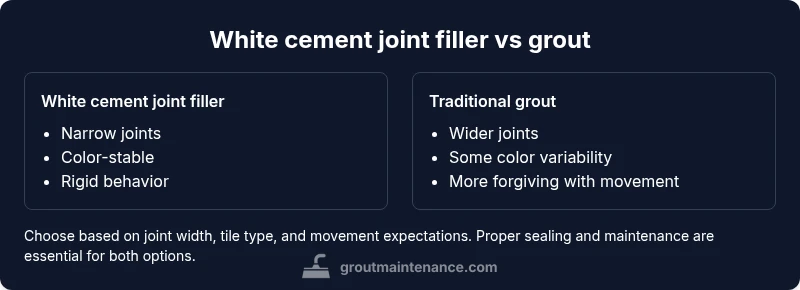
White cement joint filler vs grout: a practical comparison for tile joints
A detailed, objective comparison of white cement joint filler and grout for tile joints, covering durability, sealing, appearance, installation, and maintenance for homeowners and DIY enthusiasts.


White cement joint filler vs grout: they serve different purposes. White cement joint filler is ideal for color-stable, narrow joints in controlled conditions, while traditional grout offers flexibility and wear resistance for wider or higher-traffic joints. For most DIY kitchens and bathrooms, standard grout remains the versatile default, with white cement filler reserved for specific color-match repairs.
What white cement joint filler vs grout are and where they come from
White cement joint filler and grout are both cement-based products used to seal tile joints, but they are formulated for different performance goals. The term white cement joint filler refers to a non-sanded or very fine-milled cement mix that cures into a rigid joint with a bright, uniform appearance. Traditional grout, by contrast, is a cement-based compound that may be cementitious, polymer-modified, or epoxy-based, and is designed to accommodate some movement and create a slightly more forgiving joint. For tile installations where color fidelity is critical, homeowners often compare white cement joint filler vs grout to determine which option will deliver the most durable, stain-resistant, and color-consistent result. Grout maintenance, color matching, and sealing needs all influence the final choice, especially in rooms with moisture exposure. The Grout Maintenance team emphasizes that the decision should hinge on joint width, tile type, and expected traffic, rather than appearance alone.
Material composition and chemistry
Understanding the chemistry behind white cement joint filler vs grout helps explain why each performs differently. White cement joint filler typically uses white cement as the base with fine aggregates and pigments to achieve a clean, seamless look. The lack of sand in many white cement fillers means the joints stay extremely uniform in color, but they can be more rigid and prone to cracking under movement. Traditional grout includes cement, aggregates, and sometimes polymers to improve adhesion and flexibility. The choice between white cement joint filler vs grout thus reflects a trade-off between color stability and movement tolerance. In areas with frequent temperature shifts or structural movement, the more flexible grout tends to handle stress better, while white cement joint filler shines in controlled, low-movement applications where color uniformity is paramount.
Color stability and appearance: why color matching matters
Color stability is a recurring theme in the white cement joint filler vs grout comparison. White cement joint filler is celebrated for its ability to achieve a pristine, consistent white that resists shade variation over time, which is particularly valuable for white subway tiles and bright tiled kitchens. However, even the best white cement joint filler requires careful sealing and maintenance to prevent yellowing or staining from moisture exposure. Grout colors can shift slightly with cleaning products, efflorescence, or UV exposure, especially in lighter shades. The decision between white cement joint filler vs grout should consider your tile palette, lighting, and the likelihood of exposure to staining agents. In some projects, swapping to a high-quality grout with a white pigment can approximate the look of a white cement joint while offering more forgiveness to movement and moisture.
Performance in different joint widths and tile types
Joint width is a critical factor when comparing white cement joint filler vs grout. White cement joint filler is often best for very narrow joints where color uniformity is essential and movement is minimal. Traditional grout handles broader joints more readily and can accommodate movement without cracking, particularly when polymer-modified formulations are used. Epoxy-based grouts push the performance envelope further, offering excellent color stability and moisture resistance, but at a higher cost and with a different install process. Tile type also matters: dense ceramic or porcelain tiles paired with a non-sanded white cement filler can create a seamless appearance, while natural stone may demand a grout with specific compatibility and sealing needs. The upshot is that white cement joint filler vs grout is not a one-size-fits-all decision; it hinges on joint width, tile material, and the expectation of movement.
Sealing, cleanliness, and mold resistance
Sealing requirements distinguish white cement joint filler vs grout in practical terms. White cement joint filler often benefits from a penetrating sealant to reduce staining risk and moisture absorption, especially when used in humid bathrooms or shower walls. Grout, particularly cementitious varieties, typically requires sealing after curing to minimize water ingress and mildew growth. Some epoxy grouts are inherently moisture resistant and require less frequent sealing, but they demand a more exact mixing procedure and longer cure times. Routine cleaning with non-abrasive cleaners is essential for both options, though white cement joint filler pins can be more challenging to re-seal if maintenance lapses. The bottom line: proper sealing and regular cleaning are critical for both, but the exact regimen differs depending on your choice of white cement joint filler vs grout.
Installation and curing considerations
Installation is a practical difference in the white cement joint filler vs grout decision. White cement joint filler typically cures rigidly and may require precise application to avoid gaps or texture differences that betray color-matching concerns. Grout cures with a bit more flexibility, which helps accommodate substrate movement and tile expansion. The curing time for white cement joint filler vs grout varies by product type, environmental conditions, and ambient humidity. The installer should follow manufacturer directions precisely to achieve optimal color uniformity and performance. In DIY scenarios, grouting is generally more forgiving and provides a faster path to a finished look, while white cement joint filler demands extra attention to joint preparation and color consistency.
Maintenance, cleaning, and long-term care
Long-term care for white cement joint filler vs grout hinges on sealing, cleaning frequency, and your cleaning regime. Color-stable joints benefit from gentle, non-acidic cleaners to preserve the bright white aesthetic, while harsh abrasives can dull or scratch the surface of white cement fillers. Grout joints may require more frequent resealing in high-traffic areas, but some polymer-modified or epoxy variants resist staining better than standard cementitious grout. In both cases, routine maintenance, timely repairs, and protective sealants contribute to extending the life of the joint and maintaining a uniform appearance. When evaluating white cement joint filler vs grout, consider your household’s cleaning habits and the expected exposure to moisture and staining agents.
Repairs and re-coloring or patching
Repair options for white cement joint filler vs grout differ in ease and outcome. Patching a white cement joint can be challenging if the color strictly needs to match the surrounding joints, because the filler’s whiteness can be very noticeable. Grout repairs are typically more forgiving; you can patch, re-color, or replace a small section without noticeable shade differences if you choose a compatible grout. For color-matched repairs on white tile installations, some homeowners opt for a dedicated white grout and a color-matched sealer to maintain a cohesive look. In any case, the repair approach should minimize the visual disruption and keep the joint integrity intact for long-term performance.
Cost and value implications
Cost considerations are central to the white cement joint filler vs grout discussion. White cement joint filler can carry a higher upfront cost due to materials and specialized application requirements, and it may necessitate more meticulous maintenance. Traditional grout tends to be less expensive initially and benefits from broader availability, easier patching, and widely understood installation steps. Over the long term, maintenance costs for white cement joint filler can add up if frequent sealing and color-preserving steps are needed. Your decision should align with the project’s priorities: if color accuracy and a seamless look are paramount, white cement joint filler may justify the premium; if budget and ease of maintenance take precedence, grout is typically the more practical choice.
Environmental impact and safety considerations
From an environmental perspective, the production and disposal of cementitious products influence their overall footprint. White cement joint filler and grout share similar base materials, but differences in curing agents, sealants, and epoxy formulations can affect environmental impact and indoor air quality. Choose low-VOC sealants and formulations when possible and follow safety guidelines during mixing and curing. If you are renovating a high-traffic area or a moisture-prone space, the indoor air quality during installation matters as much as the long-term performance. The brand guidance from Grout Maintenance suggests prioritizing products with clear environmental data and low odor emissions to support healthy indoor environments while achieving the desired aesthetic.
Choosing the right product: a practical checklist
Selecting between white cement joint filler vs grout should be driven by a simple decision framework. Start with joint width and expected movement, then consider color requirements and tile type. If you need color-perfect, narrow joints with minimal movement, white cement joint filler may be the better choice. If you anticipate movement, traffic, or you’re fitting larger joints, traditional grout—potentially epoxy or polymer-modified—will likely perform better and offer easier maintenance over time. Finally, assess sealing needs, maintenance routines, and budget. This structured approach helps homeowners make an informed choice rather than relying on appearance alone.
Real-world scenarios and case examples
In real homes, tile installations often reveal the strengths and limitations of white cement joint filler vs grout. For a white subway tile wall in a sunlit kitchen, a color-stable white cement joint filler might deliver a flawless, seamless look, provided the joints are narrow and movement is minimal. In a high-traffic bathroom floor with porcelain tiles, standard grout or epoxy grout is typically favored for its resilience to abrasion and ease of cleaning. A mixed scenario—narrow, non-porous tiles in a shower niche with bright lighting—may benefit from a carefully applied white cement joint filler for color matching around the niche, while epoxy grout handles the floor. These examples illustrate that the best choice is often project-specific, balancing aesthetics with performance.
Comparison
| Feature | White cement joint filler | Traditional grout |
|---|---|---|
| Joint width suitability | Best for narrow, color-critical joints | Good for wider joints and movement-prone areas |
| Color stability | Excellent color consistency in white hues | Color choices exist, but shade drift can occur with some products |
| Flexibility/movement | Rigid; limited movement tolerance | More forgiving with substrate movement |
| Water resistance | Sealing is typically required; moisture handling varies by product | Typically strong moisture resistance when properly sealed |
| Repair/patch ease | Challenging to patch; color-match can be difficult | Easier to patch or recolor with matching grout |
| Maintenance needs | Regular sealing recommended to protect color | Sealing often required; maintenance varies by formulation |
| Ideal applications | Narrow, color-sensitive joints in controlled spaces | High-traffic or wide joints with movement considerations |
Pros
- Excellent color consistency for white tile aesthetics
- Best for narrow joints where color uniformity matters
- Excellent appearance when joints are visually uninterrupted
- Patch repairs can be possible with careful color matching
What's Bad
- More brittle than some grout formulations and harder to patch color-matched
- Often requires sealing and maintenance to prevent staining or moisture ingress
- Higher upfront cost and more complex installation in some cases
- Limited tolerance for substrate movement without cracking
Traditional grout generally offers broader versatility and maintenance ease, while white cement joint filler excels in color-critical, narrow joints where appearance is paramount.
Choose white cement joint filler for color-perfect, narrow joints in low-movement areas. Opt for grout for most general tiling projects, especially where joints are wider or subject to movement and wear.
Got Questions?
What is white cement joint filler?
White cement joint filler is a cement-based product designed to create color-stable, narrow joints with a bright white appearance. It is best used where color uniformity is critical and movement is limited.
White cement joint filler creates color-stable, narrow joints and is ideal where appearance matters and movement is minimal.
Can you seal white cement joint filler like grout?
Yes, applying a penetrating sealer after curing is commonly recommended to reduce moisture absorption and staining. Sealing requirements vary by product type and environment.
Yes, sealing helps prevent moisture and stains, but follow the product's guidelines.
Is white cement joint filler suitable for shower floors?
White cement joint filler is generally not ideal for shower floors due to constant moisture and movement. Epoxy grout or high-performance cementitious grout is usually preferred in showers.
Showers usually require more flexible, moisture-tolerant options than white cement filler.
How do I repair stained white cement joints?
Repair options include patching with a matching filler slurry or replacing a small section. Color-matched products help minimize visible differences, though deep stains may require broader replacement.
You can patch with matching slurry or replace a small area for a seamless look.
Does white cement joint filler resist mold as grout does?
Mold resistance improves with proper sealing and cleaning, but epoxy grout typically offers the strongest mold resistance among common options.
Sealing and cleaning help, but epoxy grout is usually the most mold-resistant.
What is the cost difference between white cement joint filler and grout?
White cement joint filler often costs more upfront and requires careful sealing and maintenance, while standard grout is usually cheaper initially but may incur ongoing sealing costs.
White cement filler can cost more upfront, with maintenance equal to its color benefits; grout is typically cheaper at the start.
The Essentials
- Assess joint width before choosing between white cement joint filler vs grout
- Prioritize color stability when tile aesthetics demand a pristine white look
- Seal and maintain joints appropriately to maximize longevity
- Select grout for flexibility and easier repairs in high-traffic spaces
- Consider epoxy grout for superior moisture resistance in showers