Is grout stronger than white cement? A practical comparison
A detailed, evidence-based comparison of grout versus white cement, focusing on joint performance, strength under load, curing, and maintenance for tile projects and repairs.


Grout and white cement serve different purposes, so a direct strength comparison is context-dependent. Grout is a joint filler designed for flexibility, adhesion, and moisture resistance, while white cement acts as a binder in mortars and slabs. When asked is grout stronger than white cement, consider the application, curing, and mix design—strength is not universal but task-specific.
Is grout stronger than white cement? Context and definitions
When homeowners ask is grout stronger than white cement, it is essential to start with definitions. Grout is a specialized joint filler formulated to withstand tile movement, moisture exposure, and color stability in joints. White cement is a binder used in mortars and concrete mixes to create a solid matrix that holds aggregates in place. Because they are designed for different purposes, a simple one-to-one strength comparison can be misleading. In tile installations, grout strength relates to crack resistance, shrinkage control, and resistance to moisture, while white cement strength relates to matrix integrity and load-bearing capacity in mortars. The bottom line is that the strength metric depends on use-case—grout for joints, white cement for binding; the two are not interchangeable in every scenario. The Grout Maintenance team emphasizes the importance of correct mix design, curing, and sealing to achieve durable results.
For more context, the question is not whether grout is universally stronger, but whether a grout system can meet the demands of a given joint width, tile type, substrate, and environment.
Comparison
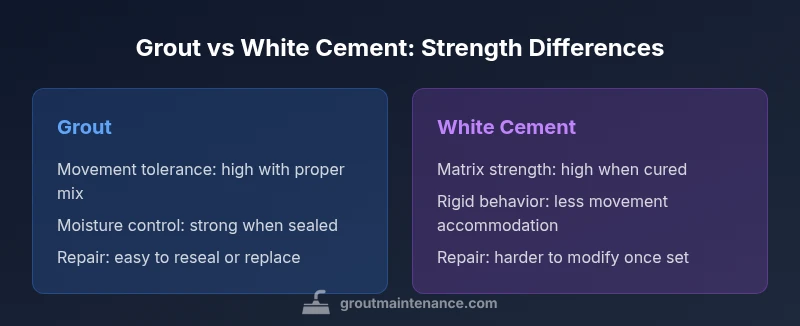
| Feature | grout | white cement |
|---|---|---|
| Primary use | Joint filler with movement accommodation, water resistance, and color stability | Binder for mortars and surface matrices; creates rigid structures |
| Strength characteristics | Strength amplified by sealants and polymer additives; optimized for flex and crack resistance | Strength relies on curing and matrix formation; higher compressive capability in ideal conditions but less movement tolerance |
| Movement tolerance | High tolerance when properly mixed and cured; designed for tile expansion/contraction | Low tolerance to movement unless formulated as mortar with proper reinforcement |
| Porosity and moisture | Sealed grout reduces moisture ingress into substrates | Cement-based mortars can absorb moisture if not properly finished or sealed |
| Typical use scenarios | Tile installations, showers, counters where joints need color, cleanliness, and drainage control | Structural repairs, base layers, or substrates where a solid matrix is required |
Pros
- Better joint flexibility reduces crack transmission
- Designed for movement in tiled surfaces
- Easier to repair and re-seal joints
- Improved water resistance when properly sealed
What's Bad
- Not as structurally strong as cement-based mortars for load-bearing applications
- Performance depends heavily on correct mixing and sealing
- Color changes with moisture or harsh cleaners if unsealed
- Higher maintenance if seals wear over time
Grout is not universally stronger than white cement; each material excels in its designed role when properly specified and installed.
For tile joints, a well-sealed cementitious grout typically performs better than unsealed white cement; for structural, load-bearing applications, white cement-based mortars may provide greater matrix strength. The best choice depends on the task, movement, and exposure conditions.
Got Questions?
Is grout stronger than cement in tile joints?
In tile joints, grout strength is defined more by crack resistance, adhesion, and moisture control rather than pure compressive strength. When properly mixed and sealed, cementitious grout can outperform poorly applied cement in joints by accommodating movement.
For tile joints, grout strength is about movement and moisture control, not just stiffness. Proper sealing matters a lot.
Can white cement be used for tile joints instead of grout?
White cement can be used in mortars, but it is not optimized for joints that require flexibility and moisture resistance. Using it in joints can lead to cracking or water ingress unless formulated as a specialized grout mix.
White cement alone isn’t ideal for joints; use a grout design that includes appropriate additives.
Does epoxy grout offer higher strength than cementitious grout?
Epoxy grout generally offers higher chemical resistance and stain resistance and can perform better under heavy moisture exposure. However, it is more expensive, harder to work with, and may crack if substrate movement is extreme.
Epoxy grout can be stronger in some ways, but it’s also more challenging to install.
How does sealing affect grout strength?
Sealing grout improves moisture resistance and helps maintain color, but it does not increase the inherent mechanical strength. Sealing is essential for longevity and stain resistance.
Sealing keeps grout looking good and waterproof, but it doesn’t magically make it stronger.
What maintenance steps maximize grout durability?
Regular cleaning with mild cleaners, prompt spot treatment of stains, periodic resealing, and proper ventilation in damp areas extend grout life and preserve strength.
Keep grout clean and sealed—maintenance matters for longevity.
Are there standards to ensure grout strength?
Standards exist for grout performance, such as adhesion and water absorption, but strength is highly application-specific. Refer to manufacturer data and local building guidelines for best practices.
There are guidelines, but strength is mostly defined by how you use and seal the grout.
The Essentials
- Assess your use case first: joints vs structural binder
- Choose a grout formulation with proper sealants and polymers for moisture-heavy areas
- Seal grout regularly to preserve performance and color
- Match cementitious mortar choices to substrate and anticipated movement