Is Grout Stronger Than Thinset? A Practical Comparison for DIYers
A detailed analysis of grout vs thinset strength, including cementitious vs epoxy variants, bond vs fill roles, and real-world guidance for homeowners and DIYers.


Is grout stronger than thinset? Not in the sense of bonding strength. Thinset mortar provides the primary bond between tile and substrate, while grout fills joints and resists movement and moisture. Epoxy grout can outperform cementitious grout in durability, but pure strength depends on the specific products and installation conditions. For most homes, thinset offers stronger attachment; grout strength is task-specific.
Is grout stronger than thinset? Key concept
Is the short answer yes or no? The longer, more accurate answer is that both materials serve different, essential roles in tile installations. When people ask, "is grout stronger than thinset," they are usually comparing two different properties: the bond between tile and substrate (thinset) versus the resistance of the joints to movement, moisture, and staining (grout). According to Grout Maintenance, understanding these roles helps homeowners make informed choices for durability and maintenance. In practice, the strength of a tiled surface comes from selecting the right products for the right jobs and installing them with proper preparation. The phrase is often a simplification; the real question is how the combination of thinset and grout performs under expected loads, temperatures, and moisture conditions. For many residential projects, the answer depends more on product quality and installation technique than on a single material being inherently stronger than the other. In this article, we explore cementitious and epoxy grout alongside cementitious and epoxy thinset to show how strength is defined and measured in real-world terms.
Bonding vs joint integrity: what "strength" means in tiles
Strength in tile work is not a single metric. Thinset provides adhesion—the mechanical bond that keeps tiles stuck to the substrate. Grout’s strength is in the joints: resistance to cracking, moisture intrusion, and color stability. A high-quality thinset with a proper adhesive bed is essential for long-term tile integrity. If the substrate moves, or if there is thermal expansion, joints must bear the brunt of that movement. In such cases, grout helps accommodate movement without tiles popping. The balance between these two materials determines overall durability. For DIY projects, misjudging either role can lead to cracked grout lines or loose tiles. Grout that is too hard for the substrate can transfer stress to tiles, while an under-bonded tile is more prone to loosening—even if the grout is strong. This balance is why professional installers emphasize both components in equal measure.
Cementitious grout vs epoxy grout: Strength differences
Cementitious grout is the traditional, widely used option. It offers reasonable durability and is generally easier to work with, which makes it popular for larger areas and budget-conscious projects. Epoxy grout, on the other hand, is a different beast: it cures to a very hard, dense matrix with excellent chemical and stain resistance. In terms of strength, epoxy grout tends to outperform cementitious grout in surface hardness and resistance to moisture-related degradation, but it can be harder to work with and requires careful mixing and cleaning. For areas that face heavy moisture, frequent staining, or chemical exposure (like near sinks or in commercial kitchens), epoxy grout can deliver superior long-term durability. Yet epoxy grout does not constitute a bonding agent like thinset; its strength is primarily in the joints and its resistance to environmental stressors. The practical takeaway is that choosing between these grout types should hinge on the environment and maintenance expectations as much as it does on any inherent notion of “strength.”
Thinset types: Cementitious vs epoxy thinset
Thinset mortar comes in cementitious forms that may be modified or unmodified. Cementitious thinsets excel at bonding tiles to concrete and other substrates, delivering strong adhesion when mixed and applied correctly. Epoxy thinset exists as a specialized option with exceptional chemical resistance and reduced water absorption, but it requires precise mixing, clean substrates, and careful rinsing. In terms of strength, epoxy thinset often provides superior bond performance in challenging substrates or high-moisture environments, yet it is more sensitive to moisture at mixing and curing stages. For most residential projects, standard cementitious thinsets paired with appropriate adhesives suffice, provided you follow manufacturer instructions, allow full cure times, and avoid rapid temperature fluctuations during curing. The key is to match the thinset type to the tile and substrate and to ensure proper substrate preparation and slab flatness to maximize bond strength and minimize the risk of crack propagation through grout lines.
Conditions that test strength: moisture, temperature, and movement
No material exists in a vacuum. The strength of tile installations is repeatedly tested by real-world conditions: humidity, temperature swings, and substrate movement. In damp spaces like bathrooms, the combination of cementitious grout with proper sealing can work well, but epoxy variants offer better resistance to water penetration and chemical attack. The substrate also matters: a stable, well-prepared base reduces shear stress on joints and enhances grout performance. Movement joints and expansion gaps are not weaknesses; they are deliberate design features to accommodate movement without cracking. When you see repeated cracking in grout lines, it often signals inadequate substrate preparation, improper expansion joints, or choosing a grout type that is not suited to the movement profile of the installation. Grout and thinset must be chosen with these environmental tests in mind to achieve long-lasting performance.
Real-world scenarios: showers, floors, exterior patios
Showers and wet areas demand high moisture resistance. Epoxy grout is frequently favored in such spaces for its low porosity and stain resistance, though it can be more challenging to install. Cementitious grout remains a common choice for showers when sealed properly, as long as the area isn’t subjected to constant water exposure that would require the superior chemical resistance of epoxy. Floors subjected to foot traffic close to exterior doors benefit from the balance between cost and performance that cementitious grout offers, provided joints remain well-sealed and the substrate stays flat. Exterior applications introduce different challenges, such as freeze-thaw cycles. In those cases, a grout type with excellent durability and low water absorption is essential. Here, epoxy grout’s performance often shines, but installation complexity and cost rise accordingly. Ultimately, the best choice aligns with the specific room’s use, moisture profile, and maintenance plan.
Reading product specs: what to look for
When comparing products, homeowners should study the data sheets carefully. Look for properties such as water absorption, stain resistance, cure time, and hardness. The difference between “hardness” and “bond strength” is subtle but important: a hard grout may resist surface wear but could be brittle if movement is not carefully managed. In addition, verify compatibility with tiles and substrates, especially if you are using natural stone or large-format tiles. Some products are formulated to reduce efflorescence, another factor that affects long-term appearance. Finally, consider the maintenance regime you’re willing to commit to: sealers, cleaners, and periodic re-sealing can influence the apparent strength of grout over time. This decision is not purely about “which is stronger” but about which product tolerates your environment and care routine best.
Maintenance and curing: setting expectations for performance
Curing time, cleaning, and sealing play critical roles in final performance. Cementitious grout often requires sealing to resist staining and moisture ingress, which can indirectly influence perceived strength by protecting the grout from breakdown. Epoxy grout, with its dense resin matrix, is less porous and generally cleaner to maintain, reducing surface wear and staining. However, epoxy grout can be more sensitive to cleaning agents and surface preparation, which can affect the final appearance and durability if not handled correctly. In either case, following manufacturer guidelines on mixing, application, curing, and sealing is essential to maximize the material’s strength and longevity. In short, strength is a function of material properties combined with correct installation and ongoing care.
Common installation pitfalls that affect strength
Even the strongest materials fail when installation practices are flawed. Common pitfalls include inadequate substrate flatness, insufficient mortar bed thickness, misaligned joints, and skipping or improperly placing movement joints. Grout failures frequently arise from failure to clean leakage channels, allowing moisture to reach the substrate, or sealing mistakes that trap water in the grout matrix. The same applies to thinset: poor substrate prep, inadequate coverage, and improper curing markedly reduce bond strength and long-term durability. A practical approach is to budget time for substrate preparation, test slabs if possible, and plan for movement joints in larger installations. These steps help ensure that the chosen grout and thinset deliver the expected performance rather than relying on strength alone to save a project from failure.
Epoxy vs cementitious grout in practice: best-use scenarios
For homes with heavy staining risk, such as kitchens and bathrooms with frequent exposures to sauces, coffee, or cleaners, epoxy grout can be worth the extra effort and cost due to its stain resistance and chemical durability. In contrast, cementitious grout remains a reliable, cost-effective option for floors with limited moisture exposure or areas where the budget is a concern. The decision should consider not only the material’s strength but also maintenance willingness, cleaning regimes, and the tile layout’s complexity. The practical takeaway is that there is no universal winner: the strongest choice depends on environmental conditions, substrate quality, installer skill, and the level of ongoing maintenance you’re prepared to perform.
Final considerations: matching materials to performance goals
The core of the is grout stronger than thinset question is that different properties govern performance. Thinset’s strength is its bonding capability; grout’s strength lies in resistance to joint failure, moisture, and staining. The strongest installations combine compatible materials—thinset that bonds well to the substrate and grout that resists moisture and movement—and are supported by proper substrate preparation and movement joints. From the homeowner’s viewpoint, prioritize products proven to meet your space’s demands and invest in proper cure times, surface prep, and sealing where appropriate. The result is a durable tile surface that maintains its appearance and structural integrity over years of use.
Conclusion: applying the comparison to your project
While the phrase is often debated, the practical takeaway remains straightforward: select the grout type for its joint properties and environmental performance, and choose a thinset that reliably bonds tiles to the substrate. This balanced approach yields a tile installation that resists movement, moisture, and staining over time. Grout maintenance practices, including timely resealing and gentle cleaning, matter as much as the initial choice. By focusing on the environment, substrate quality, and maintenance plan, homeowners can achieve a long-lasting tile installation that meets both aesthetics and functional strength goals.
Comparison
| Feature | cementitious grout | epoxy grout |
|---|---|---|
| Best for | Cost-effective, easy to apply | Superior stain resistance and durability |
| Bonding to substrate | Not designed to bond to substrate; relies on tile adhesive for attachment | Not designed to bond to substrate; functions as a filler with high chemical resistance |
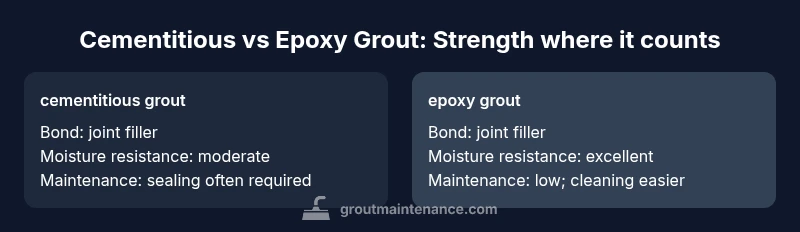
| Moisture resistance | Moderate; depends on sealing and use | Excellent; very low water absorption |
| Stain resistance | Prone to staining without sealing | Excellent; reseal not always required |
| Maintenance | Sealing often required; regular cleaning | Lower maintenance; less sealing needed but needs proper cleaning |
| Cost | Lower upfront cost | Higher upfront cost but longer-term durability |
| Best for | Budget projects and moderate moisture areas | Showers, backsplashes, and high-moisture zones |
Pros
- Epoxy grout offers superior stain resistance and long-term durability
- Cementitious grout is generally easier to work with and more affordable
- Both grout types benefit from proper sealing and maintenance
- Appropriate substrate preparation amplifies strength and longevity
- Thinset works alongside grout to maximize overall tile system performance
What's Bad
- Epoxy grout can be harder to mix and install, with a steeper learning curve
- Cementitious grout is more susceptible to staining and moisture damage if not sealed properly
- EPXY grout requires careful cleaning during installation to avoid residue
- Sealing requirements can add steps and costs to maintenance
Epoxy grout often delivers superior durability, especially in moisture-prone spaces, but cementitious grout remains a versatile, cost-effective choice for many projects.
For environments with heavy moisture or staining risk, epoxy grout typically performs better as a joint material. If cost, ease of installation, and maintenance are priorities, cementitious grout paired with appropriate sealants can be a solid option. The right decision depends on space, use, and maintenance willingness.
Got Questions?
Is grout stronger than thinset?
No. Thinset provides the primary bond between tile and substrate, while grout mainly strengthens joints and resists moisture and movement. Epoxy grout can offer higher durability in some environments, but the strongest bond typically comes from the thinset.
Grout mainly fills joints; thinset bonds tiles to the substrate. Epoxy grout can be more durable in wet areas, but thinset is the main source of tile adhesion.
Can epoxy grout be stronger than cementitious grout?
Yes, epoxy grout generally offers greater hardness, chemical resistance, and stain resistance than cementitious grout. It’s especially advantageous in kitchens, bathrooms, and commercial settings with exposure to cleaners or chemicals.
Epoxy grout is usually stronger against stains and chemicals than cementitious grout.
Does grout strength depend on sealing?
Sealing can significantly improve the longevity and stain resistance of cementitious grout. Epoxy grout typically requires less sealing, but following product recommendations still matters for long-term performance.
Sealing helps cementitious grout stay clean longer and resist stains.
Which is easier for DIY projects: epoxy or cementitious grout?
Cementitious grout is generally easier for DIYers due to simpler mixing and cleanup. Epoxy grout demands careful mixing, scrupulous cleaning, and higher skill, though it pays off with easier maintenance in certain spaces.
Cementitious grout is usually easier for DIY projects.
Should I use a cementitious or epoxy thinset?
Choose based on substrate, tile type, and environment. Cementitious thinset is the common choice, offering strong adhesion, while epoxy thinset is specialized for high chemical resistance and challenging substrates.
Pick cementitious thinset for standard jobs; epoxy thinset for tricky, moisture-heavy areas.
The Essentials
- Plan for movement joints to reduce cracking
- Choose epoxy grout for showers and kitchens with high moisture
- Seal cementitious grout to improve stain resistance
- Match thinset and grout to substrate and tile type
- Factor installation skill into product choice to maximize strength
- Expect maintenance to influence long-term performance