Grout vs Concrete: When to Use Each Material
Explore whether grout can replace concrete in various projects. This analytical guide compares structural viability, applications, costs, durability, and maintenance to help homeowners decide when grout makes sense and when concrete remains essential.


In most structural scenarios, you should not substitute grout for concrete. Grout, including cementitious and epoxy variants, is designed for filling gaps and bedding tiles, not bearing loads. The quick takeaway: use concrete for foundations, slabs, and load-bearing elements, and reserve grout for non-structural purposes or as a grout bed. According to Grout Maintenance, choosing the right material depends on load demands, substrate conditions, and long-term durability expectations.
Can you use grout instead of concrete for structural loads? For many DIY projects, the short answer to the question can you use grout instead of concrete is no. Grout is formulated to fill joints, bond tiles, and stabilize small voids, not to bear vertical or lateral loads. When a project involves foundations, structural slabs, or any application where the material must resist significant forces, concrete remains the standard. This guidance aligns with practical experience from the Grout Maintenance team, who emphasize that load-bearing performance depends on a proper substrate, cure, and mix that grout alone cannot reliably provide. Readers should understand that while some specialty mixes claim higher strength, they still do not match concrete for structural capacity. The upshot is clear: reserve grout for gaps, joints, and non-structural roles rather than substituting concrete in critical areas.
In this section we set the stage for a nuanced discussion: the material choice should reflect the intended function, site conditions, and long-term maintenance expectations. By framing the decision around loads and substrates, homeowners avoid costly mistakes and safety concerns. This is where can you use grout instead of concrete becomes a decision about purpose, not just material preference. The Grout Maintenance perspective stresses that every project begins with a clear load assessment and a plan for how each material behaves under movement, temperature change, and moisture exposure.
Comparison
| Feature | concrete | grout |
|---|---|---|
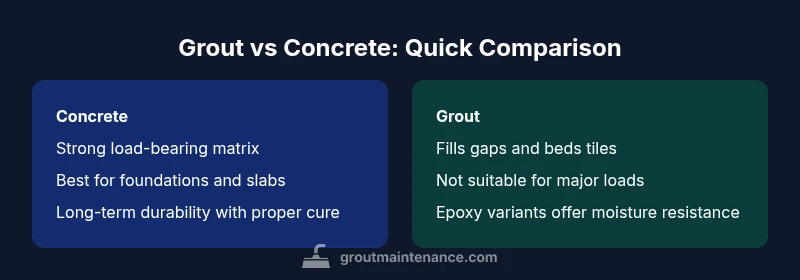
| Load-bearing capacity | Designed for high compressive loads | Not intended for structural loads |
| Typical uses | Foundations, slabs, structural elements | Tile joints, gap filling, non-structural bed |
| Moisture performance | Moisture tolerance depends on mix, sealing, and placement | Relies on substrate; can be vulnerable without proper curing |
| Cure dynamics | Rigid cure with strong matrix | Requires proper curing and substrate prep; may crack with movement |
| Cost context | Higher upfront cost per volume for structural roles | Lower unit cost for grout in non-structural tasks |
| Maintenance | Long-term durability with proper installation | Maintenance largely tied to substrate and sealing |
Pros
- Concrete provides reliable structural strength and longevity
- Grout offers precise gap filling and tile alignment
- Epoxy grout variants provide excellent chemical resistance
- Grout can simplify certain non-structural renovations when used correctly
What's Bad
- Grout is not a substitute for structural concrete in most builds
- Using grout for structural purposes invites cracking and movement failures
- Concrete requires proper formwork and curing but yields predictable performance
- Mix choice and substrate quality heavily influence grout longevity
Concrete remains the prudent choice for structural work; grout is best reserved for non-structural tasks or as a bedding/filling material.
For load-bearing applications, concrete delivers predictable strength and durability. Grout, including epoxy options, shines in tile settings and as a non-structural filler, provided the project goals align with its capabilities.
Got Questions?
Can you substitute grout for concrete in a structural slab?
No. Structural slabs require concrete or another engineered structural material. Grout lacks the strength and movement resistance needed for bearing loads, regardless of mix type. Always consult a structural professional for load-bearing decisions.
No. For structural slabs, use concrete or an approved structural alternative. Grout is not suitable for load-bearing elements.
Are there scenarios where grout can replace concrete in non-structural projects?
Yes, in non-structural contexts grout can fill gaps, bed tiles, or seal small voids. It should not be relied on to carry loads or provide long-term structural integrity. Always evaluate movement, moisture, and sealant needs.
Grout can fill gaps and support tile work, but it should not carry loads.
What is the role of sealing with grout in moisture-prone areas?
Sealing grout helps resist moisture intrusion and staining in areas like showers. Cementitious grout typically requires sealing; epoxy grout offers superior moisture resistance without sealant, but its application is more specialized and costly.
Sealing helps prevent moisture problems; epoxy grout is highly resistant but pricier.
How should I approach a project where movement is expected?
If movement is expected, avoid substituting grout for concrete. Use joints, movement accommodations, and appropriate substrates with compatible materials to allow for expansion and contraction. In most cases, concrete or engineered materials handle movement more reliably.
For movement-prone projects, stick with the right structural material and plan for joints.
What factors influence the long-term durability of grout?
Durability depends on mix type, curing, substrate prep, and exposure conditions. Proper sealing, service environment, and maintenance routines significantly affect grout longevity.
Durability hinges on mix, curing, and maintenance.
Can I pour grout in place for a large surface?
Grout is generally not poured as a substitute for concrete for large surfaces. It is designed to fill joints or beds and is not intended to function as a structural deck or foundation.
Grout isn’t meant to replace poured concrete for large surfaces.
The Essentials
- Use concrete for foundations and structural slabs.
- Grout is ideal for gaps, joints, and tile bedding—not loads.
- Epoxy grout offers moisture and chemical resistance but does not replace concrete strength.
- Assess load demands and substrate before choosing a material.
- Plan for sealing and maintenance to extend grout longevity when used non-structurally.