Grouting vs Epoxy: A Practical Tile Care Comparison
Compare grouting vs epoxy on durability, maintenance, cost, and best-use scenarios for showers and kitchens. A practical guide for homeowners and DIYers.


Grouting vs epoxy boils down to maintenance, durability, and cost. Epoxy grout delivers superior stain and chemical resistance with long-term color retention, but it costs more and is harder to install. Traditional cement grout is cheaper and easier to work with, yet may require more frequent sealing and cleaning in wet areas. Choose epoxy for high-stain environments; cement grout for DIY-friendly projects.
Grouting vs epoxy: Core differences
According to Grout Maintenance, the choice between grouting vs epoxy hinges on the chemistry of binders and the environment where it’s used. Cement grout uses a cementitious binder mixed with water and aggregates, delivering a traditional look with more water absorption. Epoxy grout, by contrast, uses resin-based binders that form a denser, chemical-resistant matrix. This difference drives most of the practical outcomes homeowners notice: stain resistance, cleaning needs, and long-term durability. For DIYers, the epoxy option often feels like a premium choice because color retention and cleaning ease can be superior, but installation is less forgiving and requires careful mixing and timing. Grout maintenance teams emphasize testing sample boards before full installation to ensure color stability and compatibility with tiles. The key takeaway is to identify where the grout will live, the likelihood of spills and cleaners, and how much time you’re willing to invest in maintenance over the years. The decision starts with the space and ends with the budget.
Material composition and color options
Grouting options are defined by two broad families: traditional cement grout and epoxy resin grout. Cement grout comes in sanded and unsanded variants, offering a wide palette of colors formed by oxides and pigments mixed into the cement matrix. That broad color range is part of the appeal for designers and DIYers who want to match wall and floor tiles precisely. Epoxy grout, on the other hand, uses a two-component resin system that cures into a dense, non-porous matrix. Color options exist, but the palette is typically narrower and more uniform because epoxy pigments are locked into a resin network. This difference influences not only aesthetics but also maintenance: epoxy tends to resist staining and moisture intrusion more effectively, while cement grout benefits from sealers that can alter look and performance over time. When selecting, consider tile size, texture, and the substrate’s flexibility; these factors influence how evenly a color settles and how easily grout lines can be cleaned without abrasion. Grout colorfastness tests on sample boards are a wise step before committing to a full project.
Performance in moisture and stain resistance
In wet environments, epoxy grout consistently demonstrates superior stain resistance and lower water absorption than traditional cement grout. The resin binding creates a smooth, dense surface that is less hospitable to mold and mildew under typical household conditions. Cement grout is more porous by nature; even with sealers, it can wick moisture and absorb dyes from spills or cleaning agents if not promptly cleaned. This makes epoxy a common choice for showers, steam rooms, and kitchens with heavy staining challenges, while cement grout remains viable where moisture exposure is moderate and maintenance routines are consistent. Keep in mind that epoxy’s performance hinges on proper mixing and full curing; improper installation can compromise color uniformity and durability. For high-traffic areas, test a small patch under your typical cleaning regimen to gauge long-term results.
Installation and cure times
Installation is the practical choke point for grout choices. Cement grout is generally more forgiving for beginners: it mixes quickly with water, tolerates minor mistiming in washing steps, and cleans up with standard tools. Epoxy grout requires precise mixing of resin and hardener, careful measurement of water-free components, and typically a longer cure window before grouting joints can be cleaned or sealed. Temperature and humidity affect curing for both materials, but epoxy is more sensitive to moisture during early cure. Improper mixing or rushing the cleanup can leave sticky residue or uneven color. Planning includes ensuring proper ventilation, using recommended sealers for cement grout if needed, and allowing adequate cure time before grout lines are exposed to heavy use. If you’re working in a tight corner or backsplash, consider practicing on a sample panel to minimize risky mistakes on the visible field.
Maintenance, cleaning, and long-term care
Maintenance requirements differ markedly between cement and epoxy grout. Cement grout typically benefits from periodic sealing to reduce porosity and staining; the sealer should be compatible with the grout type and re-applied as recommended by the manufacturer. Cleaning involves pH-neutral cleaners, gentle scrubbing, and prompt removal of spills to prevent staining. Epoxy grout, once cured, resists many conventional cleaners and generally does not require sealing, which reduces ongoing maintenance. However, epoxy can be sensitive to certain solvents and harsh abrasives, so use non-abrasive tools and cleaners that fit the resin’s chemistry. In spa-like or kitchen environments with frequent spills, epoxy’s stain resistance can translate into lower long-term maintenance, while cement grout demands a consistent sealing and cleaning routine to maintain its appearance. Periodic re-sealing for cement grout and routine inspection for cracks or color changes are prudent practices for longevity.
Room-by-room practical guidance and best-use scenarios
Different spaces demand different grout strategies. In a busy family kitchen, epoxy grout can offer easier cleaning and less frequent staining, making it attractive for high-traffic areas. For a vintage renovation with intricate tile profiles, cement grout often provides easier repairability and patching without needing specialized epoxy mixing equipment. Showers and wet rooms present compelling cases for epoxy grout, thanks to superior moisture resistance and color stability over time, while outdoor tiling or cost-sensitive projects may lean toward cement grout with a robust sealer. If you’re undertaking a retrofit with existing tile, assess substrate condition and potential movement; epoxy grout can be less forgiving of substrate shifts, whereas cement grout repairs are typically less disruptive. In all cases, testing a small area and following manufacturer guidelines will reduce surprises and ensure a durable finish that matches your maintenance capacity and aesthetic goals.
Comparison
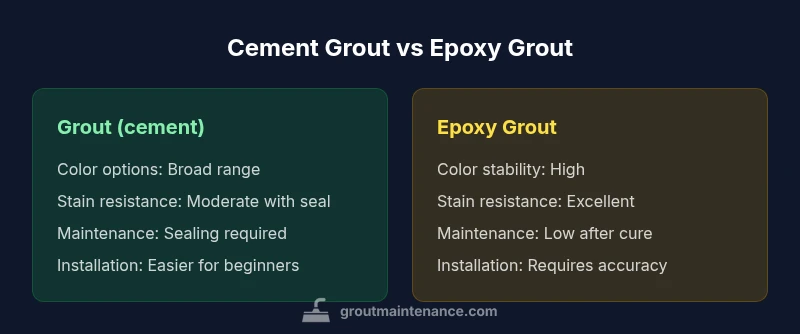
| Feature | Grout (cement) | Epoxy grout |
|---|---|---|
| Color options | Broad range, customizable | Limited range, uniform color |
| Stain resistance | Moderate-to-high with sealing | Excellent |
| Water absorption | Higher absorption, more moisture uptake | Low absorption |
| Maintenance | Sealing required, periodic resealing | Low maintenance; no sealing |
| Installation difficulty | Easier to mix and finish | Requires careful mixing and tooling |
| Cost upfront | Lower upfront | Higher upfront |
| Repairability | Easier to repair small areas | Repairing damaged sections is more difficult |
Pros
- Lower upfront cost and easier DIY with cement grout
- Wider color and texture matching options
- Easier to repair grout lines without replacing tiles
- Widely available and forgiving during application
What's Bad
- More maintenance over time, including sealing and cleaning
- Susceptible to staining and mold if not sealed properly
- Lower chemical resistance compared to epoxy
- Potential for cracking with substrate movement
Epoxy grout generally offers better long-term stain and chemical resistance, but cement grout remains a flexible, user-friendly choice for DIY projects.
For wet areas and high-stain environments, epoxy is often the better long-term bet if installation is done correctly. Cement grout is more forgiving and cheaper upfront, making it ideal for DIYers and budget-conscious renovations.
Got Questions?
What is epoxy grout and how does it differ from cement grout?
Epoxy grout is a two-component resin-based system that cures into a dense, non-porous matrix, offering excellent stain and chemical resistance. Cement grout is cementitious and porous, easier to install, and typically cheaper but requires sealing and more maintenance to resist stains.
Epoxy grout is resin-based and stain-resistant; cement grout is cement-based and easier to install but needs sealing for better stain resistance.
Which grout is best for showers?
Epoxy grout is often preferred in showers due to its strong stain resistance and moisture performance. Cement grout can work, but it requires sealing and more diligent cleaning to prevent mold.
Epoxy is usually best for showers because it resists stains and moisture well.
Do I need to seal epoxy grout?
No, epoxy grout does not require sealing after curing. Cement grout typically benefits from sealing to minimize water absorption and staining.
No sealant needed for epoxy grout; cement grout usually needs sealing.
Is epoxy grout more expensive?
Yes, epoxy grout generally costs more for materials and installation, but it can reduce long-term maintenance and staining costs in the right environments.
Epoxy grout costs more upfront, but may save on maintenance in damp areas.
Can you mix grout types on the same project?
Mixing cement and epoxy grout on the same project is not recommended because their curing and performance properties differ, which can lead to weak joints or color inconsistencies.
Mixing grout types isn’t recommended; stick to one type per project for best results.
What maintenance routines keep grout looking new?
For cement grout, use a pH-neutral cleaner, dry spills promptly, and seal periodically. For epoxy grout, use non-abrasive cleaners and avoid harsh solvents that could affect the resin.
Clean with gentle cleaners and seal cement grout as needed; epoxy grout needs gentler care.
The Essentials
- Evaluate moisture exposure before selecting grout type.
- Budget upfront costs against long-term maintenance.
- Opt for epoxy in showers and backsplashes for stain resistance.
- Choose cement grout for easy DIY repairs and lower initial cost.